Showing posts with label Romero. Show all posts

Thursday, September 30, 2010

Movies: Nagging persistence of the dead.

The good news about Survival of the Dead is that it's better than Romero's last outing, the truly dire Diary of the Dead. Unfortunately, the makes only the fifth worst "Of the Dead" film.

I don't mind that Romero's lapsed into self-parody. It's that he's grown unbelievably lazy. Survival is a bizarre zombie Western that sets a bloody feud between two inexplicably fresh off the boat Scots-Irish families on a isolated Delaware island against the ever less interesting background of a zombie apocalypse. As bored as we are by concept, Romero phones it in on every level. His characters are paper thin. The leader of his crooked band of National Guardsmen is a "I look out for nobody but myself" type who, of course, has a heart of gold. He has a good natured, baby-faced sidekick who is, of course, the first to bite it. The Latino soldier is constantly offering up prayers en Español to the saints when he's not trying to lay the only female member of the troop. And she's a lesbian nicknamed Tomboy who, in perhaps the only unexpected move of the whole flick, first appears onscreen with her hands down her pants, churning the butter in front of all the other soldiers, who seem uninterested in her masturbatory display because, the film hints, it happens regularly enough. I'm not sure what this scene was meant to suggest to use about PFC Tomboy or lesbians in general. As it never happens again in the flick and nobody even so much as says, "Hey, Tomboy, you're on guard duty. Try not to miss any zombies because you're busy with all the self-fisting." It appears to be a throwaway scene. But that's not particularly shocking: there's so many throwaway scenes in this picture it's the filmic equivalent of The Mobro.

Our AWOL unit from Cliché Company pick up a random teen - who, hold on for the shock, is wisecracking, tech savvy smart ass who warms up the stone cold heart of the unit leader - and follows a youtube video to Plum Island, Delaware. Unfamiliar with digital technology - remember how those digital cameras kept losing their vertical hold and breaking into static in Diary? - Romero seems to believe that new youtube clips will keep appearing long after the zombie apocalypse has destroyed our power infrastructure. In fact, it's completely unclear what rules govern the post-Zed world of Romero's relaunched "of the Dead" series. Nobody seems to sweat conserving power, but everybody's worried about wasting gasoline. Phones don't work, but all your iPhone apps do. People find wifi in random places, and pick up late night talk shows making bad sub-Carson zombie jokes. The oddest bit is the amount of traffic on the roads. Several scenes in the film suggest the roads are deserted, but some shots include a busy I-95 in the background. Maybe that was just laziness on Romero's part.

The soldiers get to Plum only to find themselves in the middle of a shooting war between rival families, one who wants to exterminate zombies as soon as they appear and another that thinks they can tame and contain them until a "cure" is found. At least one character in the film points out that you don't get a zombie until a person is dead, so by definition zombies are a deviation from a state of death, not life; consequently, curing them would mean returning them to a state of death, a paradoxical state of affairs that makes killing zombies and curing zombies the same thing. This character, in the interest of allegedly dramatic plot development, is ignored.

The soldiers end up taking sides with the "kill 'em" family and there's a big old shoot out in which most of our characters are offed. We find out zombies, when hungry, will eat other mammals besides humans; a fact that Romero seems to think is key, but really, who gives a crap if flesh eating zombies eat everything in their path instead of just every human in their path? Besides, even if you could sustain zombie life, what's the point? If the hypothetical cure for zombies just makes them a corpse again, then you've got the cure: a bullet to the head. If the cure makes them living people again (an unlikely result since so many of them carry around damage that would be fatal is you restarted them as Pure Strain Humans), then you've essentially cured death and you've got a bigger problem on your hands than zombies. The repercussions of that would make the zombie apocalypse preferable.

Happily, Romero couldn't be bothered to parse any of this out. The same spirit that moved him not to bother blocking out the I-95 in his night scenes led Romero to simply throw random, seemingly thoughtful problems at the plot line and see if any portion of any random one of them stuck. The result is people saying a lot of meaningless babble with conviction. Still, this beats out Diary, which embarrassingly bought its own crap about the evils of the Internet Era despite its utter ignorance of the actual details of the Internet Era.

Plus the CGI is embarrassing.

There's a general unspoken rule amongst horror bloggers that you shouldn't speak ill of Romero despite the ever mounting crappiness of his work. Whether this is because people feel early genius forgives later stupidity or because they simply find it bad form to talk smack about an old man, I don't know. The result, however, is that bloggers review Romero's work in bad faith. From here on out, get your reviews of Romero's flicks from the pitiless anonymous hordes of horror site commenters. They've got it right. Romero's later zombie films simply aren't that good. End of story.

Friday, May 28, 2010

Stuff: George Romero pulls an evil Captain Kirk from episode 37.

Over at the Boston Phoenix, Peter Keough attempts a Marxist interpretation of the popularity of vampires and zombies:

Maybe Karl Marx, wrong about so much in the real world, could offer some clarification in the realm of make-believe. Could vampires, like the filthy rich, parasitic, aristocratic, and charismatic Cullens, be representatives of the capitalist class? And zombies, those lumpen, lurching, mass-consuming legions, could they stand for labor and the proletariat? If so, vampire movies would embody the audience’s anger and fascination with the money men responsible for the recent economic collapse. And zombie movies would touch on the dread of — and wish for — an uprising of the working against those same exploiters.

Aside from the analysis itself, Keough gives us a little gem of a reaction shot from the father of the modern zombie flick:

Not even George A. Romero, who as much as anyone can take credit for the zombie phenomenon — spawning it as he did back in 1968 with Night of the Living Dead — can explain why they do this. “I don’t get it,” he remarked about these undead wannabes when I interviewed him recently about his newly released sixth film in his zombie franchise, Survival of the Dead, which opens next week. “You just want to say, ‘Get a life.’ ”

Wow. The dude responsible for Diary of the Dead thinks you're the one who needs to get over the whole zombie thing.

Wednesday, February 17, 2010

"It's a blessed condition, believe me": Images of African Americans in horror cinema #13.

Throughout February, ANTSS will be running images that reflect - for better or worse - the image of African Americans in horror cinema.


Eugene Clark in Land of the Dead, 2005.

Monday, November 30, 2009

Movies: Wu of the Dead.

Though extensive work has gone into unearthing Christian symbolism in zombie narratives, here's a less analyzed Black Muslim take on Romero's Of the Dead franchise. From the RZA's new book, The Tao of Wu:

When I first saw Night of the Living Dead, I was scared to death. But when I watched it again at the age of sixteen (when they were up to Day of the Dead), I'd gotten knowledge of myself, and could relate to what it was saying about America. The dead were alive, but they were blind, deaf, and dumb. So to me, they were symbolic of black men in America.

The dead in those movies are alive- that's just a description of physical matter, it's active - but they don't have life. Life comes when you have knowledge, wisdom, and understanding, when you can see for real, touch and feel for real, know for real. Then you are truly living.

Finally, all the Of Dead films work as metaphors for the Five Percent [The Nation of Gods and Earths, also known as Five-Percent Nation of Islam - CRwM]. The survivors are holdouts living among the mentally dead. And interestingly, they tend to be led by black men. At the same time, though, after the black man survives - he fights off destruction through the whole movie - a white man kills him.


Though factually wobbly at the end there - the black protags survive Dawn and Day - the analogy actually works far better for me than efforts to fit Romero's flicks into a Christian framework. The origin of the Five-Percent name stems from their belief (and this is a profound simplification) that 85% of humanity are blind to knowledge of themselves; 10% understand some of the divine knowledge needed to be fully realized humans, but ignore or lie about this knowledge for personal gain (notably, Christian preachers and scholars who teach about an incorporeal, or "mystery," God to advance their own political agendas - left and right); and a final 5% who understand and spread the truth, known as poor righteous teachers. The idea of a tiny, fully alive and self aware minority surrounded by a globe of the half-alive fits like a glove with Romero's flicks.

I wonder what insights Buddhists, more mainstream Muslims, and other non-Christian religious peoples could bring to the table.

Wednesday, September 09, 2009

Music: 'Cause, be honest, you kind of think the end of the world is going to be sort of fun.

The Sprites formed around the core husband-wife team of Jason and Amy Korzen. After the 2001 collapse of the nerd-tastic D.C. indie outfit Barcelona, Jason retreated into his basement with a four-track and, with the exception of Amy's consistent presence, a revolving cast of ex-bandmates and friends. The result was the 2003 Starling, Spider, Tiger, and Sprites (which opens with "Do It Yourself," power pop's greatest anti-band spirit anthem). The band went through a cycle of releases and touring, all the while losing members and focusing in on the Korzens. By the release of 2006's Modern Gameplay, Jason and Amy were pretty much a self-sufficient unit, playing nearly every instrument on every track and producing the album on their own.

The following track – a tribute to '70s horror film legends titled "George Romero" – is off the 2006 platter. Modern Gameplay features a full sweep of the Korzen's geeky obsessions, from the wonderful "I Started a Blog Nobody Read" to the slightly more esoteric "Huygens versus the Werewolf," which namechecks the 17th Century Dutch polymath who argued that light consists of waves, discovered centripetal force, and is considered the first dude to use a formula in his physics work. Pretty geeky, sis.

Despite the shut-in Muzikbunker otaku vibe this thumbnail bio might give off, the Sprite's sound is classic indie pop. Though the instrumentation tends towards the minimal, it stays bright and organic feeling. The lyrics are clever and the irony comes off as goofy instead of world weary. It's fun times.

Thursday, June 11, 2009

Movies: Aw, Hell – 3 random observations on "Drag Me to Hell."

1. The Anti-Diary of the Dead

The prodigal son trope one finds in nearly every review of DMtH is a little deceptive. While the film does indeed mark Sam Raimi's return to horror, it oddly implies that he was, before the lure of Hollywood superstardom steered him wrong, predominantly a horror director and that he's been away from the mater genre for long time.

In fact, less than a third of Raimi's directorial efforts have been horror films. The characterization of Raimi as a horror director has more to do with horror fandom's perpetual surly provincialism than any full assessment of Raimi's directorial career. As for Raimi's 40 years of wandering the Hollywood desert, the length of the break between Army of the Dead and DMtH is just a couple years longer than the break between Army and Evil Dead 2. Or the break between ED2 and the original evil dead, for that matter. Raimi just doesn't make many horror movies and he certainly doesn't make them that often.

That said, a comparison between another "return of the master" flick yields some interesting results. Much as Raimi's latest was given a strangely indier-than-thou moral gloss and framed as the director returning to a simpler, purer style of filmmaking, George Romero – perhaps more validly considered a horror master – was thought to have lost his way in the big budget excesses of Land of the Dead, and diary was framed in terms of a sort of aesthetic purification. Both films were linked, either explicitly or implicitly, to the franchises that made the director's names.

But Drag Me to Hell works and Diary of the Dead is a dog. When it came time to see if Romero still had the juice, he came up dry. Raimi, however, took a swing at something easily within his wheelhouse and connected. The difference is, I think, the latter's commitment to making a fun film. An entertaining, if mostly silly and forgettable, spookshow of jump scares and slime FX, Drag never lapses into tedious lecturing or drinks the cool-aid of its own mythology.

2. The First Lynch the Banker Movie of the New Depression

In the early days of Depression 1.0, Hollywood was divided over just how to handle the class distinctions the economic crisis brought into plain sight. Early filmmakers treated it as fodder for comedy. The rich, while foolish, just needed a good Godfrey to straighten them out. As the crisis wore on and then shaded into war, however, the bubble-headed wealthy began to yield way to poisoned-minded, literally twisted predators of the Mr. Potter variety.

Though Raimi claims to have written Drag Me to Hell before the current economic crisis, it is virtually impossible not to see a reflection of our current crisis in the character of Christine Brown, the loan officer who is, in the end, dragged to aigtch eeee double hockey sticks. The plot, for those who have not seen it, involves a loan officer who denies a gypsy woman (who lives in modern Los Angeles) a third extension on her mortgage payment. The gypsy woman falls to her knees, begins kissing the skirt of the loan officer, begs Ms. Brown to reconsider. Christine panics and she calls security. Later that night, the gypsy woman mugs her in the parking garage near the bank and places a curse upon her. Ring-like, Christine will be tormented for three days by a demonic spirit. At the end of the tormenting process, she'll be offed and dragged, well, you know.

Raimi has actually said that he wanted to make sure that Christine's "crime" was disproportionate to the punishment she faced. This was necessary, he claims, in order to ensure viewer sympathy with her.

I believe, however, this doesn't give his character enough credit. Christine's "crime" is not a minor act; it's no crime at all. It isn't, I think, even a moral infraction. Some critics have decided that Christine is an avatar for the wildly irresponsible financial institutions that have led us into the current financial meltdown. This shows both a profoundly limited understanding of the financial monkey business that took place on Wall Street and grotesquely stunted notion of morality. According to the film, the bank's handled the gypsy's mortgage for several years. By defaulting on payments twice and then asking for third extension, it is the gypsy who is acting in bad faith. She was happy to take the bank's money, using her house as collateral. But now that she can't hold up her end of the deal, she wants the bank to essentially give her a free pass. She wants the bank to be okay with unilaterally breaking a contract. Christine suggests to alternatives to the gypsy's financially untenable situation, both of which are rejected by the gypsy out of pride – a pride she then throws away to beg for help, a pride she then accuses Christine of stealing.

In contrast, what was going on in at various banks and other financial institutions was that loan officers, not unlike Christine but on a much larger scale, were bending the loan guidelines to quickly store up the mortgages as assets that could then be used as the basis for derivatives – a sort of pseudo-insurance in which parties essentially make bets on whether or not loans will default. In theory, the bank doesn't want the loan to default, because then they get the loan payments and the derivative payments, without ever having to pay anything out except the original loan. In practice, the short-term gain on derivatives was so attractive that banks rushed to make as many housing loans as they could, taking insane risks on truly bad loans. These bad loans were then packaged up as more derivative fodder. When the crappy loans feel through, not only were the banks out the original loan, but they also had to pay off the derivative bets. These problems were further compounded by what we now understand to be the deliberate falsification of the value of the assets at the base of the derivatives.

If that second part is convoluted, here's the short story: If banks had been rigorous about administering their loans – which includes not giving loans to people who can't afford to pay them back and refusing to carry the burden of potentially toxic assets in the form of shaky loans – then none of this crap would have gone down. If Wall Street had been more like Christine Brown, we wouldn't have the current financial crisis. But Drag Me to Hell touches a populist nerve by showing what Americans have always secretly felt: Debt (if not credit, which we love like crack) is a conspiracy of heartless bankers. We enjoy making beds, but we sure to hate to lie in them.

If the lightly likeable Drag Me to Hell gets a footnote in film history, it might we be as the opening shot in what I can only imagine will be a slowly growing stream on increasingly shrill populist screeds against the evils of banking.

3. The Hollywood Evil Dead

While Drag Me to Hell definitely aspires to the slapstick spirit of Raimi's Evil Dead flicks, there's something bloodless (in a literal and emotional way) about the undertaking. The film feels like Raimi is copying his earlier work. Instead of evoking the spirit of the Evil Dead films, he makes contextless winks and nods to his fanbase. References to cabins in the woods followed with the line "there's trees, you'll love it" are meant as sops to the insider.

This is faded-copy-of-the-original feeling is further reinforced by the PG-13 bloodlessnes of the film. Other than a particularly violent projectile nosebleed, there's not much in this film to remind us of the fact that Raimi once used a literal geyser of blood for a sight gag. Certainly, this isn't to suggest that "real horror needs extreme bloodshed" or some such. Raimi was always more goofy than gory. Rather, I think it is a sign of how happy Raimi is to repackage his old material as mainstream stuff. Raimi's still big on geysers, but now they're CGI'ed puke-goo or a vomited up cat.

Finally, there are the product placements. BMW, iPhones, and even Mrs. Fields Cookies get bizarrely intrusive close ups. Despite the theme of "returning to the purity of horror" theme, it seems Raimi's picked up some particularly unseemly mainstream habits and the return to horror didn't help him shed them.

Thursday, October 16, 2008

Movies: Chasing tale.

According to IMDB, the source of all cinema knowledge, George Romero was originally slated to direct Haeckel's Tale, an adaptation of a Clive Barker short story that held down the 12th slot in the first season of Masters of Horror. Romero couldn't fit it into his schedule, which leads one to make the shocking conclusion that some effort was actually put into make Diary of Dead despite the end result. After Romero bowed out, Roger Corman was tapped for the gig. Corman – who actually had a full schedule: in 2006, Corman produced five films and made three appearances in various film and television projects – took the helm, but then bowed out because of health reasons. This led series producer and Haeckel writer Mick Garris to tap one horror-hit wonder John McNaughton. Though, to be honest, what a hit: Henry: Portrait of a Serial Killer. If you're going to do just one major horror flick, coming out with a flick so bleak and grim that the MPAA slaps you with an X not on the basis of the films violence (which is gritty, but not particularly over-the-top even for the time) or sexual material (which, again, is grim, but, again, well in R territory) but for the films "moral tone." Between Henry and Haeckel, McNaughton tried his hand at one other horror flick, the sci-fi/horror/comedy/train wreck The Borrower, before walking away from the genre. Over time he amassed an interesting, if not always great track record. Among other things, he shot the DeNiro/Murray/Thurman romantic comedy Mad Dog and Glory (penned by crime-lit giant Richard Price), the sun-baked cult sleaze-o noir Wild Things, and several episodes of Homicide: Life on the Streets (a.k.a. The Wire version 1.0).

So, can a guy with only one great horror flick to his name really be a "master" of horror? I can't say. But I will say that he does a better job on his episode than many, more firmly established horror directors did on their episodes. Haeckel's Tale is moody, well paced, suitably naughty, willing to be absurd, and makes a stylistic nod to the Hammer period thrillers – all in less than an hour.

Having never read the Baker story, I'm not qualified to tell how loyal it stays to the original. The flick opens with a framing device involving a widower who wants a local witch to bring back his dead wife. The witch says that she will do so, but only on the condition that the man listen to the tale of Ernst Haeckel. If, after her tale is done, the widower is still keen on the idea of resurrecting his spouse, then she'll do it.

Open on a surgical theater in Boston medical college at the turn of the Eighteenth Century. The titular doctor, having studied the notes of one Frankenstein, informs his med school prof that he can re-animate the dead. Forced to make good on the boast, Haeckel makes a mash of it and ends up setting his subject, a female corpse, on fire. After a hearty round of mockery, Haeckel is left with his failure and a local body-snatcher suggest that he should perhaps look in on "Professor" Montesquino. Montesquino, played as a cross between Caligari and a used car salesman by Homicide vet Jon Polito, is a necromancer that Bostonites credit with the ability to bring back the dead.

Doubtful, Haeckel sees Montesquino's show. After watching the necromancer bring back a dead golden retriever (a bit of anachronism: efforts to create the golden retriever didn't begin until the 1860s, with the "first" of the breed being registered in the first decade of the Twentieth Century), Haeckel attempts to bribe the secrets of reviving the dead from Montesquino, but is rebuffed.

Shortly there after, Haeckel receives news that his ailing father has taken a turn for the worse. Haeckel takes to the open road, hiking from the metropolis into the country. On the road, Haeckel finds shelter at the modest Wolfram cabin, home of Mr. Wolfram and his lovely, if creepily otherworldly, wifey: Elise. (As an aside, Elise is played by Leela Savasta, so if you're life has been incomplete because you haven't seen the lovely boobies of Battlestar Galatica's Tracey Anne, then run, don't walk, to your nearest video rental joint.)

I can't go much further without ruining the plot, but rest assured that the Wolframs' have a nasty secret that turns things all messy right quick and involves something that rhymes with "ROM bee hex." I kid not. It's based on a Clive Barker story. You could see it coming. You know what these zombies saw coming?

Where was I? Oh. The movie.

So, aside from the Ye Olde Talke™, which grates a bit before you get into the groove, the period trappings have the lush and stagey artificiality of Hammer or Amicus flicks, though the coozed up climax, if you will, of the flick is considerably more explicit than either of those inspirations implies. The graveyard set is especially nice. The acting is adequate to excellent, with the exception of Elise, who is more of narrative conflict than a character. The plotting moves along purposefully, with enough slack to add some tangential stuff and avoid giving the viewer the feeling that their on a forced march. The mood of the film goes from lushly Gothic to darkly, almost nihilistically, comedic. There is, I guess, a sort of "approval of alternate lifestyles" subtext here, but the metaphor is hopelessly clumsy and one gets the feeling that the message was in the original but that McNaughton didn't give a crap about it. The result is that whatever ideological content there is remains vestigial and under-developed. The film has too much fun with the eerie/goofy surreality of its own plot to try to hone it into some sort of take-home message.

Haeckel's Tale is really one of the highpoints of the MoH series. Playful and nasty, taboo breaking without being ponderous or smug, thoughful without being preachy of clumsily political, it's fun times.

Wednesday, February 20, 2008

Movies: More tired than dead, really.

I did not have high hopes for Diary of the Dead. The idea of re-setting the "Of the Dead" series so we could see the opening days of the zombie plague was, I thought, a profoundly uninteresting idea. The advantage the "Of the Dead" series had was that we got to leap into the story, post-zombie crisis. We don't have to waste time watching a bunch of characters figure out what we already know. We can get right to the good stuff. Besides, we've had quite a few years of zombie flicks re-hashing Zombie Week 1 or what have you. Do we really need yet another movie showing what's essentially the same scenario. The only less interesting than that premise was the "twist": the movie will be a Blair Witch vérité-style thingie, so we can witness the zombie nightmare with value added shaky camera work.

As low as my expectations were, Diary of the Dead actually managed to underwhelm them. Diary of the Dead is definitely the worst flick in the "Of the Dead" series and it might very well be the worst flick of Romero's career.

The plot of Diary is perfectly serviceable if not particularly interesting. A film school crew is making a mummy-centric horror flick of in the woods when they hear news that dead people are coming back to life. They don't fully believe it, but they decide that something's up and they'd better get somewhere more secure than the middle of the woods. The group splits up. The "mummy," a snotty trust fund kid, grabs a dame and zips off to his parents Wayne-manor grade estate. There they plan to wait out the disaster Masque of the Red Death style. The rest of the group decides they need to follow Jason, director of the film within a film and the character that "shoots" most of the film, back to school to make sure his girlfriend is okay.

After securing his dame, the cast hops in an RV and starts making their way across Pennsylvania, presumably to get to their various homes. What follows are episodic zombie scenes that involve, among other things, a mute/deaf Amish farmer, a group of African American separatists who view the zombocaust as their chance to run things, rogue National Guardsmen, and a swimming pool full of living dead folks.

From a production standpoint, the film fails on so many levels. Even by the standards of the series, which has never been super strong in the acting department, the acting is pretty crappy. This isn't helped by the fact that Romero burdens his struggling thespians with atrocious dialogue. For some reason, Romero feels the need to have his characters narrate what we see. After shooting three zombies in a hospital, one of the characters says, "I just shot three people in less than 30 minutes." Characters will point to some dead person and say, "Look, he's dead!" Characters constantly recap the story for other characters. They share deep thoughts like, "It used to be us versus us. But now it's us versus them. But they are us." Indeed.

The plotting is haphazard. I imagine there is a certain temptation in writing a road movie to let things side a bit. You can just write a scene, end it, pile everybody in the RV, have 'em chat a bit while scenery rolls past the window, and then just throw them into the next scene. You don't have to sweat connecting them scenes or anything because we'll assume they spent the time just sitting the RV, waiting for their next adventure. After all, there's always a good reason to stop somewhere: gas, food, lodging, "maybe this guy has a working phone," and so on. The end result is a start/stop pace and a bunch of scenes that seem almost randomly strung together. The flick really only picks up in the final scene, when it gets somewhat surreal and grimly silly. This is a pleasant change from the clumsy drama and shallow efforts at gravitas that dominate the first four-fifths of the flick, but it is too little, too late to save it.

As for the subjective camera work, it’s a failed aesthetic choice because the film never really commits to it. Unlike Blair Witch or Cloverfield, the conceit here is that the footage from the character/filmmaker's camera was edited so as to include film from a second camera, other camera sources (such as security cameras), and resources like video clips grabbed from online sources. To top it off, the camera never misses anything. Furthermore, unlike Blair or Clover, there's no sense that your not getting the whole picture. Every time a zombie pops out, every time somebody offs a zombie in some gory way, and every time some character gets it, the camera's right there, with the action nicely framed in the middle of the shot. Basically, the whole first-person cinema thing is a wasted, unused opportunity.

Really the only thing the conceit of the subjective camera does do is give Mr. Romero a hook from which to hang some political content. And that's definitely not a plus. As the "Of the Dead" franchise has gone on, the plots have been forced to carry more and more of Romero's ideological baggage. The political observations of Night, while sometimes strained, were unobtrusive. The anti-commercial message of Dawn, on the other hand, was front and center. Day's "who are the real monsters" shtick was considerably less powerful than Night's similar theme, mainly because it was so over the top and overt as to be shrill and bothersome. By the time we get to Land, it feels like we're getting a checklist of generic liberal talking points: race, check; wealth is the bad, check; our enemies aren't as bad as our leaders, check. It was tiresome and made for a clunky, preachy flick.

In Diary, Romero takes on the YouTube/Facebook/media culture we now live in. No longer content to bludgeon us with his messages, Diary provides Mr. Romero with a narrator so he can lecture us directly through an in-film mouthpiece. That would be bad enough, but the fact that Mr. Romero doesn't seem to have any coherent thoughts on the subject. In one part of the film, his in-flick puppet praises the bloggers and YouTube posters of the world for being a source of truth when the mainstream media lies. Later, however, this same narrator will moan that, when you have thousands of different voices out there, all putting their spin on something, it make the truth impossible to find. Everything the movie has to say about the media, its effects on us, and its impact on our culture is of that nature. It’s a collection of shallow, contradictory statements that all sound like they were pulled of the jacket copy of a random selection of pop media study books. There's actually an interesting way in which Romero's lack of anything cogent to say about the wired world is reflected in his representation of how tech works. For example, in this film, when digital signals start to fade, you don't drop the signal and get a dead screen. Instead you get static, like an old television set gets when its bunny ears aren't receiving a channel clearly.

I can help but feel this is part of the general exhaustion of the zombie theme. Perhaps zombies aren't really the universal metaphor, ready to help you make whatever point you can shoe horn into a flick. I think it's time Romero put the zombies away. I'd argue that his two most interesting and creative flick, Martin, suggests what he could do if freed from the shackles of the "Of the Dead" franchise. Here's hoping.

Tuesday, January 08, 2008

Movies: The reason for the season.

Martin and Season of the Witch are two of the most interesting films legendary horror director George Romero ever made. Of course, Romero will go down in fright flick history for his "Of the Dead" series, the In Search of Lost Time of zombie cinema. Romero's soon to be five pic cycle (six films if you count the remake he made of his own Night of the Living Dead) pretty much defined the modern zombie flick by replacing the tropical voodoo trappings with the massed mindless flesh eating hordes that have dominated horror cinema for the past six or so years. And this fame is justly deserved. Though Romero's latest outings have bogged down under increasingly obvious semi-subversive political content, taken as a whole the films are perhaps the most sustained, relentless, and insightful critique of late capitalist Americanism yet produced in the genre. Still, Romero's strangest, most inventive writing and visuals appear not in his monumental zombie epic, but in these two one-gems.

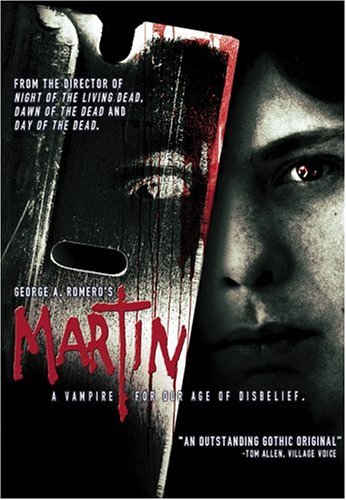
The first, Martin, is a radical revision of the vampire film. Tossing the Romantic Gothic trappings, Romero centered his tale around a disturbed young man who obtains blood by drugging victims and extracting it through small slits made with a razor blade. He can't turn into a bat or compel the actions of nubile victims with his captivating gaze. Is he just some sick nut case? Or does he suffer from an ancient curse? Your humble horror host reviewed said flick earlier.

The second, Season of the Witch, is similarly open-ended. Originally entitled Hungry Wives by a distributor who hoped confused skin-flick fans would attend mistaking it for a porno, Season was filmed after Night of the Living Dead and before Dawn of the Dead. The film is a character study of Joan Mitchell, a stifled housewife who begins exploring witchcraft in the hopes of discovering the passionate self her dead-end domesticity has all but completely buried.

In my review of Martin I mentioned how weirdly non-stylish Romero's style was. In his zombie flicks and in Martin Romero seems confident to simply set up the camera and meticulously capture the details of life passing before his lens. Season of the Witch shows a remarkably different visual aesthetic at work. The film begins with a blatantly allegorical dream sequence, a surreal combo of dead-pan Monty Pythonism and the overtly meaningful stuff of "art house" cinema. Jump cuts and stutter editing borrowed from French New Wave cinema make the already curious scene and even stranger exception to Romero's typical filmmaking approach. Though the film will calm down a bit as the narrative starts to spool out, Romero never fully packs away the tricks he has on full display in these first few minutes. Visually, Season is his most daring film.

Once the plot gets underway, we follow Joan through the tedium of her loveless family life. Her husband is mentally abusive in a sort of low-grade, dismissive way. Her daughter, a "switched on" fully realized product of the early '70s, is similarly dismissive of her square mom. Eventually, in search for some kicks to help yet another pointless night pass as quickly as possible, Joan and a friend visit a tarot card reader that professes to be a real life witch. Joan becomes obsessed. Plagued by nightmarish visions, Joan begins to dabble in witchcraft, following the steps in a sore-bought primer called To Be a Witch. It I in these scenes, a Joan begins to dabble in witchcraft, that Romero's usual attention to the minute details of mundane existence best meshes with the experimental style of the flick. Joan, like any other housewife-turned-witch, must gather materials at antique shops and specialty gourmet stores in order to collect the tools of witchcraft. Where does one get eye of snake in suburban Pittsburg? Eventually Joan uses her newfound powers to seduce the sometime boyfriend of her daughter. Convinced that she has frivolously tapped into dark forces or trivia purposes and that she'll be punished, Joan starts to spiral into a more and more pit of dangerous paranoia . . . Dum da dum!

Like Martin, Joan's not your typical cinematic witch. She stumbles through her conjuring as she sits on the floor of her extremely '70s living room, a sacrificial blade in one hand and her copy of Witchcraft for Dummies in the other. At turns sexy and tired, dangerous and wounded, sympathetic and frustratingly dense, Joan is possibly Romero's most realistic character. And Romero goes even further in Season in leaving the question of whether Joan's going nuts or whether her witchcraft is genuine than he did in leaving Martin's vampirism unresolved. Unlike Martin, however, which is Romero's least political film, Season is Romero's The Feminine Mystique, a film essay in unfulfilling domestication.

As an aside, the film benefits from the wonderful job Jan White does playing the unhappy, haunted Joan. I've read somewhere that folks are planning a remake of the film. I can't imagine who could be a better Joan. This isn't because White is such a magnificent actress. She does a great job, sure; but this isn’t Oscar grade stuff. What she has that I can't imagine the remake producers looking for is authenticity. She looked like the kinda hot housewife next door. The kind of uptight, quiet woman who, under the right light, sudden looks like a passionate, hungry woman. Some box office drawl would be simply too obvious, too movie-ish to be the convincing witch next door.

Season of the Witch isn't for everybody. There's almost no gore and it is paced like a drama and not a horror flick. Still, for fans of Romero, this is an essential display of a range you wouldn't guess he has based solely on the zombie flicks.

Wednesday, August 01, 2007

Movie News: Dead heads.

More news from the "nerd prom," as people seem to be dubbing the Comic Con International in San Diego. Comic Book Resources has an article on a panel discussion with George Romero and J. Michael Straczynski.

Most of the article focuses on Romero and his upcoming Diary of the Dead. He's pitching it a prequel of sorts, saying that it locks into the "of the Dead" continuity at the beginning of the zombie outbreak. This seems a little odd to me as the "of the Dead" films supposed that the flesh-eaters start their reign of terror in 1968 and the new film will be shot in handcam digital-video first-person perspective (think Blair Witch with a more pixilated vibe).

Romero revealed that the style of the film will take a different approach from any of the previous films. Shot entirely on subjective camera and security camera footage, "Diary of the Dead" will follow the story of a group of college students experiencing the first night of a zombie breakout. "That's what this one is, it's about a bunch of college kids that were out doing a school project when the shit hits the fan."

When asked what inspired the premise behind "Diary," Romero explained that he makes his movies based on what he sees in today's world. "'Land' is about the Bush Administration basically," Romero said. "And 'Diary' is about YouTube."


Romero also discusses how little he's actually made off the "Dead" flicks – a bit of a cautionary tale for up-and-coming horror filmmakers.

On the subject of money, Romero revealed that he rarely sees the profits his films produce. From losing the copyright to "Night of the Living Dead" to companies selling the rights to his movies to themselves, Romero doesn't receive very many royalties. Surprisingly okaywith that, Romero explained that even if he had all the money in the world, it wouldn't change how he made his movies. "I'll make ‘em as long as I'm standing," he told the convention goers.

Even though Romero is heralded as the man who created the zombie genre, that wasn't his intent when he made "Night of the Living Dead." Originally, he was simply looking for an extraordinary event to happen to mankind that he could use to push his characters to the edge. The original title of the movie was simply "Night of the Flesh Eaters" until it was later changed.

"And that's how we lost the copyright," Romero said.


Straczynski, producer and writer for such television shows as He-Man, Murder, She Wrote, and Babylon 5, gets some copy near the end, mainly about his in-progress adaptation of the novel World War Z.

Tuesday, December 12, 2006

Movies: “Whatever it takes to get through the night. Right, Count?”

George Romero has gone on record saying that his underappreciated 1977 vampire flick Martin is his personal favorite of all his films. Considering the fact that his justly famous Night of the Living Dead stands as an ur-text for just about every zombie flick made since and is universally considered a modern horror landmark, Romero’s love for this relatively unsung flick is initially surprising. At least, it is until you see the film. Martin is one of the most engrossing and innovative vampire flicks ever made and it ranks easily as Romero’s most thoughtful and emotionally involving film.

Martin begins with our title character, a pale and awkward man in his late teens or early twenties, taking a train from Pittsburgh to the town of Raleigh, Pennsylvania. As the train rolls through the endless, anonymous landscape of suburban blight, a legacy of the financial downturns of the late 1970s that can still be found on long stretches of the Eastern Corridor’s right of way, Martin notices a young woman traveling alone. That night, as most of the passengers retire to their berths or sleeping compartments, Martin attacks the nameless young woman. He breaks into her sleeping compartment, injects her with a heavy-duty sedative, undresses her, possibly rapes her, before, finally, opening up her forearm with a razor blade and lapping up her blood. Then, calmly, methodically, he cleans himself up, positions the body, and scatters sleeping pills around the sink in her compartment lavatory to make it look like a suicide. Martin leaves her cabin and returns to his seat. He takes out a small paperback about stage magic and reads distractedly.

This is our introduction to Martin.

We learn later that Martin is on the train because he is being sent to a small town far from Pittsburgh. There he will stay with his uncle, Tada Cuda, an old Eastern European who has taken charge of Martin in order to, as Tada tells Martin, “save your soul and then destroy you.” Martin’s family line, according to Cuda, is cursed. Every generation or so, one of the family becomes nosferatu. Martin, according to Cuda, is just such a creature. But it isn’t that simple. For a vampire, Martin’s a pretty lame specimen. Sunlight bothers his eyes, but it doesn’t kill him. He’s not particularly fond of garlic, but that’s a matter of personal preference. He’s got no aversion to crosses and even attends church with his uncle. He can’t hypnotize ladies (he’s kind of afraid of girls) or turn into a bat. He doesn’t even have fangs. Even Cuda, who clearly expected something more majestically sinister, seems a bit under-whelmed by this supposed creature of the night.

Cuda’s granddaughter, a thoroughly Americanized young woman (played by Romero’s wife) thinks that Martin is just a poor, mixed-up kid who has been driven crazy by his family’s twisted Old World superstitions. In her opinion, Martin is the unwitting actor in a grotesque psychodrama sustained by the family. He needs therapy, not an exorcism. Although, if that’s true, why does Martin maintain he’s more than 80 years old – despite the fact that he’s clearly younger than his uncle’s granddaughter? And what’s with the flashes Martin has to scenes of him killing a young woman in what appears to be 1920s Europe? Are these head trips the movie-fueled delusions of an insane wannabe vampire or is Martin remembering the early days of his unnaturally prolonged life?

Martin is Romero’s most meditative film and its wounded and haunted central protagonist is Romero’s most carefully constructed character. In many ways, the surreal mix of the mundane decay of small town Pennsylvania, the dark struggles of Martin, and the guilt-ridden actions of his family make if almost Kafka-esque. It has this uniquely American take on what I feel is a very European sort of dreadful absurdity. If Samsa had awoken to find himself a vampire instead of a giant insect, the Metamorphosis would have resembled this film. I say the film is uniquely American, however, in that it strips away the mist shrouded gentility of the fussy European Gothic aesthetic, even going so far as to lightly lampoon that lush sensibility. Despite the leisurely pace of much of the film, Romero knows his audience and delivers several exciting and tense set pieces, mostly gathered around Martin’s efforts to secure blood. Without the powers of your standard cinema vampire, getting blood is a major undertaking.

As an aside, I suspect gorehounds will find Martin a serious disappointment. The body count is tiny and the blood, what there is of it, is that cherry red latex paint stuff that seemed to be go-to blood stand-in for ‘70s horror flicks.

The film has its flaws. Romero’s filmmaking consistently falls short of his creative ambitions and his intellectual aspirations. He understands the complexity of the characters and the uncanny beauty of their decaying landscape, but too often his set ups are uninspired. I can’t help but wonder if, as a young indie guerilla-style filmmaker, Romero found such success that he never bothered to advance his art. Even as his budgets and scope have increased, he continues to rely on a remarkably small vocabulary of basic shots and set-ups. This leads to the other amateurish aspect of the film: a sort of naïve belief in the power of the camera to render things interesting. Part of the meditative pacing comes from Romero’s unfortunate tendency to just linger on a scene or shot long after it has been drained of significance. This could be a long and silent shot of people walking to their car or an over-long moment of Martin watching empty train tracks. The line between introspection and self-indulgence is a thin one and Martin wobbles across it more than once.

The creativity and intelligence of the film, however, far outshine the films few short comings. Martin is not my favorite Romero flick (that’s still Dawn of the Dead) but it is genuine masterwork from an accomplished legend of the genre and I recommend it to anybody interested in thoughtful, moody horror. Using the revamped and improved Named Summits of Georgia Movie Ranking System, I’m giving Martin an unqualified Hickory Knob.