skip to main |
skip to sidebar
 Personally, I'm ready to bench the corpses for another decade or two. Horror lit needs to rotate the crops. But, as I seem to be in the minority on this, I point you to a spiffy little contest being held by the fine folks at the Largehearted Boy blog. For just naming a book that scared you, you could win three free zombie books, including World War Z, Breathers, and, um, something else that complete escapes me at the moment.So, right on, free stuff. Don't say I never did nothin' for yah.
 More news from the "nerd prom," as people seem to be dubbing the Comic Con International in San Diego. Comic Book Resources has an article on a panel discussion with George Romero and J. Michael Straczynski.
Most of the article focuses on Romero and his upcoming Diary of the Dead. He's pitching it a prequel of sorts, saying that it locks into the "of the Dead" continuity at the beginning of the zombie outbreak. This seems a little odd to me as the "of the Dead" films supposed that the flesh-eaters start their reign of terror in 1968 and the new film will be shot in handcam digital-video first-person perspective (think Blair Witch with a more pixilated vibe).
Romero revealed that the style of the film will take a different approach from any of the previous films. Shot entirely on subjective camera and security camera footage, "Diary of the Dead" will follow the story of a group of college students experiencing the first night of a zombie breakout. "That's what this one is, it's about a bunch of college kids that were out doing a school project when the shit hits the fan."
When asked what inspired the premise behind "Diary," Romero explained that he makes his movies based on what he sees in today's world. "'Land' is about the Bush Administration basically," Romero said. "And 'Diary' is about YouTube."Romero also discusses how little he's actually made off the "Dead" flicks – a bit of a cautionary tale for up-and-coming horror filmmakers.On the subject of money, Romero revealed that he rarely sees the profits his films produce. From losing the copyright to "Night of the Living Dead" to companies selling the rights to his movies to themselves, Romero doesn't receive very many royalties. Surprisingly okaywith that, Romero explained that even if he had all the money in the world, it wouldn't change how he made his movies. "I'll make ‘em as long as I'm standing," he told the convention goers.
Even though Romero is heralded as the man who created the zombie genre, that wasn't his intent when he made "Night of the Living Dead." Originally, he was simply looking for an extraordinary event to happen to mankind that he could use to push his characters to the edge. The original title of the movie was simply "Night of the Flesh Eaters" until it was later changed.
"And that's how we lost the copyright," Romero said.Straczynski, producer and writer for such television shows as He-Man, Murder, She Wrote, and Babylon 5, gets some copy near the end, mainly about his in-progress adaptation of the novel World War Z.

When I was a kid the survivalist fantasy of choice was "Commie invasion." Fueled in part by the right-wing wet dream that was Red Dawn, me and my youthful amigos were convinced that, at any moment, we might be required to raid a sporting goods store, flee into the woods, and fend of the advancing tide of the advancing tide of Commie with good old American know-how and shotguns. Ignoring the taint of Reagan-Era paranoia, the scenario had a real Huck Finn quailty to it. It was all about leaving the current, comprosmised world behind, living off you own hidden (but always there) resources, and creating something new that's all the truer for its isolation. This is its appeal. It is an escape fantasy that diguises the morally questionable act of running away with the narrative trick of making the flight required and out of our hands. We want the humdrum work-a-day world stripped away and replaced by a world were every action is essential and each and every day is crucial. The world has meaning again because, at square one, what we must do is perfectly clear and the stakes are always total.
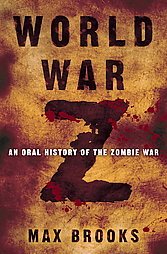
This same heroic survivalist spirit - but with zombies instead of Commies - is at the core of Max Brooks's World War Z: An Oral History of the Zombie War. A fictional work of oral history covering a global-scale zombie infestation, Brooks's work is a flight fantasy played out on an epic scale. In Brooks's novel, the infestation starts with "Patient Zero," a young Chinese boy who gets zombified and infects a handful of other villagers. The Chinese government swiftly destroys Patient Zero (so swiftly, in fact, that the hint is given that PZ is not actually the first zombie) and covers it up. The Chinese government's efforts to suppress the spread of zombie menace are, of course, ineffective and, before you mumble out that you crave brains, zombies are popping up all over the globe. Through the first person narratives of dozens of characters, the novel charts the rise of the zombie hordes, the decline of civilization, the human counter-offensive, and the slow climb back to a living-dominated globe. We see some countries completely collapse under the strain (North Korea) while others develop in predictable (China goes democratic - don't tell Guns 'N' Roses) or unexpected ways (Russia becomes a theocratic czarist nation). We see the developing war from the eyes of housewives and generals, doctors and priests, footsoldiers and lost children. Brooks even takes time to tell us what happened to the astronauts stranded on the International Space Station.
World War Z is an interesting hybrid of a book. The oral history approach is novel and Max Brooks, whose previous book was the underwhelming Zombie Survival Guide, proves that he has the writing chops to develop distinct voices for his many different speakers. Brooks is also adept at creating arresting images and scenes. However, the format also has some crucial drawbacks. First and foremost, some of the suspense of the book is undermined by the fact that you know not only do the individual interviewees survive, but that humanity wins out in the end. Part of the framing device is that Brooks (playing himself, so to speak) gathered these interviews as part of a UN fact-finding mission. Before you've gotten out of the introduction, you know that the zombie menace was pretty much completely wiped out. The second element which somewhat undermines the sustained menace is the fact that the interview-by-interview structure makes the while thing feel like a collection of short stories rather than a novel. This impression is all the strong for the fact that some interviewee's tales are so much more detailed, powerful, and exciting than the stories of other interviewees. Finally, because every interviewee speaks in a realistically average speaking voice, the verbal artistry necessary to create the proper mood and tone of terror is strangely lacking. Like reading the eyewitness reports of any disaster, it is the scope of events and not the retelling that evokes a response. Since none of us has even indirect experience with fighting the living dead, the emotional register of the book is often oddly flat.
Another unusual element of the book is Brooks's interest in all matters military. Brooks's interest is almost exclusively focuses on the military response to the zombie menace. After giving us a few stories from the panicked populace at the beginning of the zombie take-over, the book becomes increasingly about the armed forces and the war. In a way, World War Z more properly belongs to the subgenre of war sci-fi than it does the genre of horror fiction.
These issues aside, however, Brooks has likely set the bar for depicting the "zombie world" scenario. The scope of what Brooks depicts is so massive and so thought out that one suspects this novel will become one of those seminal works that inspires others create work within the world it envisions. You can imagine future works containing zombies that are "Brooksian" or containing soldiers who refer to zombies as "Zack" (the way Germans became Fritz or the North Vietnamese became Charlie). In this, Brooks approaches the world-building fiction of Lovecraft, an author who, though completely dissimilar in style, also built a sort of "creative world" for others to inhabit. In this aspect, for the zombie fan and anybody else not yet zombied-out, Brooks's novel is likely to be essential reading in the same way Romero's Dead Series is essential viewing.
 Personally, I'm ready to bench the corpses for another decade or two. Horror lit needs to rotate the crops.