Lucky McKee's debut feature film, the 2002 film May, is a fine addition to the long tradition of revenge-horror flicks.
Unbalanced underdog revenge is one of the more prominent themes in horror cinema. In the alternate universe of horror movies, it makes complete sense that, for example, being taunted and bullied as a kid would make you, later in life, an axe-wielding madman who got your kicks by turning nubile camp counselors into cutlets. Though a host of contemporary characters spring to mind (Carrie, Jason, Crowley from Hatchet, the melty-faced guy from The Burning, and so on), it is a remarkably old pattern. The Golem, one of silent film's landmarks of horror, follows the same pattern. You start with an underdog group (in this case, we've got an entire ghetto of Jewish residents instead of your mutant kid or awkward teenage girl), give them a means for revenge, and then let the revenge get out of hand.
From a filmmaking perspective, this theme does double duty: it gets you a motive for your villain and it's a clever bait and switch that suckers viewers into sympathizing with a character, thus pulling them into your flick.
It's a smart little way to exploit of our innate ethical sense of reciprocity. Some evolutionary biologists have suggested that a handful of hardwired prejudices are at the root of all moral codes. One of these inherent concepts is reciprocity: we expect people treated nicely to behave nicely and people treated poorly to behave poorly. We such behavior sensible and, regardless of the consequences, there's something comfortable in the word making sense. That is, of course, until the mechanics described in part one final start to disgust us. Horror films can exploit our perhaps ingrained sense of reciprocity by pushing it too and absurd and crazy level. By some weird quirk of film watching psychology, events viewed on the silver screen often seem to happen outside any framework of ethical scale. It doesn't make any sense, really, that Jason's mom would decide to arbitrarily show up and slaughter a random group of counselors because, years and years ago, a different group of counselors negligently allowed her boy drown. Why the wait? Why kill other counselors? But, in a film context, we somehow accept that blood demands blood and we accept the notion that it is a sort of permanent rupture – once there's a dead person, all the rules that would limit your response are off. The rupture is, in horror films, the essence of "crazy." Ironically, in action films, it's often not a sign of being crazy, but of holding a monopoly on appropriate violence because you're "justified." Imagine a world in which every kidnapping elicited an institutional response similar to what we accept as appropriate in Commando. In genre films, "crazy" and "righteous" function in pretty much the same way, the key difference seems to be in their selection of targets. What horror films do it find the limit of the mediated moral flexibility, showing how far we can let moral frameworks slide and remain in our comfort zone.
(As an aside, I suspect that the moral flexibility of cinema is a trait of all media, regardless of content. We often talk about content influences on the genre. One popular theory has it that Halloween is the product of news coverage of 'Nam – the latter making the violence of the former a possibility. What if, instead, the capacity to stomach violence and accept its extreme depiction wasn't a matter of content exposure, but something allowed by the medium itself. That is to say, what is the very fact of mediation changes what we will and will not accept as tolerable. We'll happily watch something on a screen that we wouldn't watch with our naked eye, regardless of what it happens to be. If this is true, what does horror cinema tell us about our reactions to, say, the news and what implications would it have for how we ethically evaluate political leaders? I don't have any theories on that. I just bring it up as something worth thinking about.)
May is a classic revenger's tale. The titular character, an awkward woman who had a lonely and psychologically traumatic (though, honestly, not that psychologically traumatic) childhood, finds herself suddenly involved with two lovers. The first is a garage mechanic who, in his off-time, is a would-be horror film maker. The second is a none-to-bright predatory lipstick lesbian who works with May at an animal clinic. These erotic connections start to bring May out of her shell, leading her to volunteer time at a daycare for handicapped kids and to adopt a cat. But, since this is a horror flick, it isn't long before May gets her fragile sense of self completely shattered. Neither affair ends well, the kiddie thing goes disturbingly South, and she ends up braining the cat (perhaps by accident). This all pushes May into a short and bloody downward spiral. Out come the shears and scalpels, off comes the body parts or friends and acquaintances, and everything comes to an appropriately nasty climax - culminating in May stitching together a human sized doll out of the parts of her victims. It all gets tied up with a curiously downbeat and almost gentle conclusion which would seem almost anti-climactic if it wasn't so appropriate.
McKee's direction is assured and he beings a low-key naturalistic feel to much of the movie. In fact, he's so good at making his weird story feel accidental and natural that it sometimes feels like you're watching an off-kilter slacker flick – Edgar Allan Poe's Reality Bites. Though McKee's more acidic view of the people who populate his world is considerably less self-serving then gently ironic flicks of Generation X's awkward twenties. This isn't to say that there aren't some efforts as visual lyricism. In this case, we get flowing scraps of fabric whenever May's at her sewing machine. These scenes are not embarrassing, but they're less compelling than when McKee and Co. are out on the streets, among the full mess of everyday life.
He and his production crew are also great at capturing the telling details of his characters' lives. After we watch a truly goofy black and white short film "created" by May male love interest, the film-within-a-film rolls credits and we see that the character has credited himself in Italian, as if he was an Argento.
Finally, the film hinges on a wonderful performance by Angela Bettis, who has to carry most of the flick. Bettis, who is really too good looking to convince us that May would live in isolation, manages to give us a character who is sad and painfully awkward, while never letting us forget that something really nasty is building up within May. The truly horrific stuff in May doesn't shake until the last half hour or so, and it is a testament to Bettis's chops as an actress that the lead-up never seems to drag.
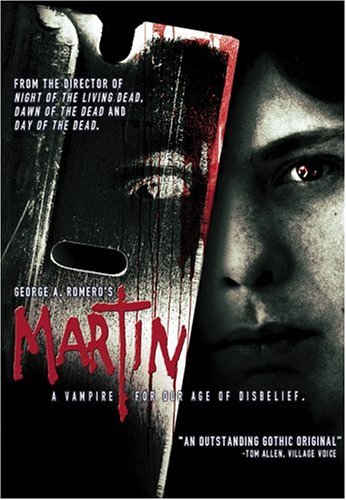
May is not a by-the-numbers horror flick. Most of the films is a slow burn character study of a figure who wobbles on the line between sympathy and repulsion. In that, it reminds me of Romero's excellent Martin (another M name title – hmmmm – a pattern perhaps?).