Friday, July 10, 2009

Mad science: Capturing the Imp of the Perverse.

In 1845, Poe published the short work "The Imp of the Perverse" in Graham's Magazine, the magazine that famously published Poe's "The Murders in the Rue Morgue" and, later, infamously passed over the opportunity to publish "The Raven."

The nearly plotless tale begins with a seemingly objective – but clearly first-person – description of the concept of the "Imp of the Perverse." The "imp" in question is a primitive, illogical, unproductive impulse that the narrator believes is innate to the human mind. From the tale:

Induction, a posteriori, would have brought phrenology to admit, as an innate and primitive principle of human action, a paradoxical something, which we may call perverseness, for want of a more characteristic term. In the sense I intend, it is, in fact, a mobile without motive, a motive not motivirt. Through its promptings we act without comprehensible object; or, if this shall be understood as a contradiction in terms, we may so far modify the proposition as to say, that through its promptings we act, for the reason that we should not. In theory, no reason can be more unreasonable, but, in fact, there is none more strong. With certain minds, under certain conditions, it becomes absolutely irresistible. I am not more certain that I breathe, than that the assurance of the wrong or error of any action is often the one unconquerable force which impels us, and alone impels us to its prosecution. Nor will this overwhelming tendency to do wrong for the wrong's sake, admit of analysis, or resolution into ulterior elements. It is a radical, a primitive impulse-elementary. It will be said, I am aware, that when we persist in acts because we feel we should not persist in them, our conduct is but a modification of that which ordinarily springs from the combativeness of phrenology. But a glance will show the fallacy of this idea. The phrenological combativeness has for its essence, the necessity of self-defence. It is our safeguard against injury. Its principle regards our well-being; and thus the desire to be well is excited simultaneously with its development. It follows, that the desire to be well must be excited simultaneously with any principle which shall be merely a modification of combativeness, but in the case of that something which I term perverseness, the desire to be well is not only not aroused, but a strongly antagonistical sentiment exists.

After quite a bit of similarly thick philosophy, Poe's narrator then explains how he is a victim of the "Imp" himself. The narrator confesses that he murdered a man (using a poisonous candle, like you do) and got away with the crime. However, the impulse to turn himself in to the cops nags at him and, eventually, compels him to work against his best interests and his sense of self-preservation. He confesses to the authorities, is tried, and relates this tale shortly before he's to be taken to the gallows.

The work's form is, in itself, a bit perverse. "The Imp" is an example of Poe's idiosyncratic mini-genre the "essay that turns into a fictional story." What makes these works (his "Premature Burial" is another example of the odd form) weird is that they are self-subverting. In "The Imp," the work seems to advance a theory and then provide exemplary anecdotal evidence in support of that theory. However, the evidence is faked up. The murder and confession are, we know, just an invention of Poe's. Does this mean the theory itself is also just a narrative contrivance? Are we supposed to understand that the first half of the tale presents a sincere observation of human nature or do we put it down as the self-justification of a killer who is trying to convince himself that anybody could commit murder if they'd just been put in his place?

Curiously, some have suggested that the whole thing is a weird justification for what literary historians now dub the "Longfellow War." As part of a larger New York versus Boston culture clash that shaped the direction of American letters in pre-Civil War America (and, as a bizarre side effect, definitely split clam chowder into Manhattan and New England styles – but that's another story), Poe and Henry Wadsworth Longfellow had a long-running and nasty public feud. At the time, Poe's star sank and Longfellow's rose partially due to Poe's repeated and seemingly inexplicable public attempts at career suicide, including near hysterical diatribes about imagined conspiracies of Boston literary culture and public readings in which he deliberately alienated his audience (most infamously, after promising a Boston audience a new poem, Poe read his interminable and absurdly obscure early work "Al Araaf," then declared that Boston audiences didn't deserve new works, and then stormed off stage). As a manifesto for flushing one's career down the tubes, "The Imp" more than suffices.

Regardless of the sincerity of Poe's concept and despite his statement that the Imp will not "admit of analysis," the NY Times reports that modern psychologists are attempting to capture the Imp. From the article:

“There are all kinds of pitfalls in social life, everywhere we look; not just errors but worst possible errors come to mind, and they come to mind easily,” said the paper’s author, Daniel M. Wegner, a psychologist at Harvard. “And having the worst thing come to mind, in some circumstances, might increase the likelihood that it will happen.”

The exploration of perverse urges has a rich history (how could it not?), running through the stories of Poe and the Marquis de Sade to Freud’s repressed desires and Darwin’s observation that many actions are performed “in direct opposition to our conscious will.” In the past decade, social psychologists have documented how common such contrary urges are — and when they are most likely to alter people’s behavior.


In a recent paper, Wegner proposes that the actions of the Imp, which the good doctor dubs "ironic errors," are a byproduct of the process of error and taboo avoidance:

At a fundamental level, functioning socially means mastering one’s impulses. The adult brain expends at least as much energy on inhibition as on action, some studies suggest, and mental health relies on abiding strategies to ignore or suppress deeply disturbing thoughts — of one’s own inevitable death, for example. These strategies are general, subconscious or semiconscious psychological programs that usually run on automatic pilot.

Perverse impulses seem to arise when people focus intensely on avoiding specific errors or taboos. The theory is straightforward: to avoid blurting out that a colleague is a raging hypocrite, the brain must first imagine just that; the very presence of that catastrophic insult, in turn, increases the odds that the brain will spit it out.


Interestingly enough, even when it isn't causing overt errors, the Imp can apparently distort our perceptions:

Efforts to be politically correct can be particularly treacherous. In one study, researchers at Northwestern and Lehigh Universities had 73 students read a vignette about a fictional peer, Donald, a black male. The students saw a picture of him and read a narrative about his visit to a mall with a friend.

In the crowded parking lot, Donald would not park in a handicap space, even though he was driving his grandmother’s car, which had a pass, but he did butt in front of another driver to snag a nonhandicap space. He snubbed a person collecting money for a heart fund, while his friend contributed some change. And so on. The story purposely portrayed the protagonist in an ambiguous way.

The researchers had about half the students try to suppress bad stereotypes of black males as they read and, later, judged Donald’s character on measures like honesty, hostility and laziness. These students rated Donald as significantly more hostile — but also more honest — than did students who were not trying to suppress stereotypes.

In short, the attempt to banish biased thoughts worked, to some extent. But the study also provided “a strong demonstration that stereotype suppression leads stereotypes to become hyperaccessible,” the authors concluded.


Photo credit: Jason.

Thursday, July 09, 2009

Movies: In space, no one can hear you suck.

I'm going to propose a hypothesis about Dracula movies. For any Dracula movie that contains a year in the title, the movie's quality is inversely proportional to the absolute value of difference between 1897 (the publication of Dracula) and the year in the title.

To test this hypothesis, we can look at the relative values of Hammer Studio's Dracula 1958, Alan Gibson's Dracula A.D. 1972 (a.k.a. Dracula Chases the Mini Girls, where "mini girls" means girls in short skirts and not, sadly, midget women) and Patrick Lussier's Dracula 2000. The hypothesis correctly predicts that the best of the lot is the stylish and inventive 1958 flick, which some feel represents the high point of Hammer's creative output. The once-trendy cheesiness of 1972 makes it at least fun to watch, giving it second place in our trio. The dour, clumsy, and stylistically inert 2000 performs the worst of all three test subjects.

I bring this up to provide a firm scientific context for my review of Dracula 3000: Infinite Darkness, the low-budget sci-fi/horror/actioner that takes the Dracula mythos and projects it 1,000 thousand years into the future, into a universe of intergalactic space travel, androids, and Coolio.

That's right. Coolio.


This context is important because, as I discuss the film, you might be tempted to think, "What an amazingly wacky flick, I should take pains to experience it for myself!" But don't be fooled. Remember the Dracula Title Year Hypothesis. It's science. You can't argue with it.

The film opens with Udo "anything for a buck" Kier as captain Varna of the spacefaring cargo ship the Demeter. In the first in series of video log entry interruptions that act as a running exposition, Varna explains that his cargo ship is on a return run from the planet Transylvania in the Carpathian system. He also complains of some sort illness has struck the crew.

Cut to 50 years later, and the intrepid crew of the salvage ship Mother (despite all the clamor George Clinton made over the Mother ship in the day, I must say that it's a little disappointing when you actually see it) it on their way to make a quick buck of the floating hulk of the Demeter. The salvage crew is led by Captain Abraham Van Helsing, played by Casper "the friendly ghost of a career" Van Dien. His crew includes the by-the-book second in command and love interest Aurora Ash, played by Baywatch alum Erika Eleniak. There's also the pot-addled 187, played by Coolio, natch. Tiny Lister provides the muscle in the form of the brutish Humvee, who never explains why his nickname means any more to his 31st century comrades than the nickname "Lectica" would mean to us. The brains of the operation is the wheelchair-bound brainiac Arthur Holmwood, whose allusive name is wasted because there's no Lucy Westernra analog. Nor it is explained why, after a century of tech development, the wheelchair apparently remains the best option for people who have lost the use of their legs. Finally, the crew is completed by the inept navigator-intern Mina Murry. Like Arthur's name, it is another wasted allusion.

The crew of Mother reaches the Demeter and, after scanning the ship and finding no signs of life, sends in Humvee and Mina to recon. After a false jump scare, the two test the oxygen in the ship using the traditional method of the sci-fi space explorer: they pop of their breathers and see whether or not exposure to toxic fumes or lack of oxygen kills them. Since they don't die, the ship is declared safe and the rest of the crew boards. Holmwood gets most of the Demeter's systems online while the rest of the team searches the ship. They find a small collection of coffins, the sole cargo of the ship, all filled with sand. They also stumble across the desiccated remains of Varda (what happened to the rest of the crew mentioned so many times by Varda in the video logs is unclear). The corpse of Varda is still clutching a crucifix, which baffles the salvage experts because religion was apparently outlawed decades ago. Whether or not this ban has anything to do with all the Soviet iconography around the ship – Did Soviet Communism experience a second wind and finally crush the West? And, if so, why then are these salvage guys so keen on the market value of the ships they find? – is never explained.

As pleasing as it might have been to watch Casper Van Dien and Tiny Lister debate the merits and shortfalls post-Soviet universal secularism in a universe that clearly allows for the existence of the supernatural, the salvage crew doesn't have time to ponder these abstractions. Almost as soon as the Demeter comes online, Mother "inexplicably" (read, Dracula) decouples and launches off into space. Trapped on the Demeter, the crew starts getting picked off by Dracula. Coolio goes first. Drac turns him into a spastic vampire and orders him to destroy the rest of the team. He attacks his former coworkers several times, eventually turning Mina into another bloodsucker.

During these hit and run attacks, Dracula corners Aurora and makes as if he's going to bite her. However, we find out that he never goes through with it because she turns out that she's an android narc sent by the galaxy police or whatever to keep an eye on Van Helsing's crew of disreputable scallywags. Instead of killing her, she claims Drac spilled his guts to her. He said that Transylvania was a planet of vampires, but Drac's now the last of his kind, the sole survivor from the now dead planet. He wants to get to Earth to get some grub.

Finally, in a fight scene that includes an unnecessarily extensive monologue in which twitchy vampire-Coolio describes masturbating to visions of the second-in-command, Coolio is dispatched by a pool queue through the heart. Sending him to . . .


Now fully convinced that their problems are vampirical in nature, the remaining team members do what anybody would: They google "vampires" to figure out what to do. At this point the viewer learns that the vampire stalking the Demeter is, in fact, the Dracula of Stoker's book fame (traveling under the alias Orlock). Further, we learn that Van Helsing is the great-great-great-and-so-on grandson of Stoker's original vampire hunter. Holmwood freaks out at this notion and suggests that what is really happening is little more than a revenge plot. Drac has waited more than a millennium to end the Van Helsings. Curiously, either his research is insufficient or he simply finds it a coincidence that his name and Mina's also appear in the original story, because those links don't bother him at all.

At this point, viewers can construct a backstory on their own and it goes something like this. Dracula was real. He came to England in the late 1800s and fought Van Helsing and the many suitors of Lucy. He was somehow not actually killed at the end of the conflict. He stayed out of the limelight for a few centuries, apparently having a low intensity conflict with the Van Helsing family. Whenever long distance space travel became feasible, he hopped on a ship went to a distant planet in another galaxy to set up, for some reason, an all-vampire world. Which, in retrospect, was a bad idea. Without something to feed on, the new Transylvania became a dead world. But, Drac couldn't just ditch the dead planet. Instead he waited until the year 3000, when the family he was fighting on Earth would come to him in far space. That way he could combine his vengeance with his move.

The salvage teams google search reveals that sunlight and stakes through the heart are the two ways to kill a vampire. At this point Officer Robot announces that there is no sunlight in the dark of space – an unfortunate mistake since ever freaking visible star is, in fact, a sun and, without atmospheric effects to disperse it, the light they give would be the very definition of direct sunlight – so they'll have to aim the ship at a double sun system and hope they can keep Drac and Vampire Mina of their backs until they get there.

The crew gets proactive and they find Mina sleeping in a coffin. They stake her, but have a harder time with Drac, who manages to vampate Holmwood and Van Helsing. Humvee manage to dispatch the newly minted bloodsuckers, but the worst they can do to Drac is lob of one of his arms when he gets it stuck in one of the ships massive steel doors. Trapped on the ship with a wounded, but still deadly Drac, Humvee and Aurora realize that they cannot prevent the Demeter from crashing into the sun.

Aurora announces that, prior to being upgraded to a cop bot, she was a pleasure droid. She suggests that they spend their last few hours have sex. Humvee picks up Aurora, throws her over his should like a sack of potatoes, and goes off to look for somewhere to have sex.

Their ship hits the sun and everybody dies.

The end.

I actually applaud the makers of this flick for its bizarro ending and their willingness to dispatch their Van Helsing character. Unfortunately, this little treats aren't enough to save the rest of the flick. Visually dull, crippled by a script that is neither scary nor funny, and carried by a cast that seems slightly embarrassed to be there, Dracula 3000 is strongest evidence yet for Dracula Title Year Hypothesis.

Wednesday, July 08, 2009

Mad science: They saved Michael Jackson's brain!

After various reports in the blog-twit ProAm that Jackson would be preserved like Lenin, embalmed like the Chinese prisoners of the traveling Bodies exhibit, or otherwise turned into a freakish display, the late entertainer is, somewhat anti-climactically, going to buried in Los Angeles's Forest Lawn cemetery.

But, it seems, the King of Pop will be shuffling off a few bits of his mortal coil prior to ending up in the cold, cold ground. Reports are that the LA corner's office will be keeping Mr. Jackson's brain topside.

Why? From the Mirror:

Los Angeles Coroner’s spokesman Craig Harvey confirmed that neuropathology tests will be carried out to see if it holds any clues to the exact cause of his death.

But the examination cannot begin until at least two weeks after the death when the brain has hardened sufficiently to slice it open.


Vaughan Bell of the Mind Hacks blog clarifies:

Although this may seem unusual, the 'hardening' process is actually a standard part of any post-mortem examination where the brain is thought to be important in the cause of death, such as in suspected overdose.

It involves removing the brain from the skull and leaving it to soak in a diluted mixture of formaldehyde and water called formalin. This soaking process usually takes four weeks and the brain genuinely does harden.

A 'fresh' brain is a pinkish colour and has the consistency of jelly, gello or soft tofu meaning it is difficult to examine and the various internal structures are often hard to make out.

After soaking the brain, it has the consistency and colour of canned mushrooms making it easier to slice, examine and photograph. However, because the brain is so soft to start with, it can't just be dropped in a tank of fixing solution, because it will deform under its own weight.

To solve the problem it is usually suspended upside down in a large bucket of formalin by a piece of string which is tied to the basilar artery.

After it has 'hardened' or 'fixed' it is sliced to look for clear damage to either the tissue or the arteries. Small sections can also be kept to examine under the microscope.


On hopes the LA corner's office is taking the necessary security precautions to prevent brain-napping. The crime is not without precedence: in 1955, Dr. Thomas Harvey removed Albert Einstein's brain without the permission of Einstein's estate. Harvey sliced the brain into 240 individual sections, doling out a few sections to interested researchers, but keeping the majority in preserving jars at his home. In 1996, after years of negotiation and acrimony, Harvey surrendered the brain to Princeton Hospital in New Jersey.

Tuesday, July 07, 2009

Books: Dex gets back to basics.

After an auspicious debut and a sequel that actually improved on the original, the third book in Jeff Lindsay's Dexter series – the popular killer-kills-killers mystery series that inspired the Showtime TV series – was something of a debacle. While the novel contained some of the pleasingly black humor that is the series's hallmark and included a few important series-altering narrative developments, the third novel's unexpected foray into overt supernaturalism was widely considered a mistake and, for the most part, left fans groaning or scratching their heads. I know of more than one fan that swore off the series.

Whether Lindsay also felt that the more blatantly supernatural route was a dead end or he was simply reacting to the overwhelming response from the fan base, the upcoming fourth Dexter novel, Dexter By Design (available in hardcover this September from Doubleday), happily strips the jarring otherworldly elements from the series and returns Miami's most prolific serial killer to the Florida Weird crime comedy he's best at.

For those more familiar with the show than with the books, I'll do a quick recap of the story so far and, hopefully, the differences between the two series will become clear enough.

Dexter Morgan is a Miami PD blood splatter expert. He's also a serial killer. Adopted by a police officer who recognized Dexter for what he was, Dexter was trained to become a rigorously meticulous vigilante, taking out his bloodlust on criminals too clever to be nabbed by conventional means. Dexter's sister, Deborah, is also a police detective. Though she was kept in the dark by both Dex and her now deceased father for most of her life, as the fourth novel opens, Deborah is aware of, but uncomfortable with, what Dexter is.

While working in the police department gives Dexter access to the info and resources he needs to carry on his gory campaign against Miami's criminal population, it also means that he's surrounded by the professionally suspicious. While Dexter's thin façade of bland likeability is enough to throw off most off his co-workers, there are a couple of suspicious cops keeping an eye on him. First and foremost is a former detective named Doakes. Once a formidable officer, Doakes ran afoul of one of Dexter's targets and was left horribly crippled (he's missing some major extremities and has to speak through a Stephen Hawkings-esque voice box). Though no longer a major player in police investigations, Doakes continues to watch Dexter, hoping for a screw up. In one particularly nice bit of characterization, we learn that Doakes has preprogrammed the phrase "I'm watching you, motherfucker" into his voice box to avoid having to type the whole thing out every time he has to say it.

Dexter is newly married to Rita, his long-time girlfriend, and has two children by way of that marriage: his stepdaughter Astor and his stepson Cody. Previously, Dexter recognized that both Astor and Cody exhibit the same barely suppressed homicidal urges that he himself showed as a child. Though the chronically unaware Rita seems oblivious to her children's nascent serial killer drives, Dexter makes it his task train them as his own father trained him.

The fourth novel opens with Dex and Rita on a Paris honeymoon. A quick appetizer before the main course, this short section serves to introduce Dex to new readers and suggest the theme of the new mystery in the form of a violent performance art piece Rita and Dex stumble across. Called Jennifer's Leg, the piece features a young woman – Jennifer, one assumes – removing her leg with a circular saw. Ah, Paris!

Safely back in the land of doughnuts, traffic jams, Cuban ex-pats, and loud Hawaiian print shirts, Dex quickly finds himself put on a case involving a visual artist who is leaving artfully mutilated corpses as part of campaign of civic terror. The investigation into the corpses goes awry when one of the suspects knifes Deb, putting her into a coma due to blood loss.

Dexter may be an emotionless sociopath, but even he understands that violence directed at one's kin demands some level of special attention. Dex does as Dex does and exacts a swift and gory revenge on the morbid installation artist. The end.

Only, for poor Dex, it ain't. Following Dex's swift retribution, he finds out, in rapid succession, that 1) the artist wasn't actually killing people because the bodies were swiped from a local morgue, 2) the artist was not working alone, 3) the artist's two collaborators caught Dexter's vengeance on video, and 4) decide, in the face of Dexter's violence, to escalate their own project to new homicidal heights.

As if that wasn't bad enough, Deb's new partner, a bloated oaf of a man whose outsized frame hides a surprising effective detective's mind, starts to suspect something is amiss with Dex. But he'll have to get in line. Deb's stabbing attracts IA's attention, which means the Internal Affairs is all up in Dex's grill – what with the main suspect in Deb's stabbing going missing and all and Dex's career being one long series of "just happened to be where all the shit went down" incidents. And, for good measure, Doakes uses the possibility that the corpse-installations are serial murders to point out Dexter to a sympathetic FBI agent from the branch office.

Seriously, it's like it isn't even worth being a serial killer some times.

Credulity straining plots and overly elaborate serial killings are par for the series. I can't prove it, but I suspect the number of fans who read the Dexter books as mysteries can be counted on a single hand. Like may post-hardboiled mystery books, plotting takes the place of detection and who the villain is seems less important than how the hero gets to them. For example, in this particular "case" Dexter and Deb's first real lead pays off in just a couple chapters. The series's real draw has always been its bracingly amoral, yet charming narrator – Dexter, himself – and the cognitive dissonance of his bemused detachment from the carnage he witnesses and causes. Unlike the television series, which has made Dexter a more tortured character who is less emotionless than simply profoundly emotionally damaged (a good choice for the show's episodic, soap-ish format), the book's Dexter is a more blithely inhuman creature. There's a degree to which Lindsay is incapable of preventing some humanizing emoting; the task of creating a truly sociopathic character would be impossible for anybody except, I imagine, a sociopath. Emotions are simply too central to everything we understand about characterization and motivation. That said, Lindsay's original Dexter is a far creepier and in some ways a more interesting character. When Lindsay's writing him well, Dexter possesses a sort of internal bright-eyed innocence. Incapable of horror or moral discernment, he grasps ethics and morals the way others attempt to grasp the finer points of good manners: There's a code and Dexter tries to follow it for the sake of easing necessary social interaction, but none of it makes much sense and it all seems kind of silly. (Perhaps the finest example of this occurs in the second book, where Dexter finds himself in the clutches of a torture specialist turned serial dismemberer. Instead of fight-or-flight panic or stoic courage in the face of definitive discomfort, Dexter is simply curious about the techniques that he suspects will be used on him. This light and almost boyish curiosity is made even more grisly by the fact that he's thinking these thoughts while Doakes is getting chopped up in front of him.) Happily, for die-hard loyalists and those fans that may have declared the series dead, this pleasingly twisted Dexter is back in fighting form.

An excellent return to the core values that made the books work so well, Dexter By Design is a welcome addition to the series.

Monday, July 06, 2009

Music: Meat the Beatles.

Today's link is flagrantly, flamboyantly NSFW – in the truest and most sincere meaning of the acronym.

The Gigwise music site presents a slideshow of 20 disgusting album covers, including the infamously short-lived "butcher cover" of the Beatles' in1966 US only Yesterday and Today LP shown above. This is actually one of the less repulsive covers in the lot. The site's commentary informs us, to nobody's surprise, that it was "John Lennon who pushed for the photo to be used." We didn't think it was Ringo's idea.

Given the tiny sample size, it's a little presumptuous to make generalizations . . . but, hell, I say, let's do it, let's be presumptuous.

Among "genres" of foul ideas, violence – usually depicted as potential or in its aftermath – makes up the largest proportion of the covers. But, curiously, second place goes to poop. Word hounds Peter Novobatzky and Ammon Shea have pointed out that the English language, "tongue of Shakespeare, Bryon, and Mellville" contains "a puzzling number of words that mean 'to spray with shit.'" This cultural obsession with human waste seems to have carried over into the American cultural innovation of rock and roll. Defecation – human, animal, and human-from-an-animal (deathgrind unit Cattle Decapitation's oh so tasteful Humanure album cover) – is an oddly popular topic for album covers.

Also, there's not one, but two covers (and the commentary mentions a third) featuring the taboo of bestiality. How this subject, which is hardly a major theme of rock, ends up on even a single cover is mystery best answered by minds smarter (or more twisted) than my own.

Saturday, July 04, 2009

Movies: Everything falls into place.

Though the 1970's has been pretty much stripped mined as far as horror cinema diamonds in the rough go, its odd that under appreciated flicks can still be found there. And yet, despite the relentless and meticulous efforts of exploitation era cinema-archeologists, weird good stuff still litters the ground. How are these pieces overlooked? Because much of the myth of 1970s horror cinema rests on a sort of gonzo aesthetic of "batshit crazy," the horror fancy often overlooks that some of the finest '70s era specialized in a sort of ultra low-key, faux social realism that placed a sort of lush squalor before stylishness, bleak minimalism before show-stopping pyrotechnics. Such films were exploitation to the core and pandered in straight-out sleaze as their primary draw, but these flicks also trafficked in a lightly worn documentary feel that gave them an unearned gravitas. This shallow 'realism' didn't make these flicks any smarter of more artistic than their more overtly trite exploitation brethren, but it did mean that they unfurled at a more deliberate pace, included thoughtfully rendered characterization, tonal grace notes, and attracted A-list talent. It has become unfashionable to suggest that some works transcend their genre the same way it has become gauche to suggest that some children are simply brighter than others. Yet, fashionable or not, the fact remains; genre fans are often satisfied with subpar work, and films that both deliver the goods and still go above and beyond the call of duty should be celebrated as doing more than they need to. That's called transcending the genre.

Richard Fleisher's 1971 true-crime serial killer pic 10 Rillington Place is one of those pictures that, though firmly rooted in the traditions of sleazy exploitation, manages to approach something almost Dostoevskyan by allowing the visuals of squalor and the power of two first rate leads to drag the story into affecting human directions it wasn't originally meant to contain.

Based on a much recounted historical incident, the plot of 10 Rillington Place tells the story of a blue collar couple who run afoul of a genuine monster. In the post-war squalor of Austerity Britain, illiterate Tim and Beryl move into a crumbling townhouse in Notting Hill occupied by John Christie. The role of Tim is rendered with pity-inducing inarticulateness by an excellent and shockingly young John Hurt. The cruelly meticulous and avuncular Christie is brought to chilling life by Richard (the old dude in Jurassic Park) Attenborough.

For horror fans, Attenborough's Christie would be enough to recommend the film. Played with dark humor, Attenborough's Christie is at once a ruthless predator and fussy old grump. A passionless unman who covers his pathetic unlife with an endless gloss of lies, he's only filled with energy when raping the corpses of his victims (mostly women who come to him under the misapprehension that he's a former medical man with a special passion for treating female complaints). In many ways, his protean shallowness reminds me of Warren Oates's pathetically mercurial G.T.O. from Two Lane Blacktop, trickster as crippling condition, a man whose great tragedy is that his only pleasures must be fleeting, which dooms him to live in the sharp clawed clutches of a desire greater than his decaying and insufficient frame. Though where G.T.O. is all American tall tale and gregarious banter, Christie is the murderous reflection of British reserve and the famed stiff upper lip. There's a scene is in the film where Christie stands by an old gas light (to save money, you know) talking his victims into their own doom, as the gas sputters with a constant snake hiss. The shot is one of the most perfect in all horror cinema. Attenborough's Christie ranks up with Perkins's Bates, Rooker's Henry, and Hopkins's Lecter. He's that good. Seriously.

The plot is as trashy as they come. The film opens with a sort of intro killing by Christie back during the war. Taking advantage of a wartime blackout, a young seeks Christie's unregulated amateur care. He hooks her up to a homemade gas delivery system, convincing her that it will cure her of her chronic pain condition. When he fight of flight reflex eventually kicks in, she's too weak to fight Christie, who overpowers her, strangles her, and sexually abuses her.

Jump forward: post-war Austerity Britain. The nadir of modern British culture – think Swinging London and then imagine the point furthest from which that can still boast enough infrastructure to support electricity. A time period when the national color was brownish-grey and the chief domestic product was diminished expectations.

A young couple, Tim and Beryl avec infant daughter, move into the Christie's apartment building. Beryl is a stifled ghetto flower whose desire for better things drag the family deeper and deeper into debt. Tim is a semi-alcoholic truck driver with a flair for self-aggrandizing tall tales. Their home life is tempestuous and, perhaps, not quite loving. When Beryl is knock up and with second child, she attempts some pill-delivered remedy of dubious utility. Her attempts at self-medication fail and she ends up confessing her problems to the awkward, but seemingly friendly Mr. Christie. Christie claims to have become familiar with abortion techniques when he served as a special policeman during the war and offers his assistance. Beryl and Christie convince the doubtful Tim to go along with it. (Which leads to the grimmest joke of occasionally darkly sharp flick: Christie rehashes an old joke about delivering babies and recontextualizes it to discuss the planned abortion: "Don't worry Tim; we haven't lost a father yet." Careful listeners might remember the same joke, used to very different effect, in Disney's Lady in the Tramp.)

Shortly thereafter, while Tim is at work and Christie's wife, Ethel, is off on an errand, Christie uses the fiction of his medical prowess to get Beryl up in his apparatus. He gasses and then strangles her. Christie then informs Tim and Ethel that Beryl died during the operation. He convinces Tim it would be wisest to help Christie hide the body and then flee town until such time as Christie can get everything sorted with the police. When Tim asks what will happen to his infant daughter, Christie says he knows of a nice, childless couple that would be happy to care for the girl in the meantime. Tim packs up and flees immediately. With the father gone, Christie takes one of Tim's neckties and strangles the daughter.

The frame up, though hastily constructed, is enough to trap the dim-bulb Tim, who eventually turns himself over the cops for the crime of hiding his wife's body. The cops, of course, want him for the double homicide of Beryl and his daughter. Stunned he confesses, then recants. He's tried, convicted, and hung for murder.

In the months that follow, Christie (whose façade of lower middle-class civility was cracked, but not completely breeched on the witness stand of Tim's trial) and his wife grow estranged. Ethel now knows on a gut level that he's a monster, though the scope and exact details of his crimes are still a mystery to her. For his part Christie increasingly understands that framing Tim was a Pyrrhic victory: he's managed to escape the noose, but at the cost of his home and his sense of safety.

Christie's life quickly spirals out of control. He kills Ethel, kicking off a short string of uncharacteristically sloppy killings. He looses his job and then his house, becoming a homeless drifter. The house's new residents discover the hidden room Christie used to hide the corpses of his post-Tim victims. The police quickly realize their error and launch a manhunt.

Like so many serial killers before and after him, Christie is caught when, during a chance encounter, a beat cop happens to recognize him.

The plot, while lurid, benefits from an odd structure that continues the story long after the "thriller" aspect – centering around the destruction of Tim, Beryl, and their daughter – has past. By giving equal time to the aftermath, both in terms of the legal consequences and the slow decay of Christie himself, the film weds its exploitative and sleazy aspects to a genuinely dramatic framework that emphasizes the dreary fatedness of these characters.

Saving the exercise from completely lapsing into a dreary social realism is the disciplined hand of the vastly underrated Richard Fleischer. Son of the legendary animation producer Max Fleischer, Richard made his early rep cranking out budget-minded and successful film noirs flicks. He then moved on to a series of Disney produced effects-driven actioners, most notably 20,000 Leagues Under the Sea and the original Doctor Doolittle. However, Fleischer's directorial career shows an astounding range and includes a surprising number of hits and enduring cult classics. Aside from big ticket pics like Tora! Tora! Tora! and the Neil Diamond version of The Jazz Singer, the sci-fi cult classics Fantastic Voyage and Soylent Green both belong to Fleischer. He's also behind Violent Saturday, Compulsion, The Boston Strangler, and the exploitastic Mandingo. Fleischer keeps Rillington moving at a calm, creepy pace, he let's his actors infuse certain scenes with almost Coen brothers-style humor. He also knows when to let the characters inject excruciating levels of pathos into a scene. These emotional tones counterbalance the detached stoicism of the rest of the flick.

10 Rillington Place is one of the better flicks in the serial killer subgenre and I think it deserves to be better known.

Friday, July 03, 2009

Music: "You know me. I hate everyone."

I haven't seriously thought about Nine Inch Nails since I was in college, some two trillion years ago. There was a brief moment, back then, when it looked like the twin attack of NIN and Ministry was going to push industrial music into the mainstream (including the legally-mandated David Bowie style cop that let's you know when a particular music is ready for mass production). However, just a few years or so after Closer and Psalm 69, it all fizzled and the public started diggin' a resurgent wave of pop and embracing mall punk. Apres le Ministry, Blink 182.

To my shame, I did not keep the faith. I was vaguely aware of NIN's Year Zero album/game/lifestyle-choice whoopjamboreewho – though I caught up to it late in the cycle and it all seemed a bit daunting to come in on the middle.

Given this neglect, I find myself oddly moved by the news that Reznor is calling it quits and shelving the NIN brand. This is, I think, only news to me. After all, his current tour is called the "Wave Goodbye" tour and the merch for contains the one-man-sonic-factory's incep and termination dates (1989 – 2009). Still, my utter invulnerability to the obvious doesn't change the fact that the news saddens me.

So, Screamers and Screamettes, let's wish Mr. Reznor happy trails and enjoy this clip from what is reported to be NIN's last US performance ever, from this year's Bonnaroo.

Wednesday, July 01, 2009

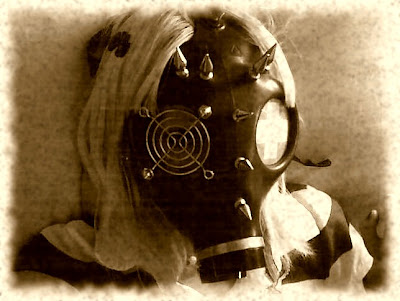
Guest Blogger: Zoe on gas mask art.

Screamers and Screamettes, I've asked blogger Zoe Blue, surrealism guru and art fancier, to curate this month's gas mask display. Enjoy.

Gas masks in Art


Delirium:
A disoriented
condition with
clouded consciousness,
often accompanied
by hallucinations,
illusions,
misinterpretations
of events and
a generally confused
quality with reduced capacity to
sustain attention.
(from Victor Koen's Funny Farm alphabet)

From gas masks


"Delirium," by Victor Koen


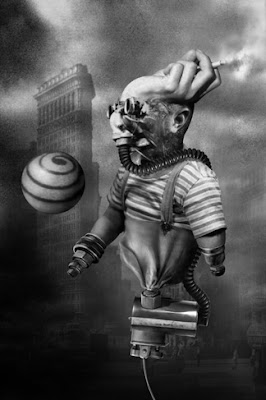
"The obsession with the "perfect baby" and children who would be progressively more intelligent and fit than the last generation, is an ancient one. Today through genetic technologies, social engineering and developmental psychology we believe we control previously inaccessible natural workings that strongly influence the way children are born, learn and grow...From extreme authoritarian rhetoric to schooling systems of total autonomy. The revolution in reproductive science has come to add yet another dimension to the issue, and blurred the borders between fact and fiction. 'Tasks & Games, portraits of the never young' is a series of 24 portraits, depicting children caught in the middle of the pursuit of perfection before and after their birth....Dramatically lit and staged in traditional photography studio settings, in front of bizarre backdrops or locations that some times overtake their little bodies, or what's left of them, the children are posed with their favorite toys or objects, in their Sunday best. A closer look will reveal signs of severe pain. We get to observe visual renditions of the nightmares they live in, and through them, maybe we face some of our own. They have obviously taken their toll on the kids even if most of them are smiling or smirking. ...The majority of the raw photographic materials originate from the early nineteen hundreds. The children are ...are fused with contemporary objects and environments that seem to consume them. The images are titled after traditional tasks and games. A sharp juxtaposition between the pure nature of old fashioned children activities with scientific methods and their results."


From gas masks


This one is called "Dusting." Victor Koen


From gas masks

"Vanity Study #39" Victor Koen


Another Fine Artist who has some exceptionally creepy images of gas masks is Chris Anthony. He is most famous for his award-winning 2007 series of photographs entitled "Victims and Avengers," which caught women and children at the moment of violently overcoming their abusers. A more recent series, called Venice is, as he describes it, "a metaphor for a sinking city, deserving of nature's wrath, leaving its citizens to tread water and explore new ways to sustain life on aquatic earth." In keeping with his apparent leaning towards--or at least readiness for--apocalyptic moments of reckoning and punishment:


From chris anthony


by Chris Anthony

From chris anthony


by Chris Anthony

I think these are also gas masks, though I'm not an expert...
From gas masks

by Chris Anthony


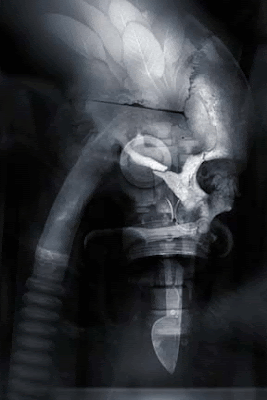
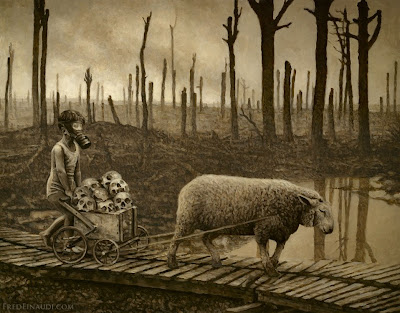
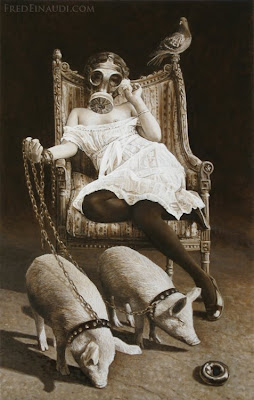
Fred Einaudi also seems to enjoy apocalyptic themes. He likes to place images of innocence together with images of death and dissolution, and gas masks help express his ideas quite clearly:

From gas masks


"The Button Maker" Fred Einaudi

From gas masks


"Chocolate Donut" Fred Einaudi


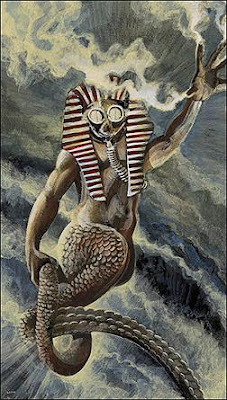
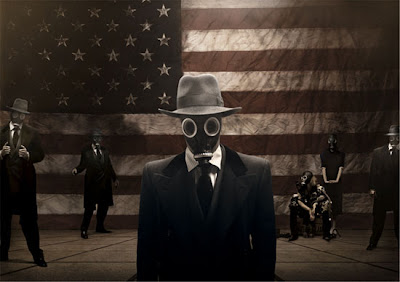
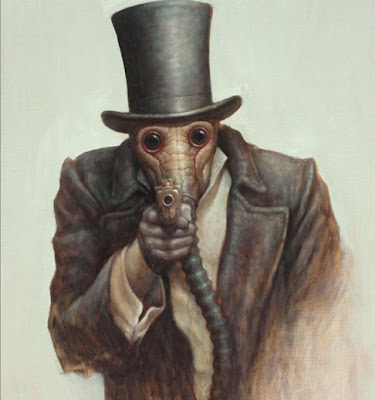
Chet Zar has tons of them in his paintings, often with the mask merging into actual flesh, as in an evolutionary mutation. Here's Clown of Doom, and Uncle Sam, and It's All Good:

From gas masks


From gas masks


From gas masks


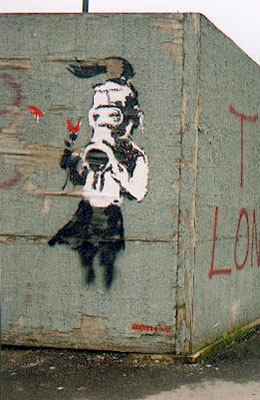
Moving into more political territory, we have street graffiti artists. A minor amount of wandering on the web gave me all kinds of commentary on why gas masks are so popular in this art form: graffiti artists often have to be very quick, so rapidly understood symbolism is a must, and the gas mask is easily seen as representative of government oppression (riot police-- so also as a symbol of preparedness for engagement with them), the effects of social violence but also environmental violence, and general dehumanization (facelessness). Greg Nog says, "It's a perfect symbol for anyone fearing the impending decay of civilization." A comment which would also fit nicely next to the Chris Anthony photos or the Fred Einaudi paintings.


From gas masks


Cellist with gas mask: a photo by smiling bag production from stenciled graffiti in Tel Aviv. There's a whole series here: http://www.bigartmob.com/meta/artist/Smiling%20Bag%20Production/ .

From gas masks


Bansky

Here, Nicole Dolly made her own, gothic, version of a gas mask, I assume for clubbing (or maybe just so when the day comes, you can maintain your style):
From gas masks


And onward into full-blown sculpture, here is "Dystopian Art by Yanobe Kenji: Mickey the Knight:"

From gas masks


This was actually a commissioned work, commissioned for Disneyland's 50th anniversary celebration in 2005. Strangely, they didn't actually end up displaying it. Yanobe Kenji has several other sort of terrifying child-centered sculptures which use gas masks. You can see his work here:
http://www.yanobe.com/works.html
Apparently, though, he actually got the idea for this sculpture by reading his history books. According to a gasmasklexikon article written by Major Robert D. Walk:

"The Mickey Mouse Gas Mask was produced as part of the war production program. The Sun Rubber Company produced approximately 1,000 Mickey Mouse gas masks and earned an Army-Navy ‘E’ for excellence in wartime production in 1944. Overall, production of the Noncombatant Gas Masks (and in fact, all gas masks) was one of the most successful production programs of the war. In fact, production had to be curtailed early due to the vast quantity produced."
More on this creepiness is available here:
http://www.gasmasklexikon.com/Page/USA-Mil-Mikey.htm

From gas masks


In case the mask itself isn't enough for you, I'll leave you with this extended version:
From gas masks

Sweet dreams!

--zoe

Zoe's own mind-warpingly beautiful blog, Zoe in Wonderland is worth checking out. Go forth and dig hard, my friends.