Saturday, July 04, 2009

Movies: Everything falls into place.

Though the 1970's has been pretty much stripped mined as far as horror cinema diamonds in the rough go, its odd that under appreciated flicks can still be found there. And yet, despite the relentless and meticulous efforts of exploitation era cinema-archeologists, weird good stuff still litters the ground. How are these pieces overlooked? Because much of the myth of 1970s horror cinema rests on a sort of gonzo aesthetic of "batshit crazy," the horror fancy often overlooks that some of the finest '70s era specialized in a sort of ultra low-key, faux social realism that placed a sort of lush squalor before stylishness, bleak minimalism before show-stopping pyrotechnics. Such films were exploitation to the core and pandered in straight-out sleaze as their primary draw, but these flicks also trafficked in a lightly worn documentary feel that gave them an unearned gravitas. This shallow 'realism' didn't make these flicks any smarter of more artistic than their more overtly trite exploitation brethren, but it did mean that they unfurled at a more deliberate pace, included thoughtfully rendered characterization, tonal grace notes, and attracted A-list talent. It has become unfashionable to suggest that some works transcend their genre the same way it has become gauche to suggest that some children are simply brighter than others. Yet, fashionable or not, the fact remains; genre fans are often satisfied with subpar work, and films that both deliver the goods and still go above and beyond the call of duty should be celebrated as doing more than they need to. That's called transcending the genre.

Richard Fleisher's 1971 true-crime serial killer pic 10 Rillington Place is one of those pictures that, though firmly rooted in the traditions of sleazy exploitation, manages to approach something almost Dostoevskyan by allowing the visuals of squalor and the power of two first rate leads to drag the story into affecting human directions it wasn't originally meant to contain.

Based on a much recounted historical incident, the plot of 10 Rillington Place tells the story of a blue collar couple who run afoul of a genuine monster. In the post-war squalor of Austerity Britain, illiterate Tim and Beryl move into a crumbling townhouse in Notting Hill occupied by John Christie. The role of Tim is rendered with pity-inducing inarticulateness by an excellent and shockingly young John Hurt. The cruelly meticulous and avuncular Christie is brought to chilling life by Richard (the old dude in Jurassic Park) Attenborough.

For horror fans, Attenborough's Christie would be enough to recommend the film. Played with dark humor, Attenborough's Christie is at once a ruthless predator and fussy old grump. A passionless unman who covers his pathetic unlife with an endless gloss of lies, he's only filled with energy when raping the corpses of his victims (mostly women who come to him under the misapprehension that he's a former medical man with a special passion for treating female complaints). In many ways, his protean shallowness reminds me of Warren Oates's pathetically mercurial G.T.O. from Two Lane Blacktop, trickster as crippling condition, a man whose great tragedy is that his only pleasures must be fleeting, which dooms him to live in the sharp clawed clutches of a desire greater than his decaying and insufficient frame. Though where G.T.O. is all American tall tale and gregarious banter, Christie is the murderous reflection of British reserve and the famed stiff upper lip. There's a scene is in the film where Christie stands by an old gas light (to save money, you know) talking his victims into their own doom, as the gas sputters with a constant snake hiss. The shot is one of the most perfect in all horror cinema. Attenborough's Christie ranks up with Perkins's Bates, Rooker's Henry, and Hopkins's Lecter. He's that good. Seriously.

The plot is as trashy as they come. The film opens with a sort of intro killing by Christie back during the war. Taking advantage of a wartime blackout, a young seeks Christie's unregulated amateur care. He hooks her up to a homemade gas delivery system, convincing her that it will cure her of her chronic pain condition. When he fight of flight reflex eventually kicks in, she's too weak to fight Christie, who overpowers her, strangles her, and sexually abuses her.

Jump forward: post-war Austerity Britain. The nadir of modern British culture – think Swinging London and then imagine the point furthest from which that can still boast enough infrastructure to support electricity. A time period when the national color was brownish-grey and the chief domestic product was diminished expectations.

A young couple, Tim and Beryl avec infant daughter, move into the Christie's apartment building. Beryl is a stifled ghetto flower whose desire for better things drag the family deeper and deeper into debt. Tim is a semi-alcoholic truck driver with a flair for self-aggrandizing tall tales. Their home life is tempestuous and, perhaps, not quite loving. When Beryl is knock up and with second child, she attempts some pill-delivered remedy of dubious utility. Her attempts at self-medication fail and she ends up confessing her problems to the awkward, but seemingly friendly Mr. Christie. Christie claims to have become familiar with abortion techniques when he served as a special policeman during the war and offers his assistance. Beryl and Christie convince the doubtful Tim to go along with it. (Which leads to the grimmest joke of occasionally darkly sharp flick: Christie rehashes an old joke about delivering babies and recontextualizes it to discuss the planned abortion: "Don't worry Tim; we haven't lost a father yet." Careful listeners might remember the same joke, used to very different effect, in Disney's Lady in the Tramp.)

Shortly thereafter, while Tim is at work and Christie's wife, Ethel, is off on an errand, Christie uses the fiction of his medical prowess to get Beryl up in his apparatus. He gasses and then strangles her. Christie then informs Tim and Ethel that Beryl died during the operation. He convinces Tim it would be wisest to help Christie hide the body and then flee town until such time as Christie can get everything sorted with the police. When Tim asks what will happen to his infant daughter, Christie says he knows of a nice, childless couple that would be happy to care for the girl in the meantime. Tim packs up and flees immediately. With the father gone, Christie takes one of Tim's neckties and strangles the daughter.

The frame up, though hastily constructed, is enough to trap the dim-bulb Tim, who eventually turns himself over the cops for the crime of hiding his wife's body. The cops, of course, want him for the double homicide of Beryl and his daughter. Stunned he confesses, then recants. He's tried, convicted, and hung for murder.

In the months that follow, Christie (whose façade of lower middle-class civility was cracked, but not completely breeched on the witness stand of Tim's trial) and his wife grow estranged. Ethel now knows on a gut level that he's a monster, though the scope and exact details of his crimes are still a mystery to her. For his part Christie increasingly understands that framing Tim was a Pyrrhic victory: he's managed to escape the noose, but at the cost of his home and his sense of safety.

Christie's life quickly spirals out of control. He kills Ethel, kicking off a short string of uncharacteristically sloppy killings. He looses his job and then his house, becoming a homeless drifter. The house's new residents discover the hidden room Christie used to hide the corpses of his post-Tim victims. The police quickly realize their error and launch a manhunt.

Like so many serial killers before and after him, Christie is caught when, during a chance encounter, a beat cop happens to recognize him.

The plot, while lurid, benefits from an odd structure that continues the story long after the "thriller" aspect – centering around the destruction of Tim, Beryl, and their daughter – has past. By giving equal time to the aftermath, both in terms of the legal consequences and the slow decay of Christie himself, the film weds its exploitative and sleazy aspects to a genuinely dramatic framework that emphasizes the dreary fatedness of these characters.

Saving the exercise from completely lapsing into a dreary social realism is the disciplined hand of the vastly underrated Richard Fleischer. Son of the legendary animation producer Max Fleischer, Richard made his early rep cranking out budget-minded and successful film noirs flicks. He then moved on to a series of Disney produced effects-driven actioners, most notably 20,000 Leagues Under the Sea and the original Doctor Doolittle. However, Fleischer's directorial career shows an astounding range and includes a surprising number of hits and enduring cult classics. Aside from big ticket pics like Tora! Tora! Tora! and the Neil Diamond version of The Jazz Singer, the sci-fi cult classics Fantastic Voyage and Soylent Green both belong to Fleischer. He's also behind Violent Saturday, Compulsion, The Boston Strangler, and the exploitastic Mandingo. Fleischer keeps Rillington moving at a calm, creepy pace, he let's his actors infuse certain scenes with almost Coen brothers-style humor. He also knows when to let the characters inject excruciating levels of pathos into a scene. These emotional tones counterbalance the detached stoicism of the rest of the flick.

10 Rillington Place is one of the better flicks in the serial killer subgenre and I think it deserves to be better known.

Friday, July 03, 2009

Music: "You know me. I hate everyone."

I haven't seriously thought about Nine Inch Nails since I was in college, some two trillion years ago. There was a brief moment, back then, when it looked like the twin attack of NIN and Ministry was going to push industrial music into the mainstream (including the legally-mandated David Bowie style cop that let's you know when a particular music is ready for mass production). However, just a few years or so after Closer and Psalm 69, it all fizzled and the public started diggin' a resurgent wave of pop and embracing mall punk. Apres le Ministry, Blink 182.

To my shame, I did not keep the faith. I was vaguely aware of NIN's Year Zero album/game/lifestyle-choice whoopjamboreewho – though I caught up to it late in the cycle and it all seemed a bit daunting to come in on the middle.

Given this neglect, I find myself oddly moved by the news that Reznor is calling it quits and shelving the NIN brand. This is, I think, only news to me. After all, his current tour is called the "Wave Goodbye" tour and the merch for contains the one-man-sonic-factory's incep and termination dates (1989 – 2009). Still, my utter invulnerability to the obvious doesn't change the fact that the news saddens me.

So, Screamers and Screamettes, let's wish Mr. Reznor happy trails and enjoy this clip from what is reported to be NIN's last US performance ever, from this year's Bonnaroo.

Wednesday, July 01, 2009

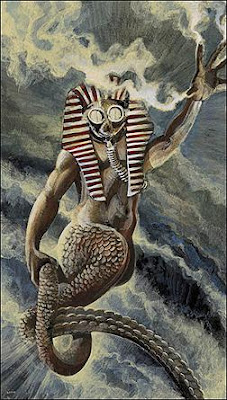
Guest Blogger: Zoe on gas mask art.

Screamers and Screamettes, I've asked blogger Zoe Blue, surrealism guru and art fancier, to curate this month's gas mask display. Enjoy.

Gas masks in Art


Delirium:
A disoriented
condition with
clouded consciousness,
often accompanied
by hallucinations,
illusions,
misinterpretations
of events and
a generally confused
quality with reduced capacity to
sustain attention.
(from Victor Koen's Funny Farm alphabet)

From gas masks


"Delirium," by Victor Koen


"The obsession with the "perfect baby" and children who would be progressively more intelligent and fit than the last generation, is an ancient one. Today through genetic technologies, social engineering and developmental psychology we believe we control previously inaccessible natural workings that strongly influence the way children are born, learn and grow...From extreme authoritarian rhetoric to schooling systems of total autonomy. The revolution in reproductive science has come to add yet another dimension to the issue, and blurred the borders between fact and fiction. 'Tasks & Games, portraits of the never young' is a series of 24 portraits, depicting children caught in the middle of the pursuit of perfection before and after their birth....Dramatically lit and staged in traditional photography studio settings, in front of bizarre backdrops or locations that some times overtake their little bodies, or what's left of them, the children are posed with their favorite toys or objects, in their Sunday best. A closer look will reveal signs of severe pain. We get to observe visual renditions of the nightmares they live in, and through them, maybe we face some of our own. They have obviously taken their toll on the kids even if most of them are smiling or smirking. ...The majority of the raw photographic materials originate from the early nineteen hundreds. The children are ...are fused with contemporary objects and environments that seem to consume them. The images are titled after traditional tasks and games. A sharp juxtaposition between the pure nature of old fashioned children activities with scientific methods and their results."


From gas masks


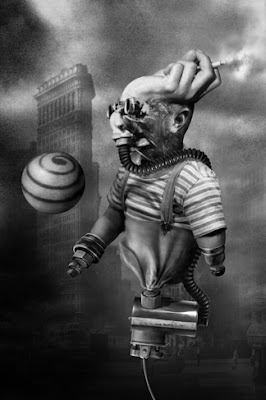
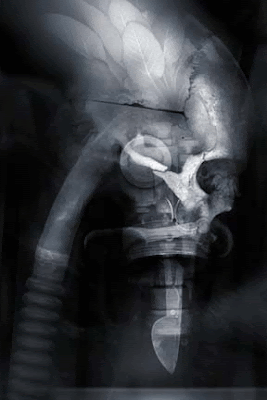
This one is called "Dusting." Victor Koen


From gas masks

"Vanity Study #39" Victor Koen


Another Fine Artist who has some exceptionally creepy images of gas masks is Chris Anthony. He is most famous for his award-winning 2007 series of photographs entitled "Victims and Avengers," which caught women and children at the moment of violently overcoming their abusers. A more recent series, called Venice is, as he describes it, "a metaphor for a sinking city, deserving of nature's wrath, leaving its citizens to tread water and explore new ways to sustain life on aquatic earth." In keeping with his apparent leaning towards--or at least readiness for--apocalyptic moments of reckoning and punishment:


From chris anthony


by Chris Anthony

From chris anthony


by Chris Anthony

I think these are also gas masks, though I'm not an expert...
From gas masks

by Chris Anthony


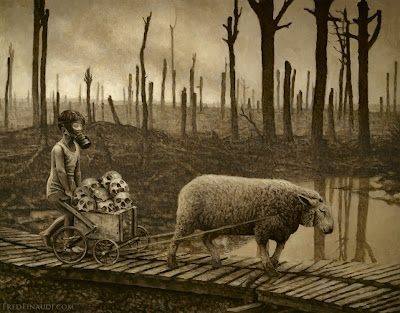
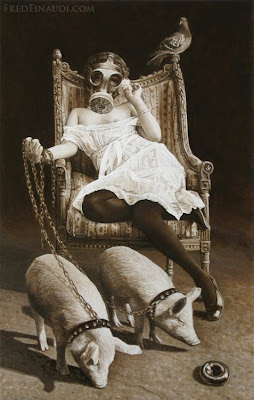
Fred Einaudi also seems to enjoy apocalyptic themes. He likes to place images of innocence together with images of death and dissolution, and gas masks help express his ideas quite clearly:

From gas masks


"The Button Maker" Fred Einaudi

From gas masks


"Chocolate Donut" Fred Einaudi


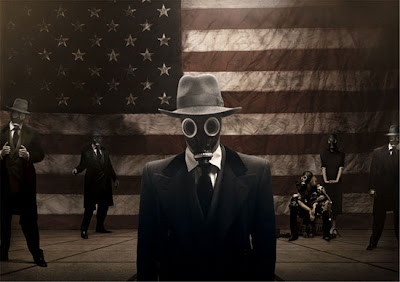
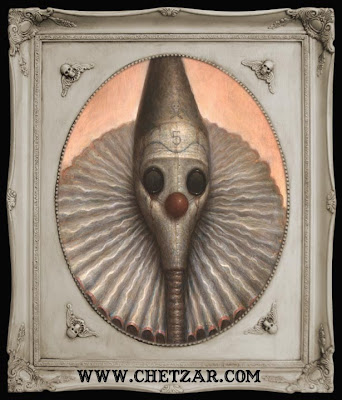
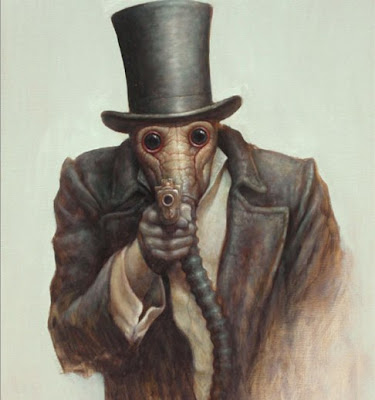
Chet Zar has tons of them in his paintings, often with the mask merging into actual flesh, as in an evolutionary mutation. Here's Clown of Doom, and Uncle Sam, and It's All Good:

From gas masks


From gas masks


From gas masks


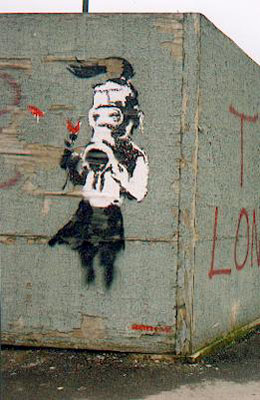
Moving into more political territory, we have street graffiti artists. A minor amount of wandering on the web gave me all kinds of commentary on why gas masks are so popular in this art form: graffiti artists often have to be very quick, so rapidly understood symbolism is a must, and the gas mask is easily seen as representative of government oppression (riot police-- so also as a symbol of preparedness for engagement with them), the effects of social violence but also environmental violence, and general dehumanization (facelessness). Greg Nog says, "It's a perfect symbol for anyone fearing the impending decay of civilization." A comment which would also fit nicely next to the Chris Anthony photos or the Fred Einaudi paintings.


From gas masks


Cellist with gas mask: a photo by smiling bag production from stenciled graffiti in Tel Aviv. There's a whole series here: http://www.bigartmob.com/meta/artist/Smiling%20Bag%20Production/ .

From gas masks


Bansky

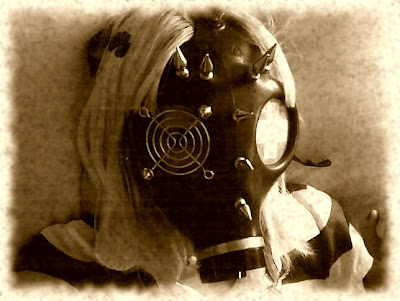
Here, Nicole Dolly made her own, gothic, version of a gas mask, I assume for clubbing (or maybe just so when the day comes, you can maintain your style):
From gas masks


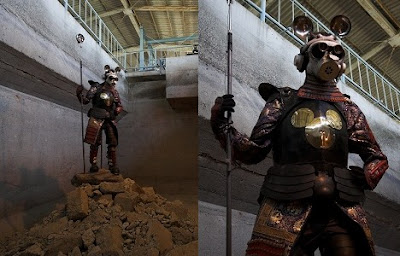
And onward into full-blown sculpture, here is "Dystopian Art by Yanobe Kenji: Mickey the Knight:"

From gas masks


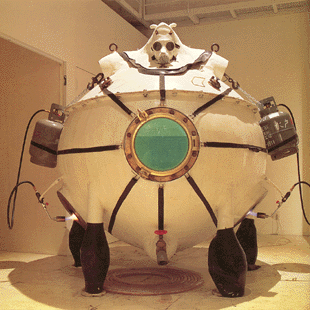
This was actually a commissioned work, commissioned for Disneyland's 50th anniversary celebration in 2005. Strangely, they didn't actually end up displaying it. Yanobe Kenji has several other sort of terrifying child-centered sculptures which use gas masks. You can see his work here:
http://www.yanobe.com/works.html
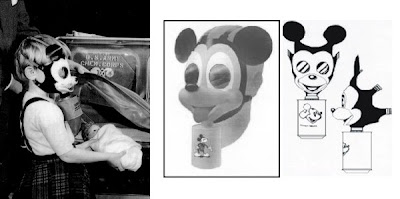
Apparently, though, he actually got the idea for this sculpture by reading his history books. According to a gasmasklexikon article written by Major Robert D. Walk:

"The Mickey Mouse Gas Mask was produced as part of the war production program. The Sun Rubber Company produced approximately 1,000 Mickey Mouse gas masks and earned an Army-Navy ‘E’ for excellence in wartime production in 1944. Overall, production of the Noncombatant Gas Masks (and in fact, all gas masks) was one of the most successful production programs of the war. In fact, production had to be curtailed early due to the vast quantity produced."
More on this creepiness is available here:
http://www.gasmasklexikon.com/Page/USA-Mil-Mikey.htm

From gas masks


In case the mask itself isn't enough for you, I'll leave you with this extended version:
From gas masks

Sweet dreams!

--zoe

Zoe's own mind-warpingly beautiful blog, Zoe in Wonderland is worth checking out. Go forth and dig hard, my friends.

Tuesday, June 30, 2009

Meta: My better half.

Pictured above, standing in front of the art section of McNally Jackson: SoHo's finest source for vendible books, are me and my lovely wife. She's the one on the right.

No, your right.

While I'm normally one to avoid this sort of self-display – after all, you didn't come here to read about me – I have to mark the occasion of our anniversary.

Thanks Jess. I love you.

As for the Screamin' fancy, come back tomorrow. We'll, um, I don't know, do Jeepers Creepers 2 or something.

Sunday, June 28, 2009

Movies: Snow job.

Some say the world will end in fire,
Some say in ice.
From what I've tasted of desire
I hold with those who favor fire.
But if it had to perish twice,
I think I know enough of hate
To say that for destruction ice
Is also great
And would suffice.


- "Fire and Ice," Robert Frost

On first seeing the trailer for The Last Winter, Larry Fessenden's snowbound 2006 eco-horror, I thought that it might very well be his The Thing. What, exactly, Fessenden's The Thing would look like, I wasn't sure; but I'd dug his urban vamp tale Habit and was a fan of his previous snowbound monster flick, Wendigo - which actually serves as a prequel to Last Winter in some odd ways – so I was willing to see what shook out. Sadly, the results are decidedly mixed. Often visually pleasing and suitably eerie, the film suffers severely from a too-baggy plot and drama killing scenes of heavy-handed green-guilt exposition.

The movie begins with a corporate propaganda film-within-a-film explaining that, decades prior to the events of The Last Winter, the North corporation (the film's conveniently evil nature exploiter) sent an exploratory well into some frozen patch of desolation nestled in the bleak heart of an enormous stretch of government-owned Alaskan wasteland. The results of that test were never released because changes in government policy locked the company out of public lands. But, to the great joy of starving oil executives everywhere, evil environmentalist fat cats and the political cronies were swept out of office and elected officials more sensitive the press concern of Energy Independence™ were voted in. Now, just miles away from the mysterious and abandoned original test well, a new project is starting up. And progress, by Americans, for Americans, is on the march again!

In practical terms, this means that we get to strand a handful of folks in a claustrophobic base camp – a series of stitched together trailers that, inside, possess all the charm of a particularly sterile DMV – until something cracks or the forces of nature, from plain ol' hypothermia to the more exotic "things man was not meant to know," do them in, which ever comes first.

The Last Winter wears its sources on it sleeve, for better or for worse. One of the better influences is the superlative 1951 Christian Nyby classic Thing from Another Planet. Though now far eclipsed in fan appreciation by the Carpenter remake, I've always admired the original for its characterization. The surly, already somewhat crazed characters of the remake always seemed to me to just be waiting for a chance to turn into paranoid psychos. Like Nicholson in The Shining, they don't give the viewer confidence that the things might have turned out even had outside evil not intruded. By contrast, the characters in the original appear confident, happy, and friendly. They also partake of that Hawksian professionalism: a refreshingly utopian view of competence that makes heroes out of men that know what they are doing and exercise that skill in an ethos of noble responsibility. When stress starts to weigh on them and trust begins to disintegrate, it seems as if the characters have genuinely lost something. The horror of the original Thing is that our best and brightest might find themselves unequal to a task and crumble under the pressure. In contrast, it is almost impossible to imagine what the protagonists in Carpenter's The Thing might actually be studying. Or, for that matter, why anybody would have armed such a hard-drinking, drugged-out, daft, and embittered crew. The research station in the first film resembles a scientific outpost being supplied by a crew of professional soldiers. The research station in the second film resembles a penal colony. Given the choice between these two options, LW tacks towards the original. Sure, the corporate taskmaster (played with familiar gruffness by Ron Perlman) is a bit of a blockhead, and the machinist is perhaps a bit too fond of his booze – but all in all you get the sense of trained folks, working under harsh conditions, to get a real job done. From their dialogue filled with authentic sounding slang to the passive aggressive "office politics," this feels like it takes place in a genuinely adult world. (I got the same refreshing quality of adultness of the demo crew in Session 9.) Whether horror is just innately a juvenile genre or whether modern horror is simply besotted with an infantilizing nostalgia, it is nice to see a horror film that goes against this grain and has genuinely mature characters in it.

Some other great influences positively inform the flick. The stark, snow-blinded visuals of Carpenter's The Thing seem to have inspired Fessenden's beautifully minimalist cinematography (though the cryptic box that marks the sinister old test well seems a nod to the Nyby original). The film even contains nods to Jack London's work, most notably his classic short story "To Build a Fire." The plot's incrementally building tension also calls to mind classic ghost stories. Not so much any particular film, but rather the sort of slow accumulation of incidents that make the characters realize that the entire haunted mansion, boat, graveyard, laundry machine, whatever, is working against them ever leaving. It has that classic structure.

Some other influences don't wear so well. The film contains what appear to be nods to Event Horizon and Resident Evil which, if intentional, makes The Last Winter the most extensive film homage to the works of "auteur" Paul W. S. Anderson yet created. So, um, it's got that going for it.

There's some other snags too.

Perhaps the fatal weakness of making a mostly smart and well-made flick is that what missteps do occur become glaringly obvious. First, after establishing that the characters in this film aren't a bunch of morons, LW requires the characters do quite a few truly boneheaded things. Most notably, when one of the youngest members of the crew goes mad and stumbles out into the artic night in his birthday suit, carrying a camcorder, determined to record the existence of a ghost he claims is haunting him, the footage the rest of the crew recovers clearly shows something bushwacking the crazed and doomed man. Instead of rewinding the film and attempting to figure out what monstrous thing might have just killed one of the crew, the crew chief destroys the tape. Hey, if it is a well-known fact that there's no such thing as monsters, then the camera must be mistaken or crazy too. The last thing anybody needs is a panicky camcorder getting everybody all riled up!

As unfortunate as some of these sudden attacks of the stupid are, they are almost so common in the creature feature subgenre as to constitute a convention in and of themselves. They don't grate as badly intrusive eco-minded monologues and montages which, aside from their horror-killing pedantic tone, feel like out of place, last minute add on. For example, in one of the scenes, one of the station's consulting environmentalists thumbs through a notebook he's keeping and we hear an internal monologue about how everything has collapsed, there is no hope, something it out to get them all, we're all doomed, DOOMED, I say! However, in the very next scene, however, he seems as chipper as the next guy; he's concerned about the environmental impact of the project, but hardly convinced that its ramifications are apocalyptic; and he seems to have pushed the whole "something there is that does not love a drilling station" fear out of his mind.

I don't particularly have a problem with eco-friendly subtexts (in fact, I seem to be on some sort of roll with the green-themed horror stuff, though the trend was unintentional). If that's what fuels the filmmaker's vision, then go to town. The issue is that these somewhat hamfisted interludes clash with the rest of the film's efforts at building an aura of mystery. If the film were entitled Larry Fessenden Explains Global Warming, with Occasional Monsters then the tone would be fine. But the "haunted tundra" vibe's artificiality is highlighted and its menace strangely drained whenever the film fails to trust the viewer to make the necessary connections and smothers the action in an unnecessary coating of exposition.

The end result is a respectable and often eye-catching flick that feels hobbled by the awkward earnestness of its message. It's not a bad film, but it isn't one of Fessenden's best.

Friday, June 26, 2009

Your new favorite unstoppable doom scenario from the Department of Crazy Crap You Didn't Even Know You Had to Fear.

Leading researchers at the DoCCYDEKYHtF headquarters in Gantsmouth, North Carolina (pictured above), have discovered the horrifying fact that Earth may be trying to kill us.

That's right, even as we speak – or, you know, as I write and you read, though, really, I've written this perhaps hours or days ago, so the illusion of contiguous presence in our communication is really more of . . . We don't have time for this! The freakin' planet Earth wants us freakin' dead!

According to a deliciously fear-mongering piece in NewScientist, the planet Earth regularly "flushes" its eco-system in an effort to rid the planet of destructive elements. Dubbed "Medean events" – named after the child murdering sorceress of Greek myth in a satiric jab (who says scientists don't have a sense of humor) at the popular Gaia theory – these global corrections involve, to quote NS, "drastic drops in biodiversity and abundance driven by life itself." In layman's terms, we're talking about worldwide, spontaneous multi-species extinctions.

Unlike "global warming" or "asteroid strikes" or any other of the millions of man-made or extraterrestrial apocalyptic scenarios we tend to focus on, the creepy thing about Medean events is that they do not represent a breakdown of the global ecosystem. They aren't the product of attacking mother Earth. Instead, the Medean hypothesis suggests that ecosystems regularly correct them in spectacularly catastrophic ways. Mother Earth has evolved to regularly slaughter most of her "children."

By way of example, 2.5 billion years ago, all life on Earth was microbial. The planet was home to a teeming diversity of tiny life. Because the life spans of these tiny little beasties were so short, the planet was nearly the Platonic ideal of an evolutionary laboratory. It may well have been Earth's singular greatest moment with regards to the sheer diversity of life on the globe. But then, some almost infinitesimally small subset of these mini-monsters evolved the novel capacity to photosynthesize: turning sunlight and carbon dioxide into energy and releasing oxygen. This evolutionary leap was an utter disaster for life on the planet. For an overwhelming majority of the microbes on Earth oxygen was a deadly toxin. In short order, only photosynthesizing plants and a handful of microbes that evolved to adapt to an oxygen environment survived.

The NS article has a spiffy timeline of the Medean events.

What's the take-away? You are not Mother Earth's precious and unique little snowflake. She's not really that kind of mom.

Thursday, June 25, 2009

True Crime: "Mr. Wan, Saw 7 is calling on line 1 for you."

Germany is looking down the shaky and forgetful barrel of a new era of crime. The citizens of that fair nation live in the terrifying shadow of a recent explosion (read "two known cases") of what the ever-quick-to-dub media has dubbed "silver crime."

What, pray tell, is "silver crime." We turn to the Time UK Online for a little enlightenment:

A group of well-to-do pensioners who lost their savings in the credit crunch staged an arthritic revenge attack and held their terrified financial adviser to ransom, prosecutors said yesterday.

The alleged kidnapping is the latest example of what is being dubbed “silver crime” — the violent backlash of pensioners who feel cheated by the world.

“As I was letting myself into my front door I was assaulted from behind and hit hard,” the financial adviser James Amburn, a 56-year-old German-American, said. “Then they bound me with masking tape until I looked like a mummy. I thought I was a dead man.”

He was freed by 40 heavily armed policemen from the counter-terrorist unit last Saturday. The frightened consultant was in his underwear, his body lacerated by wounds allegedly inflicted by angry pensioners.


The group of "impoverished" pensioners included two couples that lost a sack of Euros in the American housing market. The first couple used the cellar in the vacation home to hold the financial advisor hostage. The second couple, a pair of retired doctors, supervised the abuse. The frightening, if fragile-hipped, foursome hoped that they could beat the financial advisor into giving back all the money they lost.

The financial advisor almost escaped when, after stripping him down to his skivvies beating him badly enough of break a rib, the four amateur torturers allowed their victim a backyard smoke break.

"Oh, God! Please don't kill me! And, um, can I smoke in here?"
"In the house. Ah, no."
"Then, if you're not beating me right this moment, could I step out and have a quick smoke."
"Of course, my dear man. We're Germans, not savages. Besides, the wife's missing her stories. We can pick this up in thirty. That work for you?"

The financial advisor made it over the vacation house's back wall – the cash-strapped pensioners were so poor that they couldn't even build a decent backyard wall for their vacation house – and went running in his tightie-whities for help. However, the pensioners gave wheezy chase to the fugitive financier, shouting that he was a thief. (Having stolen, apparently, several bruises, cuts, and a single pair of briefs.) A "helpful" group of young men subdued the nearly naked "burglar" and, as you do, handed him over to the two old couples chasing him. The police, presumably, would have better things to do than investigate a robbery.

For attempting to escape, the financier was beaten again.

Convinced that they'd finally broken the suit's will to resist, the elderly couples had the advisor fax a request for funds to a Swiss bank. The advisors fax contained a coded message that played on the fact that the German word for a financial policy is spelled like the English word for "police." His captors did not notice the call for help and, a short time later, the counter-terror unit arrived.

Comic cred goes to Dinosaur Comics.

Wednesday, June 24, 2009

Television: Tru that.

I can't imagine that you’re a reader of a horror blog and you need a rundown of the premise of HBO's camped-up vampire soap True Blood; but, because this post questions an apparent contradiction in the series's backstory, we need to cover the premise anyway.

In the world of True Blood, vampires have recently "come out of the coffin" and now live openly among the people they used to treat as food. Previous to this, the vampires lived in total secrecy. Despite their individual power, this secrecy was necessitated by they fact that the vastly larger human population would, once aroused to the dangers of predation, rally and destroy the vamps while they slept. (Plus, there's something supremely unwise in waging total war against your food. If you win, you're screwed.) What's made this vast sweeping social change possible is the invention of an artificial blood substitute, TruBlood, that can fulfill the nutritional needs of vampires (though it apparently lacks the emotional kick of chomping down on humans). Although TruBlood might be considered a necessary good insomuch as without it vampires go on killing and human must kill them, within the context of the show it is distributed – at least in the Western world – in a manner similar to sports or energy drinks. Now we know from details in the show and the marketing materials that surround it, TruBlood was invented by a Japanese scientist.

Now here's the problem: The creation of TruBlood as a globally available product contradicts the backstory of the show. The concept requires that, for some extended period of time, a substantial number of humans knew about vampires prior to the widespread availability of an alternative blood source. But, contrary to the show's premise, this did not lead to the destruction of vampires.

Although the story of the creation of TruBlood is, I believe, not thoroughly detailed in the show, we get some hints to the drink's origins from other semi-canon sources: notably "marketing materials" HBO created for the TruBlood drink as part of their first season online ad campaign and a 1-ish True Blood prequel promotional comic in which a non-show vampire character discusses the first time he heard of the existence of TruBlood. From this material, we get the following bits of data:

1. TruBlood exists prior to its use as a dietary substitute to human blood and vampire outing occurs prior to TruBlood's worldwide use as such. From the promotional comic, we learn that Japanese vampires are the first to "discover" TruBlood's vampiric use. Convinced that the product's nosferatu-chow application is a paradigm shifter, Japanese vampires start using online forums to contact other vampires and promote the notion of coming out. This is important as it suggests that the notion of coming out occurs prior to the widespread availability of TruBlood. Indeed, the widespread availability of TruBlood, especially as a sort of high-end energy drink, would be predicated on the notion of the notion of a vampire market for just such a product. It might seem obvious, but it bears repeating: It appears that vampires "came out of the coffin" after an alternative to predation existed, but such an alternative was widely available.

2. There are, apparently, cultural distinctions in predation that suggest regional variations in just how "hidden" vampires population might have been prior to the revelation. The comic suggests that Western vampires, prior to the decision to "come out," lived under severe cover. Feeding, it is implied, most typically ended in the death of the victim. This seems to have been a matter of the feeding vampire covering its tracks, as it is well established that vampires can feed without killing. It is assumed that very few, if any, humans in Western culture knew of the existence of vampires. By contrast, there are very nebulous indications that Japanese vampires and their human victims had some sort of more consensual and knowing relationship prior to the revelation of vampires to the living. What exactly their relationship was and what that meant for what the developers of TruBlood is never explicitly stated. It does, however, leave open the possibility that TruBlood's developers may have known of the existence of vampires even prior to working out a viable alternative to predation.

3. That vampires are relatively ravenous. The marketing materials for the TruBlood drink imply that vampires get the itch to drink blood on a nightly basis. In fact, the range given for needing to feed is "nightly" to "six times a night." The show, however, implies that actual feeding occurs less often than this and even suggests – though such reports might be a sort of vampire urban legend – that some vampires can entirely suppress the urge to feed. Let's ballpark it and suggest that, prior to the revelation of vampires to the living world, an average feeding rate was once every six months. The average outer limit of vampire feedings, let's guess, is several years. A vamp can hold back, let's say, three years without feeding if they absolutely must. I'm kinda pulling this figure out of my ass, because we don't have any hard data to go with. Why is this important? Knowing how often vampires must feed, combined with the fact that most pre-revelation feeding led to a human fatality, allows us to start ballparking the human cost of knowing vampires are real, but choosing not to destroy them because you expect a solution to the problem to arrive soon. We need to make another WAG here: How many vampires are there? Despite how common supernatural figures are in the show, I think we're supposed to draw the conclusion that they pretty much a minority everywhere they live. Let's assume that vampires are less than one one-hundredth of one percent of the global population. This is actually an absurdly low number given the number of vampires that appear in the show. But, as you'll see, even this absurdly low number pushes the bounds of belief when we start crunching numbers. If there's a global population of 6,000,000,000 then there are 6 million vampires. Even if every vampire stretched their feeding limits to max, this would mean that, prior to revelation, vampires killed about 2 million humans a year, roughly 170,000 people a month. So, when we say that somebody knew about the existence of vampires, but decided to not destroy them, every month of inaction cost human lives.

Now let's apply some real world factors that I think we can safely assume hold true even if the world of True Blood.

1. Getting a commercial product to a global market takes time. For a comparison, it took Red Bull nearly five years from the moment it penetrated its first foreign market to the time it arrived on US shores. Admittedly, Red Bull isn't a matter of life and death – but one of the curious things about the show it the idea that TruBlood would be distributed like a sports drink rather than, say, like insulin. That's the novelist's choice and not my own.

2. Getting a commercial product to a global market requires a wide and somewhat transparent process that would preclude the possibility of keeping the products sole target demographic, vampires, a secret. We could, I think, assume that vampires found out about the existence of TruBlood through the vampire grapevine. However, even if you assume that your customers were hip, you’d have to convince numerous government and private agencies to go along with your plans.

Add these two together and you've got the following conclusion: The spread of TruBlood must have taken some amount of time, during which the existence of vampires must have been made a public fact.

Armed with this few data points, we can imagine a handful of scenarios involving the development of TruBlood. Instead of writing out a series of hypothetical narratives, I'm going to just ponder a few "what if" options and brainstorm the results of each.

We've determined that TruBlood was functional before vampires began debating assimilation into human culture. However, the hint that Japanese vampires were not a rigorously hidden as their Western counterparts opens up the idea that vampires might have had some hand in the creation TruBlood. This could have either taken the form of approaching the human creators of the artificial blood after it was complete and pitching the drink idea or one can imagine that vampires actually influenced the artificial blood's creation. The latter scenario does not, I think, require that vampires reveal themselves right away. Through the use of enthralled humans and the use of the vampire's mind-control "glamour," one can imagine that a small group of people – say a couple of key researchers – could be influenced to steer the project into directions most likely to produce a dietary substitute. Still, sooner or later, vampires would have to convince medical companies and beverage companies to start producing and packaging the artificial blood in a manner consistent with its current form in the show. At that moment, even if the existence of vampires was not widely known, at the very least several people at a handful of fairly large-sized companies would know of the existence of vampires. Further, it would be in the vamps best interest to keep the circle tight at this point. Until TruBlood is globally available, humans and vampire must necessarily conflict. Also, there's always a chance that the scientists and suits might react negatively, requiring the vamps to damage control the secrecy breech. The smaller the circle, the easier that would be. So let's assume vamp existence was reveled on a need to know basis in these early days.

This might not seem like a big deal, but it means, in essence, that everybody who knew at this point had to understand that, while their companies quietly sat on the fact of vampire existence, a truly horrific number of people were dying. Let's just look at the shortest scenario. Vampires are a total secret, preventing their destruction, until a global near consensus is reached to reveal themselves to humans. They reveal themselves to a small group of scientists, corporate suit types, a few bankers, and, most likely, a government official or two. Everybody who needs to understand why a company would want to release med tech as a sports drink. Keeping the numbers small as I think they could be, we're looking at a group of several hundred people working together for about four years (that's how long I'm guessing it would take to get people to believe in vampires; determine that the wisest course of action was assimilation and not total war; test the product; revamp, so to speak, production; and get government approval, assuming the approval was fast tracked due to the unique situation). During this time people are diligently working away on TruBlood, hiding the existence of vampires. At the same time, vampires, even if they are onboard with the overall plan, could not be certain that the end results will work out. For vampires, you could max out your eating limits, but you'd still have to assume that feedings that ended in death would be preferable to predations that could leave witnesses to your existence. You'd have to keep killing. Over the course of that initial ramp up, we can assume that over 8 million people would have died.

After that initial stage, I don't believe it would possible to keep the existence of vampires secret. The submission of TruBlood for international market approvals would inevitably lead to the question of why humans would drink fake blood. The spread of TruBlood as a drink requires that all the agents – a rapidly increasing network of people distributed widely and therefore unlikely to be influenced supernaturally by vamps – at all the stages understand the real purpose of the drink. Using the Red Bull model, it would take another, say, five years for the drink to spread around the globe. During these five years, humans are aware of the fact of vampire existence and vampires do not yet have a widely available substitute to human predation. Also, to survive, vamps would have still been feeding. However, at this point, we can no longer assume that most or all vampires would decide that murdering their victims was the wisest course of action. Some vampires might well have feed on willing victims, stopping short of murdering them. Others might have partially feed on unwilling victims, figuring that the big masquerade was no longer in danger and they could use supernatural advantages to confuse potential witnesses to their personal crime. Still, others may have simply continued to attack and kill humans, figuring that it is simply the best way to avoid human attention until such time as an alternative is easily available and human reprisals are unlikely. (Which brings up another unlikely factor in the decision making process that must have gone on: Just a vampires would have to assume the possibility that humans might not go for the plan, humans would have to assume a voluntary stop in predation was far from certain. In fact, in the show, predation still regularly occurs. Why would humans go through all this trouble just to secure an false peace that ensures that they'll always lose any interaction?) Still, even if we assume that vampire related deaths took a plunge, feedings would have to go on. Given that, by the time show takes place, voluntary feedings are only starting to become faddish, we can assume they weren't the dominant form of vampire feeding. Let's say, though I find it unlikely, that nearly half of all feedings were voluntary during this time. That would still mean that more than 10,200,000 people were attacked, some percentage fatally.

Even though we can't know the details, we can confidently can state that no matter how TruBlood was developed and spread, it required that public and private institutions around the world to work together to produce, approve, distribute, and sell the new product, during which time humans were aware of the fact that vampires were killing humans at a million people a month.

The question is: Why would any government have allowed that to happen? It makes no sense. Take the United States (please!). Assuming that vamp's are equally distributed among the human population, then there are only 300,000 vamps in the US. That's not even enough votes to carry a city election here in New York. Yet between the time Japan reveals their existence as a fact and the time TruBlood can act as a complete substitute to predation, those vampires would have offed more than 400,000 people. Why would the US government do such a thing? It would be like allowing serial killers to operate freely because a Japanese corporation says it is bringing to market a sports drink that will definitively cure their homicidal impulses, during which time they will actually kill more than their own number.

Following the show's own premises, the revelation of vampires, regardless of the existence of a food alternative, should have led to a conflict between vampires and humans that ended either in the wholesale destruction of one (vampires) or both groups (vampires and humans). That it didn't makes about as much sense as glittery vampires.