Screamin' Jay Hawkins is one of those singular characters who is either completely nuts or utterly brilliant, depending on who is passing judgment. In this clip from a Canadian television show, the High Voodoo Priest of Rock and Roll Freakery works his way through "I Put a Spell on You." This clip is especially nice in that it features Sreamin' Jay's long-time collaborator: Henry the cigarette smoking skull. Enjoy.
Friday, October 13, 2006

Wednesday, October 11, 2006
Movies: I wish I had Jesse's girl.

In my review of the new comic series Dracula vs. Capone, I discussed the mini-genre of the film team-up. These films are the product of nuanced philosophical argument that goes like this: A is good, B is good, therefore AB kicks ass.
We can use this formula to explain many modern cinematic mysteries. For example, why was Pirates of the Caribbean II so inferior to its predecessor? Let's break it down.
Pirates are good. Zombies are good. Therefore pirate zombies kick ass.
Because this sentence makes logical sense, we can see why the first film, The Curse of the Black Pearl, worked. Now let's analyze Dead Man's Chest.
Pirates are good. Rejected villain designs from the '80s cartoon 'Tigersharks' are good. Therefore piratical rejects from 'Tigersharks' kick ass.
This statement is illogical because the second sentence introduces a false premise. We now understand why the first PoC flick was so much better than the second.
The film reviewed today breaks down like so:
Jesse James is good. Frankenstein's monster is good. Therefore, Jesse James fighting Frankenstein's monster kicks ass.
Did the formula work? Somewhat.
Jesse James Meets Frankenstein's Daughter is one of the 50 titles found on the shovelware Chilling Classics DVD set. It's a charming low-budget throwaway that works, when it does, mainly because of its unpretentious effort to fuse together the B-flick clichés of discount-brand westerns and drive-in monster movies.
The flick starts in a small Mexican town. This town has a serious problem. It seems that ever since two doctors moved into the creepy mission up on the hill (a wonderfully ineffective matte painting) the young men of the town have been turning up dead. Unable to stand the misery, families have been fleeing the village and, when the movie starts, the place is pretty much a ghost town.
One of the doctors in question is Maria, the daughter of Frankenstein. Though not that Frankenstein. She is, technically, the daughter of Frankenstein, but of, like, Ned Frankenstein, general practitioner. The Frankenstein you're thinking of was her grandfather. The title is somewhat deceptive on this point, but who would watch a flick in which a famous outlaw meets the Granddaughter of Frankenstein? It would sound silly.
Dr. Maria Frankenstein, like nearly all of her accursed clan, is trying to carry on the work of her illustrious predecessor. She and her bother, the whiny and unhelpful Dr. Rudolph Frankenstein, fled to America so they could continue their work in secret. However, work has not been going well. Maria is running out of chances to get it right. Apparently, the key to getting a re-animated body to work is in the artificial brains Maria's grandfather built. Fortunately for Maria, her grandfather left several working artificial brains behind when he passed away. Unfortunately for Maria, they seem to be a one-shot usage sort of thing and Maria is down to her last artificial brain. What she needs is some big, strong, hulking man to work on. (Don't we all, sister.) But where could she ever find such a man?
Meanwhile, famed outlaw Jesse James and his big, strong, hulking man of a friend, Hank, are down on their luck. The James gang has fallen apart and our outlaws are reduced to fighting impromptu boxing matches for meals. But their luck's changing. James meets up with the remnants of the Wild Bunch, who have themselves fallen on hard times, and he agrees to help them in a heist that could get his fading outlaw career back on track. However, all our crooks are not united in purpose and arrayed against the common enemy. One of the members of the Wild Bunch resents Jesse and Hank coming in on the job and getting a share of the pay-off. This weasel snitches to the sheriff in hopes of collecting the reward on Jesse's head. The heist goes pear-shaped. The Wild Bunch, except for the Snitchy McStoolie, end up dead and Hank catches a bullet. He and Jesse are forced to flee the scene.
Now on the lam, Jesse and the wounded Hank run into a Mexican family that is fleeing the town plagued by the Doctors Frankenstein. The family's young, sassy daughter, Juanita, tells Jesse (or "Yessie Yeahmes," as she says) that she knows where they could find a doctor. But, she warns, the doctors she's thinking of are evil. Jesse says that evil's good. This is an emergency after all and beggars can't be choosers. Juanita, who rapidly develops into a love interest, agrees to lead the outlaws to Frankenstein's mansion.
Once Jesse and Hank arrive at the mansion of our good doctors, Maria greets them warmly. She immediately realizes that Hank is exactly the big, strong, hulking man she needs for her experiments. She also decides that Jesse is hot stuff and starts putting on the moves.
Will the law catch up with Jesse? Who will win Jesse's wild outlaw heart? Will Hank end up a mindless, deathless creature under the command of the evil Dr. Frankenstein?
(The answers are: kinda, Juanita, yes.)
Jesse James Meets Frankenstein's Daughter is one of those cheapie disposables that fly-by-night outfits cranked out by the dozens as something for 1960s teens to ignore as they engaged in petting-sessions in the back of the theater. A slight diversion, but only just. Using my patented "Popular Avicides" rating system, this movie is strictly chloralose.
For film buffs, the movie might hold some interest as product of the insanely prolific William "One-Shot" Beaudine. In a film biz career that stretched from 1912 to 1967, Beaudine cranked out between 350 to 500 films. Back in the '20s and '30s, Beaudine was a respected director. He worked with superstar Mary Pickford on a couple flicks and his film Sparrows was supposedly a major influence on Charles Laughton's classic Night of the Hunter.
During the Depression, One-Shot (so named for his habit of getting every shot in one take) went overseas to crank out flicks for a British studio. This three year absence from Hollywood (during which time he cranked out 13 films) was enough to bury his rep. When he returned in 1937, Beaudine became a strictly Poverty Row director. The most famous of these flicks was the "hygenie" film Mom and Dad. This pseudo-documentary promised to explain the "facts of life" and, ads claimed, included actual footage of a baby being birthed. The flick featured a marketing campaign that would have made William Castle green with envy. Men and women had to attend separate showings. Nurses (actually actresses) were on hand to help with fainters. A phony doctor ended each screening with a lecture about the importance of sexual education. Called "the Gone With the Wind of exploitation films," it was a massive success and was one of the top-grossing films of 1947. In 2005, Mom and Dad was added to the Library of Congress' National Film Registry.
Happy to work on any project that paid, this avowed atheist behind the nation's most successful exploitation film also cranked out 11 films for the evangelical Protestant Film Commission. The man who once worked with Mary Pickford also directed several television episodes of Lassie for Disney.
Beaudine retired in '67, Hollywood's oldest and most prolific director. One-Shot passed away in 1970. It is unlikely that Tinsel Town will see the likes of him again.
Sunday, October 08, 2006
Movies: Three ring circus.
In his super-sized tome Infinite Jest, David Foster Wallace describes a video that kills anybody who watches it. When the terrorist who made the tape is asked why he created such an odd weapon, his reply is that it was designed to kill only Americans. He claims that only Americans would, knowing that the tape will kill them, watch it anyway. He thinks a uniquely American combination of jaded thrill-hunger and media addiction makes the citizens of the United States particularly vulnerable to such a weapon. In this review, we'll be watching Wallace's theory in action by looking at three movies that feature movies that kill: Cigarette Burns, Ring Two, and a short film called Rings, which is featured in the extras of the Ring II DVD.
Let's start with Cigarette Burns. This short flick (clocking in at under an hour in length) was John Carpenter's contribution to Showtime's "Masters of Horror" series. I don't get Showtime, so I'm just now catchin' up to the rest of y'all.
The title refers to the circular marks that appear in the upper corner of films to communicate to the projectionist that it is time to change the reels. The era of digitized filmmaking, distribution, and projection is slowly, but unavoidably, sending the cigarette burn on its way to becoming a historical film studies artifact on par with live piano accompaniment. Which brings us to an interesting thread that tends to run through almost all of these "media products that kill" films. The media products in question are almost always quaintly outdated. Despite the 21st century setting, the Ring flicks all revolve around a video cassette, not a DVD. The madness inducing flick in Cigarette Burns appears on these giant, old-school film spools. Even the imagery in both the Ring video and the film within a film in Cigarette is notably retro: they are both bad imitations of the silent era surrealist landmark work Un chien andalou. I don't know if this is a product of the slow trip from concept to finished film versus the rapid manner in which media platforms evolve. Technology moves faster than culture these days. Maybe it has to do with nostalgia on the part of filmmakers for the mediums they fell in love with versus the mediums they now work in. There needs to be a sort of magically dangerous black-box quality to a medium for people to feel something spiritual is happening within it. Filmmakers, having seen the guts and innards of modern filmmaking might need to look back towards their own first encounters with the medium in order to evoke that awe-filled ignorance. Perhaps the ever-improving quality of formats is to blame. As playback improves, the artifacts of transmission that were once ignored are eliminated in the quest for an illusion of a truly un-mediated experience. This makes it difficult to visually represent the medium itself. That is to say, DVDs lack the lines, the static, the hissing, the stuttering flicker, the things that made you aware you were watching a video or film. Think of something like the Ring and you realize the ghost is identified with the medium's limitations. The ghost is static and jagged cuts and artifacts left by tape damage. Perfect fidelity doesn't leave you any room for hauntings.
But I digress, Cigarette Burns involves an art house theater owner who is hired by a creepy rich dude (played with typical slimy grace by Udo Kier) to find the only remaining print of the film La Fin Absolue Du Monde. This film was shown once in a Paris film festival and it drove the audience into a violent, insane frenzy. The French government seized the film and destroyed it. Or so they thought. Turns out Udo's hip to the fact that a copy of the film still exists. How? See if you can follow this: Udo knows a copy of the film still exists because he keeps an angel chained in a room off of his study. This angel was captured and mutilated to make the infamous movie. As such, it is bound to the print of the film and, if all the prints had been destroyed, the angel would no longer be bound to this plain of existence, or something like that. In desperate need of the money, the theater owner takes the gig.
Cigarette Burns suffers from the 50-minute format of the television series. There is a substantial subplot involving our hero's dead wife and his vengeful father-in-law that is compressed to the point of becoming a plot detail instead of genuine character development. The smaller scale of the project as requires that characters relentlessly push towards the conclusion of the story, often at the expense of suspension of disbelief. For example, seeing a captive angel with his wings chopped off doesn't a) give our hero pause about working for Udo or b) convince him of the reality of the film he's looking for. He takes it as he'd take a gig to find one of the several pairs of ruby slippers used to make the Wizard of Oz.
The film also suffers from somewhat clumsy borrowings. At one point in his search, our hero stumbles across a cult of Fin worshiping snuff-film makers. The scene belongs in Hostel II and is such a bad fit here that the film doesn't even bother to explain how our hero gets out of it. The plot also reminds me of the film-studies-monograph-meets-horror-novel Flicker, though, if it was a source, it is not listed as an inspiration. The use of the circular cigarette burns as a visual motif obviously echoes The Ring. Finally, the film within the film reminds me, as I mentioned earlier, of the Ring video and Un Chein. Why do all killer movies look like bad NIN videos? Wouldn't it have been more interesting if, as in Flicker, the movie itself is not scary. The method to the madness could be in editing techniques, a secret series of cuts that creates a pattern the human mind can't handle or something. Just once, let the killer flick be a musical or a love story.
Overall, however, Cigarette Burns works. The mystery element keeps the viewer's attention. The acting is serviceable (with the exception of Kier's slimy collector, who is a pleasure). The gore is well handled. There's an especially nice bit when Udo threads his own intestines through a projector. The scene is not particularly bloody, but the concept is so wonderful that it transcends its execution. The ending is definitive and satisfying. A minor and effective work, but no masterpiece. Using my well-loved "Legends of Turkish Volleyball" rating system, this gets three out of five Sinan Erdems.
Unlike Cigarette Burns, the sequel to The Ring falls flat on its face. Directed by the Japanese filmmaker who created the original Ring, the second outing is a dull, pointless, and illogical waste of time that makes so little sense that it actually undermines the premise of original.
Ring Two finds the reporter, Rachael, and her son, Creepy Kid, living in the small Oregon town of Astoria. She is working for the local rag when a local teen dies under mysterious circumstances. Rachael figures out immediately that the boy was the victim of Samara, proto-long-haired Japanese evil ghost child. Rachael finds the tape responsible for the youth's death and destroys it. This, apparently, breaks the well-established rules of Samara's game and allows her to begin doing pretty much whatever the hell she wants to anybody at any time, regardless of tape watching or television proximity or any of the other things that marked the previous film. The result is that Samara appears and attacks seemingly at random. Instead of feeling that you're watching a plot unfold, you realize you're watching thematically-link but essentially random images pile up. Eventually, somebody tells Rachael how to get rid of Samara, but that doesn't work and some other, completely unrelated thing dispatches the little ghost girl (maybe – leave everything open for a trilogy, natch). This may rank as one of the sharpest declines in horror franchise history – right up there with Jaws II for worst follow-up up to a genuinely good film. In the "Traffic Circles of Washington DC" rating system, this lemon doesn't even rank a full Pinehurst Circle.
Just about the only reason to rent Ring Two is a short film you can check out in the special features section that I believe, if memory serves, is called Rings. Though only about 15 minutes long, shot on a virtually nil budget, and having a cast of nobodies, Rings approaches genuine moments of horror film brilliance. Shot as a sort of "link" between the first and second film, Rings tells the story of a young man who finds an underground subculture dedicated to exploring the mysteries of Samara and the killer video. These groups expose their members to the video tape and then record what happens during the 7-day countdown. When the experiences of being a video victim get too intense, the tape is passed along to another member in the group. Our new recruit, hungry for new thrills, is determined to take the Samara video death trip further than any other videonaut has gone before.
During the course of the short film, we get to see how the subculture links with other groups over the Internet and even has developed their own slang. This, more than the random plot of the genuine sequel, speaks to the draw of the killer video/film concept, which is, really, the draw of horror films. How much can you take? It also harkens back to the concept I brought up at the beginning of this entry: how far can your own courage and wit hold out in the face of the unknown? Americans aren't especially thrill-hungry and media-addicted. After all, the Ring concept is as old as Wallace's book and has its origins in Japan. Instead, what Wallace failed to get as is a uniquely American faith that with a little planning, a bit of smarts, and some guts, you beat anything. Can you outsmart and contain the danger or are somethings not meant to be explored? Americans clearly believe the former. Does anybody doubt that, in the real world, if hipped to the existence of something like Jason, that American teens would be buying up Jason as Che t-shirts and going to Camp Crystal Lake in droves to get photos of the deathless mass murderer? Wouldn't somebody have tried to contain and exploit Jason in a sort of mass murderer Jurassic Park?
This is classic stuff. Unlike the protagonists of Ring Two who are essentially victims who get battered around until they accidentally stumble on a solution, the kids in Rings are genuine actors in their own story, trying to beat Samara at her own game, and this sets up real dramatic tension. With the concept behind Rings, the people in charge of the franchise had the real sequel that needed to be told. Instead, they wasted the chance. In the unlikely event of a third Ring flick, they should revisit this wonderful short. Using the "Bands of Gary Moore" rating system, this short film gets a full Thin Lizzy.
Let's start with Cigarette Burns. This short flick (clocking in at under an hour in length) was John Carpenter's contribution to Showtime's "Masters of Horror" series. I don't get Showtime, so I'm just now catchin' up to the rest of y'all.
The title refers to the circular marks that appear in the upper corner of films to communicate to the projectionist that it is time to change the reels. The era of digitized filmmaking, distribution, and projection is slowly, but unavoidably, sending the cigarette burn on its way to becoming a historical film studies artifact on par with live piano accompaniment. Which brings us to an interesting thread that tends to run through almost all of these "media products that kill" films. The media products in question are almost always quaintly outdated. Despite the 21st century setting, the Ring flicks all revolve around a video cassette, not a DVD. The madness inducing flick in Cigarette Burns appears on these giant, old-school film spools. Even the imagery in both the Ring video and the film within a film in Cigarette is notably retro: they are both bad imitations of the silent era surrealist landmark work Un chien andalou. I don't know if this is a product of the slow trip from concept to finished film versus the rapid manner in which media platforms evolve. Technology moves faster than culture these days. Maybe it has to do with nostalgia on the part of filmmakers for the mediums they fell in love with versus the mediums they now work in. There needs to be a sort of magically dangerous black-box quality to a medium for people to feel something spiritual is happening within it. Filmmakers, having seen the guts and innards of modern filmmaking might need to look back towards their own first encounters with the medium in order to evoke that awe-filled ignorance. Perhaps the ever-improving quality of formats is to blame. As playback improves, the artifacts of transmission that were once ignored are eliminated in the quest for an illusion of a truly un-mediated experience. This makes it difficult to visually represent the medium itself. That is to say, DVDs lack the lines, the static, the hissing, the stuttering flicker, the things that made you aware you were watching a video or film. Think of something like the Ring and you realize the ghost is identified with the medium's limitations. The ghost is static and jagged cuts and artifacts left by tape damage. Perfect fidelity doesn't leave you any room for hauntings.
But I digress, Cigarette Burns involves an art house theater owner who is hired by a creepy rich dude (played with typical slimy grace by Udo Kier) to find the only remaining print of the film La Fin Absolue Du Monde. This film was shown once in a Paris film festival and it drove the audience into a violent, insane frenzy. The French government seized the film and destroyed it. Or so they thought. Turns out Udo's hip to the fact that a copy of the film still exists. How? See if you can follow this: Udo knows a copy of the film still exists because he keeps an angel chained in a room off of his study. This angel was captured and mutilated to make the infamous movie. As such, it is bound to the print of the film and, if all the prints had been destroyed, the angel would no longer be bound to this plain of existence, or something like that. In desperate need of the money, the theater owner takes the gig.
Cigarette Burns suffers from the 50-minute format of the television series. There is a substantial subplot involving our hero's dead wife and his vengeful father-in-law that is compressed to the point of becoming a plot detail instead of genuine character development. The smaller scale of the project as requires that characters relentlessly push towards the conclusion of the story, often at the expense of suspension of disbelief. For example, seeing a captive angel with his wings chopped off doesn't a) give our hero pause about working for Udo or b) convince him of the reality of the film he's looking for. He takes it as he'd take a gig to find one of the several pairs of ruby slippers used to make the Wizard of Oz.
The film also suffers from somewhat clumsy borrowings. At one point in his search, our hero stumbles across a cult of Fin worshiping snuff-film makers. The scene belongs in Hostel II and is such a bad fit here that the film doesn't even bother to explain how our hero gets out of it. The plot also reminds me of the film-studies-monograph-meets-horror-novel Flicker, though, if it was a source, it is not listed as an inspiration. The use of the circular cigarette burns as a visual motif obviously echoes The Ring. Finally, the film within the film reminds me, as I mentioned earlier, of the Ring video and Un Chein. Why do all killer movies look like bad NIN videos? Wouldn't it have been more interesting if, as in Flicker, the movie itself is not scary. The method to the madness could be in editing techniques, a secret series of cuts that creates a pattern the human mind can't handle or something. Just once, let the killer flick be a musical or a love story.
Overall, however, Cigarette Burns works. The mystery element keeps the viewer's attention. The acting is serviceable (with the exception of Kier's slimy collector, who is a pleasure). The gore is well handled. There's an especially nice bit when Udo threads his own intestines through a projector. The scene is not particularly bloody, but the concept is so wonderful that it transcends its execution. The ending is definitive and satisfying. A minor and effective work, but no masterpiece. Using my well-loved "Legends of Turkish Volleyball" rating system, this gets three out of five Sinan Erdems.
Unlike Cigarette Burns, the sequel to The Ring falls flat on its face. Directed by the Japanese filmmaker who created the original Ring, the second outing is a dull, pointless, and illogical waste of time that makes so little sense that it actually undermines the premise of original.
Ring Two finds the reporter, Rachael, and her son, Creepy Kid, living in the small Oregon town of Astoria. She is working for the local rag when a local teen dies under mysterious circumstances. Rachael figures out immediately that the boy was the victim of Samara, proto-long-haired Japanese evil ghost child. Rachael finds the tape responsible for the youth's death and destroys it. This, apparently, breaks the well-established rules of Samara's game and allows her to begin doing pretty much whatever the hell she wants to anybody at any time, regardless of tape watching or television proximity or any of the other things that marked the previous film. The result is that Samara appears and attacks seemingly at random. Instead of feeling that you're watching a plot unfold, you realize you're watching thematically-link but essentially random images pile up. Eventually, somebody tells Rachael how to get rid of Samara, but that doesn't work and some other, completely unrelated thing dispatches the little ghost girl (maybe – leave everything open for a trilogy, natch). This may rank as one of the sharpest declines in horror franchise history – right up there with Jaws II for worst follow-up up to a genuinely good film. In the "Traffic Circles of Washington DC" rating system, this lemon doesn't even rank a full Pinehurst Circle.
Just about the only reason to rent Ring Two is a short film you can check out in the special features section that I believe, if memory serves, is called Rings. Though only about 15 minutes long, shot on a virtually nil budget, and having a cast of nobodies, Rings approaches genuine moments of horror film brilliance. Shot as a sort of "link" between the first and second film, Rings tells the story of a young man who finds an underground subculture dedicated to exploring the mysteries of Samara and the killer video. These groups expose their members to the video tape and then record what happens during the 7-day countdown. When the experiences of being a video victim get too intense, the tape is passed along to another member in the group. Our new recruit, hungry for new thrills, is determined to take the Samara video death trip further than any other videonaut has gone before.
During the course of the short film, we get to see how the subculture links with other groups over the Internet and even has developed their own slang. This, more than the random plot of the genuine sequel, speaks to the draw of the killer video/film concept, which is, really, the draw of horror films. How much can you take? It also harkens back to the concept I brought up at the beginning of this entry: how far can your own courage and wit hold out in the face of the unknown? Americans aren't especially thrill-hungry and media-addicted. After all, the Ring concept is as old as Wallace's book and has its origins in Japan. Instead, what Wallace failed to get as is a uniquely American faith that with a little planning, a bit of smarts, and some guts, you beat anything. Can you outsmart and contain the danger or are somethings not meant to be explored? Americans clearly believe the former. Does anybody doubt that, in the real world, if hipped to the existence of something like Jason, that American teens would be buying up Jason as Che t-shirts and going to Camp Crystal Lake in droves to get photos of the deathless mass murderer? Wouldn't somebody have tried to contain and exploit Jason in a sort of mass murderer Jurassic Park?
This is classic stuff. Unlike the protagonists of Ring Two who are essentially victims who get battered around until they accidentally stumble on a solution, the kids in Rings are genuine actors in their own story, trying to beat Samara at her own game, and this sets up real dramatic tension. With the concept behind Rings, the people in charge of the franchise had the real sequel that needed to be told. Instead, they wasted the chance. In the unlikely event of a third Ring flick, they should revisit this wonderful short. Using the "Bands of Gary Moore" rating system, this short film gets a full Thin Lizzy.
Friday, October 06, 2006
Comics: Despite what the song says, Freddy isn't dead. But you could be forgiven for thinking so.
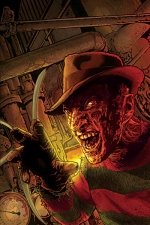
Sometimes you just don't know how good you've got it, 'till it's gone.
Case in point: The Avatar Press comic titles based on New Line's trinity of slasher icons.
In '05, Avatar Press, one of the many indie comic presses that thrives in the market niches un-served by Marvel or DC, started producing several mini-series and one-shots based on the Friday the 13th, Nightmare on Elm Street, and Texas Chainsaw Massacre franchises. These comics were, for the most part, pretty lame. I felt the writing was uninspired, the art sub par, and the scares non-existent. The TCM series, which I was most excited about, not only takes place in the revamped universe of the remake, but it suffers from the sameness that plagued the actual film series. How many times are we going to see this family kidnap a girl to add to the brood? The Nightmare books were less creative than the films that inspired them. Liberated from the necessity of having to actually produce dream sequences under the tight budgets of the films, the dream worlds in which Freddy lives and hunts should be more amazing than ever. Sadly, the thread of darkly joyous surrealism that ran through the film series was hardly on display in the comic. Only the Friday books really pushed the character – which is odd if you consider that, as a character, Jason offers perhaps the most limited dramatic range. A plot involving Jason taking on a paramilitary unit designed to capture and destroy him and a story which pitted the contemporary Jason against his futuristic Jason X counterpart were entertaining. Still, even these titles suffered from mediocre art.
What Avatar did do well was gore and the covers. The creators on the Avatar series were not afraid to spill blood and viscera by the bucket-loads. In fact, I would have to say that, in many ways, the gleefully sanguine manner in which these artists approached the destruction of their titles' supporting casts out-did the source movies. The covers, too, were exemplary. Each Avatar title came in several cover variants, almost all of which were wonderful portraits or action shots of Freddy, Jason, or Leatherface. In fact, if anybody from Avatar reads this, I would happily purchase a collection of just the covers. They were brilliant.
Overall, though, despite the bloody contents and the cool covers, I was actually excited to hear that New Line had dropped Avatar and, instead, licensed their legendary properties to DC comics. I hoped that DC would take these famous monsters of film land and actually make something truly worth reading out of them.
This week, the first issue of DC's new Nightmare on Elm Street series was published on their WildStorm imprint. The first ish makes me realize what a good thing we had goin' with Avatar. DC's Freddy is to Avatar's Freddy what post-Army Elvis was to pre-draft Elvis. DC's Freddy, while perhaps more polished, has been tamed. The story is, as far as Nightmare plots go, just serviceable. New kids come to town, one dies, the other learns about Freddy. Certainly, there is a level of genre "sameness" to slasher flicks, but the series that produced the "Dream Warriors" plot could give us something more creative than this. Perhaps worse, the gore is gone. We've got a body count of two. One girl gets the business end of Freddy's glove (off panel) and ends up in blood stained bedding. Another kid gets torched. Freddy ties him to a one-armed-bandit style school desk on top of a pile of books, pours gasoline on him, and then sets fire to him with a match. That's it. For a character in series known for constantly elevating the bizarreness of its methods of dispatch, the deaths in the Simpsons spoof of the Nightmare series were more creative.
In retrospect, even with the QC issues, Avatar's various creators brought an anarchic and disreputable joy to their work. Sure characters were under-drawn and backgrounds were, at best, impressionistic. But the split skulls, torn limbs, and flying guts were intense. Each issue of Avatar seems like it was rushed to get to the good stuff – the crazy, horrific celebration of all the stuff you're not supposed to see. Avatar's books were alive with a rebellious spirit that, while hell on the quality of the books, evoked the sort of maniacal, illegitimate, gory thrills that are the draw of the films. In contrast, DC's book plays it safe. It's a generic work meant to protect brands and sell a product. This new Nightmare might be about the marauding ghost of a pedophile child-killer, but trust me when I say that DC has taken great pains to ensure that nobody could possibly be offended by their Freddy.
Music critic Greil Marcus once said that the moment punk rock was no longer worth censoring, it wouldn't be worth listening to. The same is true of splatter horror. The moment slasher flicks aren't unnecessarily excessive, they aren't worth being afraid of.
Really, the only good that can come out of this is if we get something like a Batman versus the TCM family comic.
Thursday, October 05, 2006
Books: A two-for-one deal.
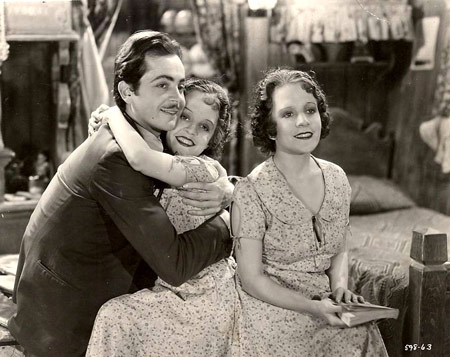
Though the famed conjoined twins, Daisy and Violet Hilton, only appear in Todd Browning's Freaks for about five minutes, they have one of the most memorable scenes. Violet (if you were facing the twins, Violet would have been on your left) is being romanced by the circus owner. Unfortunately, the footage that informed viewers that he's the circus owner was cut from the film. Consequently, his character just appears ex nihilo, giving the impression that he's some sort of fly-by-night lothario aiming to get something he can only chase when the circus is in town. As Violet and the owner pitch the woo, Daisy, whose character is married to a stuttering carnie who fights incessantly with her twin sister, ignores the couple and reads a book. Eventually, the owner moves in for a kiss and he and Violet commence to smootchin'. Daisy, without looking at her sister, suddenly looks up from her book and sits up straight. Then she closes her eyes and arches her back slightly. It is an uncanny but unmistakable image of carnal pleasure.
In a movie full of surreal, unusual, and often brutal imagery, that scene has always stuck out for me. Partially this is because the scene is one of the best moments of acting in a film filled with second-rate and non-professional film actors. Another reason it sticks out is that it is a typical auteur moment for Browning. The director liked to insert brief, evocative moments in his films where, for only a few seconds, the film completely focuses on a side character. Think of that strange hanging moment when Dwight Frye, as Renfield, crawls towards the fainted nurse in Dracula. That moment, a throwaway scene that is never even resolved, is one of the most frightening parts of that film. Finally, however, the main reason the scene sticks out in my mind is that the twins were one of the few "freak" performers who genuinely lit up the screen. Many of the freakish performers existed entirely as the embodiment of their freakishness. For example, Prince Randian, the armless and legless "Living Torso," is really a non-character. He exists in the film only to shock you with what he is. Randian is amazing, but the connection is shallow, immediate, and passing. It is this reductive gaze that critics of the film pick up on. There is something to the claim the film traffics in voyeuristic cruelty. However, the warm life the twins bring to the film shows the movie's approach to its title characters is more complicated than critics would suggest. The twins come off as stars. The film attempts to embrace their full and complex humanity. Unlike the Living Torso, we can imagine that they have lives, loves, and existence independent of the short scenes that grace.
Thanks to journalist Dean Jensen, we don't have to imagine their lives any longer. Jensen's Lives and Loves of Daisy and Violet Hilton: A True Story of Conjoined Twins is the first full-length biography of these two unusual stars.
Named after a highly fictionalized memoir the twins produced late in their lives, Jensen's story begins with their birth in Brighton, England. The off-spring of a single woman and a married man, the twins were left in the care of a barkeep and midwife who immediately began to display them to bar patrons. After tours in England and Australia, the twins came to America and made it big on the vaudeville circuit. Mercifully for the twins, they were produced as a genuine "act." The sisters were trained to dance, act, and play instruments. Though it was impossible to completely shake off the uncanny impact Daisy and Violet had on viewers, the fact that they were performing artists of no small talent helped elevate their act above the sideshow and make them respectable names on the vaudeville stage. As to twins rose in popularity, their "adoptive caretaker" sold them to a couple how kept the twins as virtual slaves. Fearing that unscheduled public appearances would diminish the twins' draw, they were confined to circus train cars or the vast estate their owners built out of the twins' earnings. All external communications were closely watched. Daisy and Violet were held as prisoners. Ultimately, their owners made a mistake and allowed the twins access to a lawyer. In a celebrated court case that grabbed national headlines, Daisy and Violet were emancipated.
Unfortunately, in many ways, their best years as a box office draw were behind them. Though they still toured and performed, the death of vaudeville and the increasing public distaste of "freak" acts took a heavy toll on the twins' popularity. They appeared in Freaks only to have that film become a legendary bomb. While Daisy and Violet actually agreed with many of the film's critics, the backlash against the film was an indication that their time as performers was passing. They went from lavish vaudeville settings to county fairs. From county fairs to drive-in movie theaters. What little of their fortune was left was blown on producing the truly horrible Chained for Life, a curious z-grade flick that Daisy and Violet delusionally believed would revive their careers. Finally, having squandered their hard-earned fortune and being unable to land gigs, they took a job in a grocery store. They couldn't even keep that gig: the often ill-tempered Violet insulted a customer and they were canned. A local church offered them rent-free housing, and it is in that house that the sisters died. Daisy went first. They think Violet might have held on for a couple of days, refusing to get help, determined to die still connected to her sister.
Jensen's book is a solid, well-researched work. The style is clean and lively in parts, but it never rises to the level of something you'd read for its own sake. Daisy and Violet are the draw here and it is the sheer tragic and frustrating oddity of their story that makes the book compelling. A good read for those interested in the twins, the vaudeville era, or in that strange jewel in the Universal monster-flick crown: Browning's Freaks.
Jensen's book is published by Ten Speed Press and is scheduled for release in November.
Wednesday, October 04, 2006
Comics: I never drink . . . bootleg hooch.

Some concepts are just so goofy, such bluntly designed vehicles for instant fanboy kicks, that they become cool. One of these concepts is pitting Dracula, vampire king of the damned, against Al Capone, king of Prohibition Era Chicago. And this is exactly what the somewhat un-creatively titled comic Dracula vs. Capone does.
The title pretty much says it all. In Chicago, the "Roaring" part of the Roaring Twenties refers mainly the fire of Thompson machine guns as Capone locks down the city. Fortunately for the good citizens of the Windy City, Capone's reign is not unchallenged. A new threat, in form of an upstart Treasury agent named Elliot Ness and his so-called "Untouchables" are giving Scarface some trouble. As the forces of organized crime and justice prepare to face off, a new player arrives on the scene. Dracula, reawakened by blood-tainted rain, comes back to life with a small army of thirsty vamps. The head blood-sucker plans to use the chaos and random bloodshed of Chicago to hide his efforts to re-establish his rule over the night. And with that bit of backstory, it's on.
Goofy? Sure. But goofy with a pedigree. Horror cinema used to be filled these bizarre mash-ups. Sherlock Holmes versus Satanic cults, Jesse James versus Dracula, any number of monsters versus one another. None of these pictures were, perhaps, cinematic gems, or even highlights of the horror genre. Though they were not without their place. These pictures were treats for genre film fans. Why treat horror lovers to just another werewolf film when you could have the Wolfman face off against Dracula and Frankenstein's monster, all in one film? Sadly, the death of the B-film has mostly ended this sort of silly, but flat-out fun sub-genre. With the exception of Jason versus Freddy and the lame VanHelsing, mash-ups seem to be a thing of the past.
At least, they are on the big screen. In comics, the hybridizing spirit is alive and well. Want to see Mark Twain and Tesla (the inventor, not the band) go up against Lovecraft's Elder Ones? Check out The Five Fists of Science. Can't decide between vampires and pirates? You don't have to with Sea of Red. Want to see Dracula take on the Silver Surfer? I can't imagine you did, but you can find that in Essentials: Tomb of Dracula. What is The League of Extraordinary Gentlemen but a giant mash-up? In fact, the efforts of folks like Moore have ensured that the comic mash-up has not only thrived, but gained a level of artistic respectability within the medium that the film variety never achieved.
That's a long way to go to say that the idea is not without precedent. And, if Dracula vs. Capone were just a fun throwaway in this long line of mash-ups, it would still be worth a peek. The art is effective and artist Chris Moreno uses color to great effect. The dark reds and inky blacks of the book are a pleasure. But, what makes it worth the full read is the care writer Jim Krueger takes with the story. The first issue is narrated by three different characters: Dracula, Capone, and Malone, the right-hand man of Ness. Like the original novel Dracula, these narrative voices tend to blend, but unlike the original, the comic uses what might be a failing to its advantage. By weaving in repeated images and motifs – Capone talks about the compulsion to drink, Malone discusses crime sucking the lifeblood of the city, both Capone and Dracula talk about ruling the underworld – the thoughts of the characters mingle into a tangle of metaphors that reflects again and again the themes of the books. The whole thing is better written than you'd expect.
The book is not perfect. In the rush to get Drac to the City of Broad Shoulders, Krueger and company rely on the narrative device that so much blood is being spilled in Chicago that it literally rains blood on Transylvania. An odd idea. The pacing is a bit off too. Stage managing the three-way confrontation between Capone, Ness, and Dracula means that readers are often run through scenes with no time to take in the details. For example, Frank Nitti appears, but his role in Capone's organization is never fully explained. (Not that there aren't some nice touches – in the space of a single frame, a tongue-tied accountant tries to warn Capone about his finances, but Capone's throwing one of his famously violent fits and scares off his one chance to avoid prison.)
Overall, though, these little things are overlooked. Dracula vs. Capone is good stuff. It might not rise to Moore-ish levels of literary pretension, but it is an effective genre fusion and worth the cover price.
Monday, October 02, 2006
Music: Keepin' it under wraps with The Mummies.
Formed in '88 for the purpose of playing loud, trashy, grade-A garage rock, The Mummies delivered their retro-rock meets noise-assault tunes with the help of an instantly recognizable shtick: they played in full-body suits that made them look like they were wrapped from head-to-toe in bandages. Check out this clip of The Mummies in action below.
Sadly, the boys in bandages threw in the towel back in '92. They've come out of retirement twice before, but the best way to check out the band is on their handful of albums. Mercifully, for the new fan, The Mummies, who played on vintage instruments and recorded only on vinyl when they were a group, have gotten over their legendary loathing of digital technology. You can now get their last album Never Been Caught and their singles collection Death by Unga Bunga!! on CD.
Special Mummified Bonus: here's a clip of the The Mummies rocking away on Devo's "Uncontrollable Urge."
Sadly, the boys in bandages threw in the towel back in '92. They've come out of retirement twice before, but the best way to check out the band is on their handful of albums. Mercifully, for the new fan, The Mummies, who played on vintage instruments and recorded only on vinyl when they were a group, have gotten over their legendary loathing of digital technology. You can now get their last album Never Been Caught and their singles collection Death by Unga Bunga!! on CD.
Special Mummified Bonus: here's a clip of the The Mummies rocking away on Devo's "Uncontrollable Urge."
Sunday, October 01, 2006
Movies: It's a reverse twist.
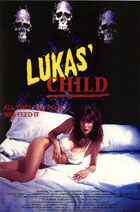
In his fake autobiography, Et Tu, Babe?, author Mark Leyner imagines a legal system where the punishment for non-capital federal offenses is forced viewing of hardcore porn with all the sex cut out. I imagine that, in Leyner's alternate universe, people who tamper with the mail or remove the tags off pillows have to watch the film Lukas' Child or Night Beast.
First, a word about the double title. The first title, which sounds more like a Suzanne Vega title and less like a horror flick, appears on the packaging for the DVD. This film is the first feature in the 10 film Brentwood Curse of the Dead box. The latter title, more traditionally cheese-horror, appears in the credit sequence of the movie itself. Use whichever makes you happiest for, just as a rose by any other name smells just as sweet, this movie is a clunker no matter what we call it.
Lukas' Child opens with a several masked and robed characters gathering for a Satanic ritual. If this film is to be believed, Satanic rituals mostly involve men in rubber Halloween masks watching a basement-grade stripper run though what she imagines the dance of the seven veils might have looked like – that is, over course, if Salomé wore a fishnet catsuit and did a lot of bump and grind moves. After five minutes of this (which, while not family-friendly perhaps, doesn't seem particularly sinister) we meet the first half of the title, Lukas Armand. Armand is pasty faced, incomprehensible, sometimes ambulatory, sometimes wheelchair bound movie producer who spends a considerable amount of the film looking confused and slightly senile. Often, he'll even deliver lines and then, as if remembering that he is, in fact, the villain of the picture, then contradict them: "You're free to go dear. Oh, wait. I'm sorry. I mean, you can never leave."
Armand, as it turns out, has been auditioning wannabe starlets and, instead of offering them film roles, has been feeding them to his "child." The "actresses" audition for a role in a horror movie. Lukas' assistant explains, "It's about good versus evil. Only in this case, evil wins. It's a reverse twist." A tsiwt, if you will.
Anyway, the actresses give their addresses to the studio, thinking that the studio is sending over a script. Instead, Armand dispatches his son, Jason, and his Mohawk sporting amigo, Maddog, to kidnap the actresses. The "child," we learn is this demonic looking thing that, apparently, can only eat women in skimpy undergarments. Whether this creature is a genuine demon from Hell or, as Lukas as one point suggests, is just a freakishly mutated human is never definitively decided.
Even in L.A., you can only disappear so many talentless actresses before somebody notices. In this case, that somebody is an Elvis-loving detective named, honestly, who cares? The Detective is enough. Although, even this gives the film too much credit. Several of the establishing shots indicate that the Detective is a member of the LAPD. However, about half way through the film, establishing shots suggest that he is a bail bonds agent. The latter makes no sense whatsoever, so we're going to just imagine that the film was unambiguous about the fact that he's a LAPD detective. Unfortunately for the under-talented actress community, despite the keen deductive skills the Detective brings to the case, he's stumped. The Detective's investigation consists mostly of getting buxom witnesses to strip down for him. Ultimately, it will be a couple of completely nameless children who just happen, inexplicably, to spend their late evening hours spying on the Satanic cult, who report the whole thing to the Detective.
The Detective manages to roll off of the endless stream of naked, but not really hot, witnesses long enough to investigate this lead. Will he stop this mad cult from depopulating Los Angeles of painfully untalented actresses? Do we want him to?
This film is utter crap. Only the cult leader, who looks like a slightly less sweaty Larry Flynt and often speaks in a sort of stream of nonsense world salad that would appeal Alfred Jarry, is an interesting element. The special effects are sub-special and the child, though he looks charmingly old school (little bat wings, small horns, like something out of an old mediaeval manuscript – only, you know, not good), moves so slowly that it takes him several minutes to trap women who are locked in a small cell with him. Avoid this stinker at all costs. Using my traditional Stations of the Monterrey Metro system of film rating, this flick doesn't even rate a single Del Golfo.
Subscribe to:
Posts (Atom)