She writes articles on fashion history and culture on her own blog, Thread for Thought, but is just as comfortable discussing what makes the sleazy Brit serial killer pic "10 Rillington Place" so pleasingly cynical. She's just as insightful about the 1936 Soviet anti-American propaganda comedy musical "Circus" as she is about the work of John Waters.
Plus, she allegedly made out with a one-legged French sailor once. Allegedly.
All this meant that, when I decided I was going to look for voices outside the horror blog world to include in this series, she was immediately on the short list of people to ask. I'm very happy she could contribute and very excited to introduce her on ANTSS.
Occasionally fancying myself an exotic woman of mystery too, I have a special place in my heart for that early 20th century icon, The Vamp. When my friend suggested I write about them, I welcomed the opportunity to revisit some silent films when this aesthetic was solidified in concept and look.
THEDA BARA & THE LURE OF THE EXOTIC
Though Theda Bara (1890 – 1955) enshrouded her adult life in mystery, she was born plain old Theodosia Goodman in Cincinnati, OH. Hollywood producers gave her the anagram of “Arab death,” on the one hand cultivating her image of smoky, exotic sensualism -- claiming she lit incense on her sets and swathed herself in tiger pelts -- and on the other hand, hyping the macabre and frightening side of her.

The vamp image, incorporating the requisite sex and death themes.
Most recognize the term "vamp" to mean a femme fatale -- an irresistible woman who leads to the destruction of those who surround her, typically men. But the term was initially coined only after the success of Theda Bara's single surviving film, A Fool There Was (1915), in which her gleefully man-destroying character is listed in the credits simply as “The Vampire.” Based on Rudyard Kipling's poem “The Vampire” (1897) and Sir Edward Burne-Jones' painting of the same name (1897); the visual inspiration is obvious:

Sir Edward Burne-Jones's "The Vampire"
In A Fool There Was, The Vampire is seen in her nightgown several times, casting a spectral quality over her. Opaque and voluminous, they are not lingerie we are accustomed to today, but were risqué for the time, obviously derived from Burne-Jones's sex-laden picture.

The Vampire grinning over her dead lover.
When wearing outerwear, The Vampire wore the amusingly impractical (and thankfully short-lived) hobble skirt, topped with exotic turbans and heavily kohled eyes. To seduce her victim she drops a flower and lifts her skirt to reveal her ankle -- she is unashamed to show blatantly erotic skin.
What differentiated Theda from other actresses of her time was her other-worldliness, which she cultivated with her Oriental aesthetics. The horror genre is filled with tales of distant or remote lands; the audience's presumed unfamiliarity with the locale makes the fantastic tales slightly more plausible; the storyteller prays on the public's inherent mistrust and simultaneous attraction to the exotic, The Other. Though the most exotic location in A Fool There Was was Italy (puzzingly portrayed as a palm tree paradise more suggestive of the Far East), The Vampire produces a non-specific and highly erotic exoticism. Not a tremendous actor, it was largely Theda's unusual costumes and makeup on and off-screen that enshrouded her in Oriental mystique and secured her notoriety.
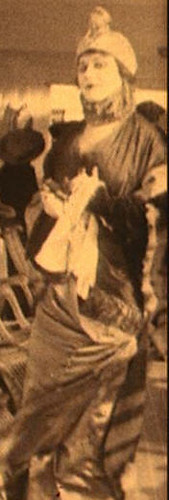
Theda Bara in hobble skirt and turban ensemble
Promises of harem girls with all the connotations of master / slave dynamics and orgies have been irrevocably linked to soft, sheer, feminine fabrics that simultaneously cover and reveal forbidden flesh (see my post on Innerwear as Outerwear on this subject). Seemingly anticipating the Egyptian madness that occurred after the 1922 discovery of King Tutankhamun’s tomb, the Far East captivated the imagination of the Western world. Designer Paul Poiret (1879 - 1944) made his mark on the fashion world by morphing the 19th century S-shape silhouette into un-corseted, athletic figures, and he incorporated many lose-fitting, Oriental-inspired designs to this end including harem pants, “formal” silk pajamas, and turbans. Poiret designed extravagant costumes for stage productions, hosted legendary Arabian-themed costume parties, his fondness for theatrical-scale dress-up evident in the fashions he produced for general consumption.
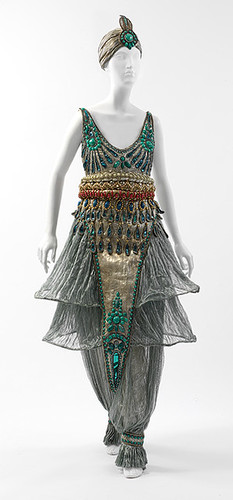
Paul Poiret, harem ensemble, 1911
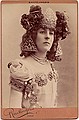
Even earlier was Emilienne d’Alençon (1869 – 1946) who performed at the Folies Bergères in the 1890s (with trained rabbits!) and was just as famous a courtesan, who wore an Art Nouveau inspired Salome costumes:
The Ballet Russes' performance of “Schéhérazade” in 1910 was enormously successful, due in large part to the extravagant costumes of vague eastern inspiration:
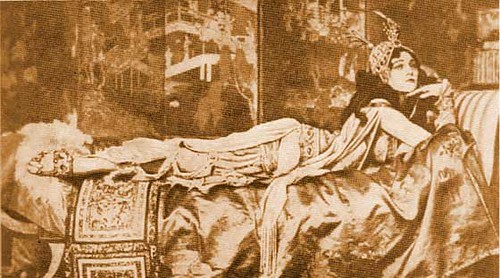
Ida Rubinstein in Ballet Russe "Scheherazade," 1910
Erte, who worked with Poiret and with whom I am obsessed, was yet another costume designer who marketed sensual Oriental decadence for lavish stage productions.

Erte Fashion Sketch with turban and harem pants
Mata Hari (1876 – 1917), the exotic Orientalist dancer of Dutch descent who posed as princess from Java while acting as courtesan and spy, was executed by firing squad just 2 years after A Fool There Was. Rumor has it that she blew a kiss to her executioners.
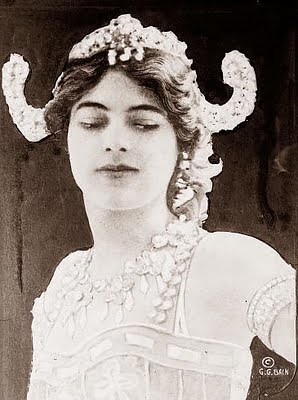
Mata Hari
Similar to our Theda Bara, non?
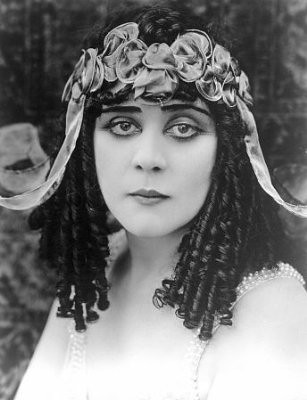
Theda Bara publicity shot for Cleopatra (1917)
Theda tapped into a cultural obsession with styles of the Far East, while exploiting the unease and xenophobia that often accompanies our regard of The Other, rolling it all into a destructive, man-eating "vampire" character. The Vamp concept was to evolve, though never to shake the ruinous qualities Theda imbued in her.
LOUISE BROOKS & MODERN ADVANCEMENTS
As Theda's star waned, a new Vamp talent stepped up: Louise Brooks (1906 - 1985). If Theda was the vaguely ancient, exotic vamp, Louise was her modern flapper vamp successor. As women's rights gained momentum in America, a powerful new woman emerged, wearing visible makeup as she walked to the voting polls, smoking and drinking and dancing in shift dresses that bared shins! Even as many women embraced this freedom, societal concerns of propriety remained and moralist detractors prophesized of hedonistic anarchy. Dress also changed radically in the nineteen-teens, with fewer layers that a woman could slip into (and out of!), exposing more skin than ever. And so Louise Brooks was a very different looking vamp from Theda, even while her characters carried the torch of man destroyer.
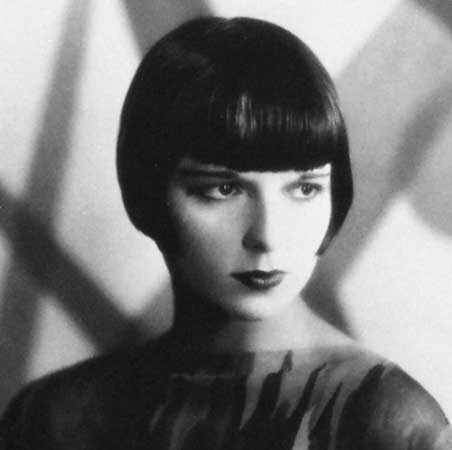
Louise Brooks, 1928
Pandora's Box (1929) was adapted from 2 erotic plays written in the 1890s by Frank Wedekind, but updated to modern times. As many young women cut their cumbersome long hair, Brooks as the Lulu character sports her own iconic, modern bob and wears clothes un-constrictive enough that she can do light gymnastics (like swing from a strongman's biceps), hinting at the newly acceptable athleticism for women (see my post on Athletic Aesthetics). The erotic zones had shifted and multiplied since Theda Bara’s time, moving from the ankle to the shoulders, back, legs, and breasts which were often displayed braless.

Lulu appears practically naked in this Y backstrap dress.
Having become a somewhat accidental murderess, Lulu goes into hiding and curls the famous hair, sweeping it off her forehead. Ridiculous as it sounds, Brooks' hairstyle was so recognizable that this shoddy disguise actually succeeds in confusing the audience a little, though Lulu is discovered anyway.
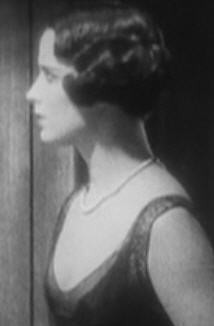
Lulu is a dangerous vamp not because she's dark, controlling and malicious, but because she's a beautiful young woman whose very power is derived from her lack of pretension and seeming ignorance of her own sexual potency, her delicious un-self-conciousness. One-upping Bara's Vampire, Lulu was a double threat desired by both men and women, so potent was her sexual power. The Pandora of the Greek myth was not an inherently evil woman, just one whose curiosity got the better of her, with unfortunately dire consequences. Lulu is not even interested in money or advancing her social status -- she shows equal preference for newspaper moguls and paupers, all of whom are trying to exploit her. However, she shares with other vamps her unrepentantance for acts that inconvenience or even destroy others and herself -- they are all animalistic, with no regrets.
She’s an unusual vamp fatale because she doesn’t have malicious intent. “Money, they all want money!” she complains of her blackmailers and suiters alike. She's not a gold-digger, she's simply a careless and carefree pleasure-seeker -- exactly what conservatives feared about real-life flappers and, by extension, the women's movement.
RESURRECTION OF THE VAMP
Since these early 20th century beginnings, the vamp has been resurrected in film and fashion many times. Blood sucking, literal and figurative, has unavoidably sexual connotations, and fetish gear has both influenced and been influenced by vamp(ire) lore. Fashion photographer Helmut Newton channels the sexy and macabre themes of bondage and female sexual power regularly. Even as women expose themselves in his photos, they seem to retain absolute authority over their settings:

Helmut Newton photo, c. 1990s
Impulse control is often explored in times of economic or political turmoil. True to point, there has been a rash of vampire productions recently including Twilight and the True Blood HBO series, but truth be told, I much prefer the original vamps!
Further Reading:
- Fashion, Desire and Anxiety, Rebecca Arnold
- Fashion Fetishism, David Kunzle
- Fetish: Fashion, Sex & Power, Valerie Steele
- Seduction: A Celebration of Sensual Style, Caroline Cox
- “The Girl in the Black Helmut,” Kenneth Tynan