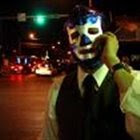
By way of a preview, here's the entire first chapter of Joe Hill's upcoming novel:
Ignatius William Perrish spent the night drunk and doing terrible things. He woke the morning with a headache, put his hands to his temples, and felt something unfamiliar, a pair of knobby pointed protuberances. He was so ill - wet-eyed and weak - he didn't think anything of it at first, was too hungover for thinking or worry.
But when he was swaying above the toilet, he glanced at himself in the mirror over the sink and saw he had grown horns while he slept. He lurched in surprise, and for the second time in twelve hours he pissed on his feet.
End of chapter one.
Friday, December 04, 2009

Thursday, December 03, 2009
Over There: Horror films and the War in Afghanistan - Part 2: Red Sands.
 The only one of the three current horror films set in the American Afghanistan conflict to actually have filmed in Afghanistan (Kabul, Afghanistan, specifically), Red Sands may have the curious distinction of not only being among the first horror films to be set on the front lines of an on-going conflict, but the added distinction of featuring footage of the country we're fighting in. Imagine a Nazi zombie film that had been shot in Germany when Nazis could have still shot you. It would be easy to make too much of this odd fact. Most of the film was shot in California. Still, historically, it's a first as far as I can tell.
Red Sands is the second stop on our tour of one of the oddest mini-genre to have developed in this particularly tumultuous era of horror: the first American horror films set on the frontlines of an on-going U.S. military conflict.
Without recapping too much of the first installment of this mini-series, the short version of the story goes like this: Horror films are usually Johnny-on-the-spot when it comes to spinning cultural anxieties into filthy lucre, but live-fire wars seem to be the exception. Horror films tend to touch on such conflicts in passing (example: Jacob's Ladder features a shell shocked 'Nam vet after he's returned home) or be influenced by such conflicts (example: some critics have suggested that the slasher formula was influenced by the tedium-then-ambush structure of the Vietnam War), but there are few, if any, American horror films made prior to 2008 that are set in a conflict that is currently popping off. In short, when bodies are actually being shipped home, we don’t tend to invent fantastical reasons that more should corpses should be on the plane.
The current Iraq War seems to follow this pattern. There are several dramatic and action genre flicks that are set in the Iraq War, but no horror films. Arguably, many films have been influenced by the war - some critics have suggested the entire alleged genre of "torture porn" is little more than a symptom of the conflict - but none have featured, say, a unit attacked by ghostly Saddam torture victims in a haunted mansion in Baghdad.Though, for some reason, the War in Afghanistan has broken this rule. In 2008 and 2009, at least three horror films have been set on the front lines of the War in Afghanistan. Questions of artistic merit aside, these three films represent something genuinely new in the horror genre. As such, I think they merit our attention.
Helmed by Alex Turner, the sadly under-appreciated director of 2004's Dead Birds, Red Sands is essentially one giant flashback. We open on a soldier being questioned about a fiasco in the wild hill country of Afghanistan. Seven troops were sent on a mission and all of them died but one. And his story just don't add up.
Credits. Start movie.
We start with a squad of seven troops. They're pretty familiar types: We’ve got a Rock (tough-as-nails sergeant) who later becomes a Hudson (he loses it late in the game), a Tori Montroc (idealist sent to the army by his upper class parents), a Vig (the racist lughead – this particular model happens to be a Southern dude who sports a Confederate battle flag on his helmet), a Fodder (who, oddly, in this flick is obsessed with obscure and most likely imaginary sexual activities of the donkey punch variety), a Bozz (a self-oriented barracks lawyer type), and a Sassoon (the bespectacled translator). Sadly, we're once again short a Brooklyn.
This band o' brothers' latest mission is to monitor a lonely stretch of desert road – well more like a flat wasteland with pretentions to roadness - for potential Taliban activity and, if necessary, engage the enemy. On their way to their new post, these proud few nearly drive over a landmine. They get separated from the rest of their convoy and end up stumbling upon an ancient idol depicting a djinn (or, as most of us say it, genie). The squad's interpreter informs the other soldiers that this genie isn’t a big blue dude who’s here to grant wish and drop one-liners. Instead, it is a shape-shifting creature driven to kill by its limitless, murderous hatred of humanity. The fact that djinn get so killy when left on their own is the reason they get trapped in things like bottles or, oh, I don't know, ancient idols. Like the one our proud few are standing in front of.
Not all the soldiers are immediately convinced that they're dealing profound supernatural forces beyond the reckoning of their feeble modern logic, and they discuss what should be done with the idol. Though none of them could be considered "true believers," they rapidly reach a consensus that there’s no point in needlessly tempting fate. They decide to leave the area immediately and tell nobody of their discovery.
Just kidding. The unreconstructed jackass with the Reb flag on his helmet shoots it to bits.
Jump to: House in the middle o' nowhere.
Our boys arrive off at a small, partially destroyed stone house facing a desolate stretch of sand, rock, and desert brush. This is the not-really-a-road they're supposed to monitor. Or, at least, they decide it must be because they don't find any more road-like features around them. The soldiers explore the house and find a quartet of singed corpses – victims of white phosphorous bombing – that they promptly bury.
Before you can say R-Point, the soldiers are receiving cryptic radio messages and getting weird visions. A massive sandstorm drives them indoors and brings them a mysterious visitor: a young woman wearing traditional garb and speaking a language even the translator doesn’t recognize (it's Aramaic, according to the "making of" featurettes). Soon, their transport is sabotaged and squad solidarity begins to crack under the strain. The situation gets no better when soldiers start disappearing.
A haunted house story in desert camo, Red Sands closely resembles Turner's Dead Birds, which featured an armed gang of Reconstruction Era bank robbers hiding out in a haunted plantation. Unlike that film, however, it lacks the baroque backstory that gave Birds its epic sense of the uncanny. This is both a blessing and a curse. Without a sense of mystery to build on, Sands slow burn approach to the scares feels like an unwise pacing choice. Turner tries to make a leaner, meaner genre machine, but fails on the leaner part. On the plus side, the stock frame lets Turner trick his film out with elements he's picked up from his study of other genre works. Indeed, the pleasures of Red don’t lie in the originality of its conceits, but in the clever application of the directors inspirations. Unlike the stylistically inert visual presentation of Sand Serpents, Red borrows the washed out, sun-blasted palate of Three Kings (complete with caption intros for the troopers). An obvious move perhaps, but appropriate and effective. The soldiers are built almost entirely out of stock parts, but their dialogue snaps and the actors suitably embody their roles. Furthermore, Turner encourages a Hawksian improvisational liveliness to their interactions that gives them an charge. Sands seems less daring and original than Dead Birds, but it is work of a man with a good eye for what works and discerning taste. On those terms, Red Sands is a more modest, but still thoroughly pleasurable success.
As a document of the war, Red Sands is a curious beast. Despite being the only film of the trio on our list to actually include footage from Afghanistan, it seems the most removed from the conflict itself. The Taliban, the ostensible reason for the soldiers' mission, never make an appearance. We witness one extended gun battle in a flashback (within the extended flashback), thought that appears to occur between two groups of US troops firing on one another in a panic. The only other combat occurs between our protagonists or between them and the djinn. Aside from a short intro, the only interactions with Afghan civilians are disasters: We see the remains of a family that’s been roasted alive by US bombs and witness a military arrest that goes sour and ends with the death of a small child. The movie's relentless centered on the American protagonists, but not in a jingoistc or egocentric way. Instead, the US presence is depicted as a sort of giant beast, so powerful that it can touch nothing, observe nothing, affect nothing without leaving destruction in its wake. It's a problem of scale, not ethics. With the exception of Johnny Reb (and the later Ahabing staff sergeant), the soldiers are presently as flawed, but basically good human beings. But they can't do anything right because the only way they have to interact with the world inevitably breaks it. Curiously, this both parallels and contrasts with djinn. The conflict between the soldiers and the evil genie is just as one-sided as any of the conflicts between the soldiers and the Afghan land they stomp through. But where the Afghans face a particularly fatal form of blundering, the djinn is deliberately bloodthirsty (and no respecter of national or political allegiance – it's an equally opportunity killer of Americans and Afghans).
The lack of context brings up a sort of chicken-egg question with regards to the films liberal borrowings and allusions. Is Red Sands‘s context of no context an unintentional product of Turner’s extensive mirroring of other pop genre works? Or did he deliberately sever the flick from its historical moment, by design or indifference? Deliberate or not, the result suggest to the viewer that, as Julio Cortázar once said of fires, "all wars are one war." No matter who is fighting, or what the fighting occurs, or what people say they’re fighting about, it’s always just a slaughter of the weak by the strong. Like the djinn of the flick, the particulars might shift and change, but its murderous essence stays the same. It's always a horrorshow.
Monday, November 30, 2009
Movies: Wu of the Dead.
 Though extensive work has gone into unearthing Christian symbolism in zombie narratives, here's a less analyzed Black Muslim take on Romero's Of the Dead franchise. From the RZA's new book, The Tao of Wu:
When I first saw Night of the Living Dead, I was scared to death. But when I watched it again at the age of sixteen (when they were up to Day of the Dead), I'd gotten knowledge of myself, and could relate to what it was saying about America. The dead were alive, but they were blind, deaf, and dumb. So to me, they were symbolic of black men in America.
The dead in those movies are alive- that's just a description of physical matter, it's active - but they don't have life. Life comes when you have knowledge, wisdom, and understanding, when you can see for real, touch and feel for real, know for real. Then you are truly living.
Finally, all the Of Dead films work as metaphors for the Five Percent [The Nation of Gods and Earths, also known as Five-Percent Nation of Islam - CRwM]. The survivors are holdouts living among the mentally dead. And interestingly, they tend to be led by black men. At the same time, though, after the black man survives - he fights off destruction through the whole movie - a white man kills him.
Though factually wobbly at the end there - the black protags survive Dawn and Day - the analogy actually works far better for me than efforts to fit Romero's flicks into a Christian framework. The origin of the Five-Percent name stems from their belief (and this is a profound simplification) that 85% of humanity are blind to knowledge of themselves; 10% understand some of the divine knowledge needed to be fully realized humans, but ignore or lie about this knowledge for personal gain (notably, Christian preachers and scholars who teach about an incorporeal, or "mystery," God to advance their own political agendas - left and right); and a final 5% who understand and spread the truth, known as poor righteous teachers. The idea of a tiny, fully alive and self aware minority surrounded by a globe of the half-alive fits like a glove with Romero's flicks.
I wonder what insights Buddhists, more mainstream Muslims, and other non-Christian religious peoples could bring to the table.
Sunday, November 29, 2009
Over There: Horror films and the War in Afghanistan - Part 1: Sand Serpents.
 American horror cinema is nimble. Surprisingly so given its dependence on genre formulas and the genre fans' insatiable appetite for re-heated leftovers. Despite the antiquity of many of the genre's most beloved tropes - the specters that haunt modern day-traders and their spiritually besieged girlfriends are fundamentally the same beasties that spooked our preliterate ancestors thousands of years ago - horror cinema is quick to assimilate our latest fears and anxieties. From genuine threats, like nuclear weaponry, to passing fancies, like the 2012 "prophecy," anything that makes us antsy is just waiting for an enterprising low-budget filmmaker to give it the fright flick treatment. The ambulance chaser of our psychic landscape, horror's often the first on the scene of any disaster, ready to help us frame up our latest fears and happy to make a buck or two doing so.
Wars would seem to be an exception to this. During the Second World War, Hollywood kept the homefront eager for slaughter by filling theaters with hundreds of patriotic flicks featuring our fighting men and women in action. Yet surprisingly few horror films made in that period - 1941 to 1945 - overtly mention the war and none are set on the frontlines or featured characters directly involved in fighting. Certainly there were exceptions to this rule: King of the Zombies and Revenge of the Zombies (1941 and 1943) feature Nazi zombie makers, 1942's Black Dragons has surgically altered Japanese saboteurs as the baddies, Dark Waters (1944) includes a torpedoed passenger ship as a backstory plot point, and Return of the Vampire (1944) is set in London and features regular blackouts and bombing raids (and the vamp baddie, in a remarkable example of good taste, poses as a Jewish refugee from Eastern Europe). But none of the era's classics - The Wolf Man, Cat People, I Walked with a Zombie, The Uninvited, The Body Snatcher, and Isle of the Dead, not to mention the sub-classic, but still beloved, late entries into Universal's Dracula and Frankenstein franchises - seriously engage with what must have unquestionably been the single greatest source of anxiety for American film-goers.
The same can be said of Vietnam. Though the "crazy vet" character quickly became a stock character (courtesy of Bob Clark's Dead of Night and other films), Vietnam War era horror flicks that are linked with the war in the critical imagination are usually thought of as metaphorical commentaries on the war era or as products of the cultural wreckage the war caused. For example, many cite the grim, relentless tone and naturalistic visual style of Last House on the Left as a product of Vietnam, but its source material is older and the film is not objectively about the conflict. Even after the war, references to the conflict were usually oblique: Piranha and CHUD (1978 and 1984) feature bio-weapons intended for use against Charlie turning against Americans, House and Jacob's Ladder (1986 and 1990) feature 'Nam vets who are literally haunted by their past, and one could make the case that the unidentified sliver of South American jungle in Predator (1987) is really just a stand-in for the jungles of Vietnam. There must be, in the vast spread of horror flicks, some flick that features soldiers in the Vietnam War coming up against monsters and spooks, but to date America has yet produce a horror film set in the Vietnam War that has the equivalent status of R-Point (2004), South Korea's box office hit spookshow about Korean soldiers battling for their lives inside a haunted abandoned Vietnamese hospital.
Perhaps the magnitude of war simply dwarfs he ability of horror filmmaker to contain it meaningfully in tried and true horror frameworks. Compared with the brutal acts of warfare, their own quiver of spookshow tricks just don't measure up. The savagery of, say, My Lai starkly reminds of how silly and harmless most of cherished horror tropes are. More cynically, perhaps the filmmakers know that their monsters and madmen slashers are the stars of the show and putting their commodity in a setting where their killing prowess would suddenly look bush league is bad for protecting brand identity.
Regardless of the reason, American horror cinema, which is otherwise quick to exploit timely preoccupations, has long avoided setting movies in a on-going conflict. It is noteworthy, then, that the War in Afghanistan is the setting of no fewer than three horror films in the past two years. The Iraq War, true to American horror tradition, remains predominantly an influence and allusion. While drama and action filmmakers have had little compunction (and, notably, little success) about tackling the war head-on, horror filmmakers have mostly kept their distance. Where it has been the direct subject of a horror flick - Joe Dante's truly execrable Homecoming - the film has focused on the homefront impact of the war and the machinations of the administration who lied their way into the conflict. But, for some reason, filmmakers have decided that the on-going conflict in Afghanistan is ripe for horror genre exploitation. In 2008, Daniel Myrick, of Blair Witch fame, helmed The Objective, a supernatural thriller involving a squad of soldiers on the hunt for Bin Laden. The next year, Red Sands and Sand Serpents streeted, each featuring U.S. troops battling monstrous threats in the Afghanistan hinterlands.
We'll start this tour of this unique subgenre of modern horror with the Syfy fodder Sand Serpents for no other reason than that happened to be the first flick that came in the mail from Netflix. In what might be one of the strangest business strategies ever, Syfy has apparently decided that it is going to corner the market on "it's a lazy Saturday afternoon and finding the remote would be harder than sitting through this movie" films. Sand Serpents is a slightly above average component of Syfy's vast plan to conquer that crucial 18 through 35 lazy-and-can't-find-remote demographic. Directed by Jeff Renfroe (who apparently knows that his involvement as the editor of Anvil! The Story of Anvil means he need not produce anything else of last quality to secure his place in film history), Sand Serpents follows the misadventures of a small squad of Marines who are sent to recon an unused sapphire mine. To save time, screenwriter Raul Inglis (best known for his cartoon scripts and the narrative interludes in the video game Marvel Nemesis: Rise of the Imperfects) rolled out his characters from a NPC random encounter generator in the Twilight 2000 rulebook. We've got all the classics here: There's the bespectacled intellectual (the Sassoon), the rough-edged soldier who's in Marines because of a "hometown jam" (the Springsteen), the green recruit leader who must earn the respect of his men (the Tori Montroc), the tough as nails sergeant (the Rock), the racist lughead (the Vig), the guy whose always got a bad feeling about this mission (the Lemchek), and the outsider specialist (the Ripley). There's also some cannon fodder (the Fodder). Despite his apparent comfort with cliché, Inglis forgets to include the loyal native (the Benny Fish), the dude who loses his shit (the Hudson), or the guy from Brooklyn (the Brooklyn). Whether this is because Inglis is tired of these particular types or due to the fickle nature of Twilight 2000 NPC generator, I don't profess to know.
After some efficient backstory setting up their mission parameters, our troops march almost immediately into an ambush. They are overwhelmed by Taliban forces and those that survive the initial attack, about five out of the initial seven, are prepped for videotapped beheadings. This scene gives us a hint of why many filmmakers hesitate to set their monster pics in a live-fire war: Nothing that follows in the movie has quite the tension of watching seven bound and blindfolded soldiers beg for fruitlessly beg for their lives. Ultimately, the soldiers are spared. As it turns out, the ambush above the mine sent tremors deep through the mine structure, awakening massive three, maybe four gigantic sand worms - several stories tall, with a mouth roughly the size of the Holland Tunnel - from their slumber. The sand worms breach the surface with the force of a small earthquake, sending the Taliban soldiers out to see what the heck is up. They are, to say the least, unprepared to deal with the sand serpents and quickly become serpent chow.
Spared the serpent's immediate onslaught, the Marines slip their bonds and regroup. Their movement arouses the ever-peckish titular monstrosities and, after the beasties whittle the number of Marines down slightly, the Marines ponder just how to make it back to base when any movement on their part brings serpentish attention.
The Marines eventually break for a nearby refugee camp. Built on the remains of what appears to be a bombed out brace of block houses, the concrete rubble foundation of the refugee camp serves as a deterrent to serpenty predations. There the team meets Amal and his daughter Asala, two refugees who are willing to to help the Marines if the Marines agree to take them out of the Taliban controlled region. The Marines and the refugees hatch a plan that involves a mad endgame return to the serpent infested mine and call for evac. It's not a utterly crap plan, but you could count the numbers who survive it on a single hand. And not even your single hand, but the hand of a dude who had one of those horrible woodshop accidents they warned you about in high school.
From a strictly horror-fan perspective, Sand Serpents may just squeeze into the the middling territory. With none of the aw-shucks wit and charm of Tremors or raw power of Aliens, its two nearest cinematic predecessors, it comes off as a unoffensive, by the numbers run-and-gun. Relatively speaking, the effects are top notch for a Syfy production. But that's relatively speaking. While this film puts The Snakehead Horror to shame, it's a stain on the shorts of Cloverfield. That said, there is an odd charm in watching the lengths the filmmakers will go to in order to avoid showing the sand serpents. In fact, the film depends on the fact that we most often register their presence solely by the panic reactions of our protags: We've see that the serpents are big enough and fast enough to snatch Blackhawk choppers (or the Syfy-budget equivalents thereof) out of the air, so seeing them on screen in most scenes would just make us wonder why they don't snatch our unlucky heroes up.
As an artifact of the Afghan War era, there are two major points of interest. First, there's the characters of Amal and Asala. During an extend sequence in which the Marines use the mines to escape - apparently the rock the mines cut through to to thick for the meddlesome beasties - the up-to-then trustworthy father and daughter duo have a weird exchange. The father starts to head down a mine and then, after some consideration, changes his mind and directs the Marines down a different shaft. His daughter then intervenes and says that they are headed in the wrong direction. Amal ignores her and maintains his stance. Now, eventually, the Marines pop out of the mines and there are Taliban crawling all over the area. But, before they surface, there's a whole scene in which a sand serpent chases them around the mines, pretty much messing up any chance we'd have to know if the Marines ended up where they were being directed. Was Amal leading them into a trap? Did he start to, change his mind, and then get pressured by his child to carry out the plan? Honestly, I'm a bit hesitant to not put this all down as a product of sloppy writing. To believe that Amal or Asala was leading the Marines into a trap would require we believe that the Taliban plant two people in a refugee camp they had no reason to believe the Marines would go to. They would then assume that the Marine would agree to travel through the mines, though they didn't know about the serpents (which had eaten every last one of the first Taliban squad) which was the only reason the Marines had to travel by mine shaft. Still, the impression you get while watching it is one of potential betrayal, never fully resolved. Where we betrayed? Do we even understand enough to know if we have or haven't been betrayed? While far from the overt racism of Pvt. Jackass, the squads resident spokesman for ethnic hatred, it speaks to a more subtle unease about whether we truly have allies, even when our best interest coincide.
Even more interesting than than the nuanced unease about our Afghan allies is the bizarre final scene of the flick. In the last moment, the remaining two Marines and Asala, the potentially traitorous Afghan girl, lift off in a chopper. Suddenly, a sand serpent rears out of the surface and lunges toward the helicopter. One of the Marines, wearing a confiscated suicide bomber belt of explosives, leaps into the maw of the beast. He detonates, saving the last Marine and the little girl. Watching this, I couldn't help but be reminded of a truly odd essay by Sunny Singh called In Praise of the Delinquent Hero, or How Hollywood Creates Terrorists. It's long been a curiosity among anti-terrorism experts that terrorist seem fascinated by American genre cinema. Terrorists often select their nom de guerres from American action cinema lore. When NYPD anti-terror agents unravelled a plot to destroy the Brooklyn Bridge, they found that they terrorists referred to the famous landmark as "the Godzilla bridge," an allusion to the '98 Emmerich flick (not only do they want us dead, their taste in films is horrific). Indian essayist Singh suggests that the connection runs deeper than average pop fandom. She suggest that genre cinema has given terrorists the mental justification they need in the form of the "delinquent hero." Think a War on Terror update of the Kracauer thesis. This figure, in Singh's words, embodies "distrust of sociopolitical institutions and individuals, the privileging of individual judgment over the status quo, and, finally, the utility of violent force in achieving goals, even if it means going beyond the pale of law." (The complete essay is available in How They See Us, edited by James Atlas - buy indie and remember: more of the dollars spent at your independent retailers are circulated back into the local economy.) Though too wrapped up in the military command structure to truly be delinquent heroes, the film does show our Marines clashing and outsmarting an incompetent and avaricious command structure, ignoring their orders because they decided their is a higher set of values they must follow, and using force to solve their problems. Though I find Singh overreaches in her essay, the irony of the fact that hero Marine becomes a suicide bomber would not be lost on him.
[UPDATE: See Singh's comment below; not only because she calls me out on an embarrassing assumption on my part, but because she directs you, dear readers of all genders, to an online version of the essay mentioned above.]
Saturday, November 28, 2009
Books: Everyday people.
 Looking through the graveyard of genre lit, the literary genre I think I would have least picked to pull a Black Lantern would have been that "jungle adventure" genre. Spawned of explorers tales and given a literary template by Robinson Crusoe, the fine genre of white adventurers subduing the natural order (along with any natives who might be at home there) was later perfected for the colonial era by Haggard and Kipling, and finally recast as a pop confection by Edgar Rice Burroughs. It isn't just the problematic racism of these texts that give us pause, there's a fundamental belief in the triumph of reason and order in these books that, as early as Conrad's quintessential deconstruction of the genre in Heart of Darkness, struck many readers as hollow and, in the case of pulp engines like Burroughs, unearned. Indeed, after Heart of Darkness, the primal jungle was recast not as ground to be conquered, but as the graveyard of civilization and reason. When we ponder the fate of white men trapped in a green hell, we're more likely to think of Col. Kurtz than we are of Allan Quartermain.
And yet, two of this years best novels have been smart, literate, exciting takes on the fatally discredited genre. First there was the new English translation of Albert Sánchez Piñol's Pandora in the Congo. ASP's novel intertwines three versions of the same tale: a pulp hack author's retelling of a disastrously failed jungle expedition, interrupted with the "director commentary" of author explaining what he understood to be the truth of the tale he was freely adapting, framed with the true story of the expedition's collapse. The brilliance of Pandora is that it simultaneously delivers the pulpy goods while at the same time adding layers of narrative self-awareness that, at once, deepen our connection to the familiar pulp pleasures and bring them to the surface for genuine self-critique.
Second is the curious Torston Krol's The Dolphin People. A Swiss Family Robinson for the post-Cannibal Holocaust set, The Dolphin People - the first novel by reclusive Queensland Aussie ex-pat Torsten Krol - is a savage revisionist take on the jungle adventure tale.
Fleeing the carnage of post-World War II Germany, Erich sails to Venezuela with his mother and his younger brother. Erich's father, a tank commander in the Nazi army, died on the Russian front. Erich's uncle, a death camp doctor on the lam in South America, has asked for the hand of his sister-in-law for marriage. Erich's mother, not wanting the boys to be fatherless and eager to leave the devastation of Germany, agrees. After a quick marriage ceremony, the doctor and his new family fly in the Amazon, headed towards the oil fields were Erich's father acts as the on-site medical officer. A storm brings their plane down and they are rescued by a native tribe who mistake them for magically transformed dolphins (the river dolphins of the Amazon are bright pink in color).
The good news is that a German sociologist, a professor who left to study the tribe years before the rise of the Nazi and the advent of war, lives with the tribe. He acts as the family's interpreter and guide. The bad news is that the family quickly finds out that demi-god-like status is a gilded cage. The family most constantly negotiate the complex social structures and expectations of the tribe, all the while maintaining the fiction of divinity, or face the the tribes most likely fatal displeasure. It's not ruining the novel to tell you now that it doesn't work. It spectacularly and utterly doesn't work.
Krol has said that the fictional tribe at the heart of the story is a composite. Presumably to stave off accusations of exploitation or sensationalism, the author's tried to make a claim for the novel's realism. I understand the impulse, but I think it's a bit disingenuous: For all the research he might have done, this book's heart beats to the tune of Modo Cane, Cannibal Holocaust, and similarly exploitative flicks. Krol's narrative features Nazi's, death by piranha, cannibalism of the death, extended drug freak out sequences, hermaphroditism, unnecessary surgery, bloodshed, sex, and as much excess as one could reasonably ask for. The difference is that Krol's book doesn't take the cheap cop out that the trite shockers of the exploitation era did. Krol's jungle doesn't show everybody to be savages. Instead, it show's everybody to be human, for better or worse. It's this genuine sympathy for human weakness that separates Krol's debut from the exploitation genre it shares so much with. It's also what makes it a great read.
Wednesday, November 25, 2009
Movies: The Cat Piano

I owe this gem of a find to commentator Emazzola who left a lead to it in the comments to my post on the grotesque katzklavier, a keyboard that plays cats. Check out "The Cat Piano," a short film from The People's Republic of Animation, directed by Eddie White and Ari Gibson. A trippy beat fable set in a fabulous musical Interzone between Disney's Aristocats and Pépé le Moko's Algiers; "The Cat Piano" uses jazzed up Silverstein-esque narration to tell a dark fairy tale of music, love, and a giant katzklavier.
Dig, Screamers and Screamettes. You wont be disappointed.
Thanks Emazzola.
Tuesday, November 24, 2009
Meta: Watch us pull an upset!
Screamer, Screamettes, and the curious passersby, lend me your ears!
Long time readers have probably figured out that I'm not a big "blog award" type of guy. It's always nice to know you're well thought of, but I don't tend to run long strings of blogger-gifted awards and the like on the side of my blog. It's just not my scene.
That said, B-Sol of Vault of Horror is running an interesting feature he's dubbed "Ms. Horror Blogosphere." Think of it as the Ms. Universe for women who have strong opinions about the film work of Paul Naschy or the have contributed to the Great Fast Versus Slow Zombies Debates of the '00s.
Breaking somewhat out of character for a second, I'm going to urge every single person reading this blog entry to go to Vault of Horror and vote for Heather Santrous, the blog mistress of ANTSS fave Mermaid Heather.
"But CRwM, why should we go so far out of our way - that's like two whole mouse clicks - to vote for Heather?" you may well ask.
I'll tell you why, my skeptical friend.
FIVE REASONS TO VOTING FOR HEATHER SANTROUS
1. If you enjoy ANTSS, you owe Heather a vote of thanks.
Heather's own blog was, a little more than three years ago, was what inspired me to start a horror-centric blog. She was an early supporter of my work and has been part of the ANTSS story ever since. So if my blog has even given you a chuckle, something to think about, a new band to listen to, a movie to check out, or just a way to waste the work day away, then please show a little appreciation by throwing a vote to the woman who, in a way, started it all.
2. Heather's made of awesome.
Before she got a gig, Heather posted a movie review on a near daily basis. There are blogs that have gotten famous boasting of their similarly prolific posting, but Heather quietly rocked that post-rate as a regular thing. On top of that, she posted regularly on a second blog. I don't know how. Just made of awesome, I guess. Admittedly, her posting has slowly slightly of late, but only because she's now working in a forensics lab. That's right, she's just slowed down a little bit so that she can WORK AMONG THE SECRETS OF THE FREAKIN' DEAD! That's called talking the talk and walking the walk!
3. Because rooting for the underdog is emotionally rewarding.
As of this writing, the candidate in the lead BJ-C, the woman who writes Day of the Woman. DotW is the "sister blog" of Vault of Horror, the very blog holding the contest! (Look below the poll and you'll see the promo link to her blog.) This isn't to suggest that there's any cheating or favoritism at work here. B-Sol and BJ are both stand up folks and they run a fair game. But let's be honest, Day of the Woman has a definite home court advantage. A vote for Heather is a vote for a dark horse candidate. When the dust settles and everything's over but the screamin', win or lose, won't you feel a little bit better knowing the your vote went for the scrappy newcomer that nobody thought had the heart to go the distance? Sure you will.
4. I wasn't going to mention it, but . . .
Given the current dust-ups about feminism and horror, I was kinda surprised to see that most of the candidate posts included glam shots. Will the Mr. Blogosphere contest have every spookshow-manfan posting shirtless beefcake shots? (Calm down Sean - we know.) But, since I didn't make the call to include them, I feel comfortable pointing out: She's a looker. Not only are you voting for a prolific, inspiring, genuine person; you're voting for swell-looking lady. You know, if that sort of thing matters to you. Which we know it doesn't. But if it did, you know, hypothetically matter. She is. Just saying.
5. Make your vote matter.
Horror blogging is a crowded field and there's a ton of good work out there. Many of the candidates on B-Sol's list have been doing great work for a long time and have justly earned themselves great reps in the horror community. A few could be called, without fear of exaggeration, major pillars of the horror blogosphere. But, our great numbers can also be a weakness. With so many of us, some bloggers just slip by the crowd. Wouldn't it be great if the "Ms. Horror Blogosphere" were used to promote a rising star. Instead of tacking yet another icon to the ever-growing sidebars of widely praised bloggers, let's turn this into an opportunity to get an under-recognized voice out there to the wider reading public. A vote for Heather will actually make a difference.
There you go. That's my pitch. There's more than 20 excellent candidates up for your consideration. So go, vote. And let's make Heather our Ms. Horror Blogosphere.
Long time readers have probably figured out that I'm not a big "blog award" type of guy. It's always nice to know you're well thought of, but I don't tend to run long strings of blogger-gifted awards and the like on the side of my blog. It's just not my scene.
That said, B-Sol of Vault of Horror is running an interesting feature he's dubbed "Ms. Horror Blogosphere." Think of it as the Ms. Universe for women who have strong opinions about the film work of Paul Naschy or the have contributed to the Great Fast Versus Slow Zombies Debates of the '00s.
Breaking somewhat out of character for a second, I'm going to urge every single person reading this blog entry to go to Vault of Horror and vote for Heather Santrous, the blog mistress of ANTSS fave Mermaid Heather.
"But CRwM, why should we go so far out of our way - that's like two whole mouse clicks - to vote for Heather?" you may well ask.
I'll tell you why, my skeptical friend.
FIVE REASONS TO VOTING FOR HEATHER SANTROUS
1. If you enjoy ANTSS, you owe Heather a vote of thanks.
Heather's own blog was, a little more than three years ago, was what inspired me to start a horror-centric blog. She was an early supporter of my work and has been part of the ANTSS story ever since. So if my blog has even given you a chuckle, something to think about, a new band to listen to, a movie to check out, or just a way to waste the work day away, then please show a little appreciation by throwing a vote to the woman who, in a way, started it all.
2. Heather's made of awesome.
Before she got a gig, Heather posted a movie review on a near daily basis. There are blogs that have gotten famous boasting of their similarly prolific posting, but Heather quietly rocked that post-rate as a regular thing. On top of that, she posted regularly on a second blog. I don't know how. Just made of awesome, I guess. Admittedly, her posting has slowly slightly of late, but only because she's now working in a forensics lab. That's right, she's just slowed down a little bit so that she can WORK AMONG THE SECRETS OF THE FREAKIN' DEAD! That's called talking the talk and walking the walk!
3. Because rooting for the underdog is emotionally rewarding.
As of this writing, the candidate in the lead BJ-C, the woman who writes Day of the Woman. DotW is the "sister blog" of Vault of Horror, the very blog holding the contest! (Look below the poll and you'll see the promo link to her blog.) This isn't to suggest that there's any cheating or favoritism at work here. B-Sol and BJ are both stand up folks and they run a fair game. But let's be honest, Day of the Woman has a definite home court advantage. A vote for Heather is a vote for a dark horse candidate. When the dust settles and everything's over but the screamin', win or lose, won't you feel a little bit better knowing the your vote went for the scrappy newcomer that nobody thought had the heart to go the distance? Sure you will.
4. I wasn't going to mention it, but . . .
Given the current dust-ups about feminism and horror, I was kinda surprised to see that most of the candidate posts included glam shots. Will the Mr. Blogosphere contest have every spookshow-manfan posting shirtless beefcake shots? (Calm down Sean - we know.) But, since I didn't make the call to include them, I feel comfortable pointing out: She's a looker. Not only are you voting for a prolific, inspiring, genuine person; you're voting for swell-looking lady. You know, if that sort of thing matters to you. Which we know it doesn't. But if it did, you know, hypothetically matter. She is. Just saying.
5. Make your vote matter.
Horror blogging is a crowded field and there's a ton of good work out there. Many of the candidates on B-Sol's list have been doing great work for a long time and have justly earned themselves great reps in the horror community. A few could be called, without fear of exaggeration, major pillars of the horror blogosphere. But, our great numbers can also be a weakness. With so many of us, some bloggers just slip by the crowd. Wouldn't it be great if the "Ms. Horror Blogosphere" were used to promote a rising star. Instead of tacking yet another icon to the ever-growing sidebars of widely praised bloggers, let's turn this into an opportunity to get an under-recognized voice out there to the wider reading public. A vote for Heather will actually make a difference.
There you go. That's my pitch. There's more than 20 excellent candidates up for your consideration. So go, vote. And let's make Heather our Ms. Horror Blogosphere.
Movies: On Heck Street, just off Darn It Boulevard.
 The Legend of Hell House is one of those odd cultural artifacts that, whatever is own merits, gets magnified by the needs of critics who are not so much reviewing the text as using it as an ideological bludgeon.
An early pioneer of the contemporary mania for taking a classic work (say, Barchester Towers) and adding heavy-handed horror tropes to it (say, sexy vampires), the relentlessly prolific Richard Matheson's 1971 novel Hell House was basically a tarted up remix of Shirley Jackson's famed 1959 spook book The Haunting of Hill House. Though, in Matheson's defense, when he decided to tart it up, he tried hard to make his tart the craziest girl working the street.
A temporally displaced Victorian Gothicist, Jackson's icy horror has at its core a deep hatred of the humanity's inherent weakness born of a compassion so strong it turns toxic. Like one of those insane billionaires who end up locking themselves in a sterile room to protect themselves from germs that exist mostly in their mind, the insane passion of Jackson's best work is driven by an imaginative empathy with people that digs immediately down to something that appalls and repulses her. This is readily detected in her overtly fantastic works, from the Gothic Hill House and We've Always Lived in the Castle to that high school English staple "The Lottery," but is just as true with her meticulously drawn fantasias of modern urban life, like the James Harris cycle.
In contrast, Matheson's book is the work of a professional thrill provider. What powers it's mad heart is a Grub Street desperation to keep the reader's eyes glued to the the page. Matheson of Hell House is a sideshow barker: He isn't horrified by humanity so much as he's always ready to deliver whatever he thinks the reader wants and he's cynical enough to know that the average horror fan wants to see the freaks. If this sounds like a dismissal, I don't mean it as one. There's a craft to the ballyhoo that, prior to the postmodern transcendence of genre lit, has often been criminally underrated. Feeding the deep desire of horror fandom might not be the most delicate of tasks, but it is a specific skill that requires real talent. Matheson has neither the time not inclination to fuss with the correct proportions of rich veal stock, Valpolicella, and balsamic in a good l'anitra arrosta con salsa di pere balsamico; but only because he busy cooking up the best damn ribs you've ever had. Matheson expertly applies sex, violence, and absurdity the way an expert pit master brushes on his bourbon-based, habanero-infused, cane syrup kissed secret sauce. It's got heat, punch, and sugar - what the heck else do you want?
Because the aging base of the horror blogosphere grew up in a culture besotted with late-stage Cold War binary thinking, we like presenting the interactions of marketplace for cultural products as if it were a zero sum game. Either Jackson plays the ripped-off master or Matheson is a raw example of literature's noble savage. Horror fans, by and large, tend to side with Matheson. Long the red-headed step child of the literary world, our wounded dignity is constantly on the search for perceived slights. The radiant disgust that fuels all of Jackson's works is, for the reader who only ever encounters her horror-related output, often mistaken with a disgust for the genre. She's accused of slumming. Matheson, then, gets points for some sort of deconstructive, almost punk act. His work is treated like a glorious work of vandalism, a blow against some ivory tower hegemony.
But, honestly, that's all bullshit.
Jackson's Hill House is one of the creepiest things ever written and the fact that she's not considered a "horror" author has more to do with the weirdly restrictive nature of genre labels than the shape of her mental universe. As for Matheson, Hell House is the sort of thing he could turn in on spec at the drop of a hat. It is not a howl of primal energy; it's a carnival dark ride spookshow built to give you a high jolt for buck ratio. The connection between the two: Matheson knew a solid framework when he saw it and picked it up. It's easier than building your own and that thing isn't his bag anyway. Matheson plays to his strengths, so he smartly took what he needed to free up his hands.
I bring this up because I feel that it is high time we strip the insincere culture war gloss off our assessments of The Legend of Hell House, the 1971 film adaptation helmed by John Hough and penned by Matheson himself. Looked at without the need to use it as a crowbar to dislodge Robert Wise's The Haunting (and, by extension, that meddling woman who wrote Hill House), the film must stand or fall on its own merits.
Looked at squarely, Hell House is a mildly entertaining haunted house flick that delivers reliably delivers, but suffers from a baggy script that ultimately undercuts the force of the film by stomping on whatever uncanny power a ghost story might have delivered.
The films starts well enough. In an extended, but narratively tight, pre-title sequence, viewers learn that an ailing but wealth man wants to pay a team of investigators to spend one week in "Hell House," the one place where ghostly activity has never been definitely falsified. The team consists of a Barrett, a physicist convinced that the ghostly phenomenon is actually a sort of residue of the energy emitted by previous residents; the physicist's wife, Ann; a spiritualist, Tanner; Fischer, a medium who was the sole surviving member of a previous investigation of the house.
(As an aside, it would have been nice if the scientist on the team had suggested that not disproving something is not quite the same as proving it. In fact, ghostly activity has never been definitively disproven anywhere, because that's not the problem. Proving it is the problem. I can't disprove the existence of the Loch Ness monster, but that's not how science works. You want me to put Nessie in the schema of known marine animals, then you've got to prove her existence. Sadly, the scientist of the team seems unfamiliar with the wrinkle in the philosophy of science.)
The researchers' week starts off slowly enough. But before you can whistle out the entire Casper theme song, an unseen assailant is throwing silverware at our heroes and generally being unpleasant. The ghost, not content to drop heavy objects on our heroes, start possessing the women folk and cause a stray feline to go all Wolvie berserker style on Tanner. As the film progresses, the quartet splits into two groups. The spiritualists focus on solving the mystery of why the attacking ghost is restless and attempt to put him to rest while the scientist and his wife focus on building a sort house de-ghosting machine that will, theoretically, disperse the energies that are causing the haunting. This leads to a lot of awkward discussions about what is causing the haunting: One ghost, two ghosts, red ghost, blue ghost, etc. At first interesting, the viewer rapidly realizes that these conversations are just so many disposable red herrings. For starters, it is unclear what the difference, on a practical level, would be if one or more of the many theories bandied about would be. When invisible forces throw a table at you, does it really matter whether it was one ghost or two working together? Second, the resulting action items of each theory seem to be the same: If its one ghost, the spiritualist tries to contact him. If we're wrong about the identity of the ghost. we try to contact the right ghost. If he's a mean ghost, we contact him to try to negotiate; if he isn't mean, we contact him to ask why he's acting so mean. The view gets the feeling that the flick is just stalling for time.
The film does have many significant saving graces. The lush Hell House set is lovely - a missing link between the stately mansion of The Haunting and the art deco freak out of Susperia's dancing school. The often low-fi haunting effects are arresting (with the exception of an unfortunate attack-by-stuffed-cat scene). The acting is also noteworthy. Matheson left the backstories of most of the group out of the script, so the actors have to make do with characters that are thin almost to the point of becoming cyphers. Still, the actors are game and manage to give their characters not only a fleshy solidity, but add moments of genuinely resonant humanity. Pamela Franklyn and Roddy McDowell especially so.
The filmmakers also edit the film to a herky-jerky rhythm that keeps you pleasantly off-kilter. Viewers often get the sense that they're walking in on a scene already under way, only to be yanked out of it before we get to see the scene through. The stuttering, lurching rhythms of the individual scenes play like a counterpoint to the more relentless passage of time marked by the title cards.
That said, everybody is working against a surprisingly thin script and sadly undisciplined direction. For example, for reasons that are never explained, the film plays out over the lead up to Christmas. Not only is the season never mentioned, the few external shots we get are free of wintery seasonal signs. Nobody seems particularly bundled up for winter weather. There are no roaring fireplaces at night, no frost on the windows. I mention this because this sort of did-they/didn't-they shagginess is typical of the flick: The viewer can never be sure if your witnessing cleverness or sloppiness. Are we meant to watch this and speculate on meaning of the oddly un-Christmasy Christmas? With its themes of family disintegration, lack of good will, a ghostly spirit working through the guise of his son, and so on, it isn't difficult to imagine the underplayed holiday connection is intentional. However, an equally compelling case can be made for the fact that the filmmakers just couldn't be bothered. Elsewhere in the movie they prove blithely unconcerned with fussy little details. For example, when the researchers discover a body that's been rotting since the 1950s, the body is holding glass of red wine the hasn't turned into a crusty purple stain on the glass and it's prosthetic legs are 1970s tech. If that sounds too nitpicky, more obvious are time and date titles that appear throughout the film that seem not to be synced up with the exteriors, which occasionally show that its light outside when the titles claim it is night and dark when it is supposed to be daytime. The end result is that you will either find jarring, underdeveloped elements like this "raw" or "bush-league" depending on your willingness to indulge the filmmakers.
My recommendation. Be indulgent. It's more fun that way. But check the pretensions of greatness at the door. The movie's simple pleasures are best taken straight up.
Subscribe to:
Posts (Atom)