Over the last several months, collectors of movie memorabilia have been rocked by claims that a Georgia-based collector, Kerry T. Haggard, has corrupted what had been seen as a relatively safe market for classic horror film posters by selling or trading forgeries of the promotional art for pictures like “Frankenstein," "Dracula,” and "The Mummy."
In July a Los Angeles collector, Ronald Magid, filed suit against Mr. Haggard in Federal District Court in California. Mr. Magid claimed he had been persuaded to swap Mr. Haggard 20 genuine posters and other memorabilia valued at about $150,000 for nine items Mr. Magid said were fakes.
In August another collector, James Gresham, filed a similar suit in Federal District Court in Michigan. That suit claims that Mr. Haggard had joined a restoration artist to create forgeries, 28 of which Mr. Gresham bought or traded for in deals he valued at $852,400.
In an answer filed on Monday to the California complaint, Mr. Haggard denied committing any fraud, contending in turn that Mr. Magid had not only damaged his reputation with smears on various Internet sites, but also sold him items that Mr. Haggard, upon reselling them, were told were fake. As of Friday, federal court records available online did not show a response by Mr. Haggard in the Michigan case.
Because I don't trade in high-priced horror collectables, I can find humor in Haggard's profoundly skewed sense of self importance. Again, from the article:
In response to an e-mailed query, Mr. Haggard said he was the victim of a “colossal frame-up.”
He added: “The monsters of fiction that I have loved & adored so all my life have destroyed my life in a conspiracy not seen since Lee Harvey Oswald."
I'm very proud to present the first guest post in our annual look at silent genre cinema. I promised to mix in aces from beyond the horror-centric blog-o-sphere, and I'm going to make good on that promise right off the bat.
Screamin' Shon has been a supporter of ANTSS and a regular presence in the comment section for, what, like a year now? But his witty comments don't fully reflect his truly prolific and twisted genius. If you want to be virtually bukkaked in Shon Genius, then you need to wait until your back in the privacy of your own home, you've put the kids to bed (or sold them Singapore - sorry baby, you work for them now), and check you his regular original erotica on Erotiterrorist.
That's right. The first guest is a master of the naught story and he's come here to talk about sexy freakin' robots. Told you this year would be different.
I'd like to thank Shon for guest starring and without further ado . . .
The 1927 Metropolis is an impressionistic film. That means it is really best viewed while sleep deprived. The internal logic doesn’t quite hold up but if you are aching for sleep and are in a highly suggestive frame of mind, it may be the best waking dream you have ever had. The city of Metropolis is a fantastic utopia of skyscrapers, flying cars and stock markets. Pleasure gardens and bars exist for the upper class to frolic and dance. They engage in athletics for fun. They chase girls. They get chased by girls. Serious men in suits look at ticker tape and manage vast industries. Everyone is joyfully clean. The people who actually keep the city running work in vague factories with the shambling enthusiasm of tortured zombies. These people sweat, toil and endure hardships for no reward what so ever. They gather in mass elevators very much like herded concentration camp prisoners. The elevators send them up to work in terrible factories and then take back down to their subterranean lives. Everyone is heartbreakingly filthy. There is a plot about the workers trying to set sympathy from the ruling class but I don’t want to get into that. The moral of employee relations that Metropolis tries to teach is pretty laughable to anyone who has ever worked in a real world factory. This is compounded further by the fact that we don’t even have the complete movie now. It was chopped apart for the sensibilities of American audiences and no one made back up copies. There are still large tracts of the movie missing. What makes a truncated Metropolis worth watching almost a hundred years later is the monster of the movie and her perverse creator. Rowtang is the mold from which other mad scientists in film were forged from. Crazy hair? Check. Robot hand he designed himself? Check. Should really avoid being around great heights near the end of the movie? Check. Insane manner of handling the grief of his lost love by recreating her as a robot? Double Check. Rowtang as played by Rudolf Klein-Rogge, is a wonderful madman. Years ago, the love of his life, a woman by the charming name of Hel, married another man and had his rival’s child. Hel died in childbirth so Rowtang creates a metal woman in her image so that he can be with her again. It’s the first sexbot. Rowtang’s rival comes to him and asks for his help in dealing with a meddlesome social worker type, by the name of Maria. Rowtang comes up with the brilliant plan of kidnapping the social worker and using her likeness to cover his robot. He sends the Robot-Maria out to sabotage the workers, as well as the ruling class, as a way of getting back at his rival. Let me tell you something. Mad Scientists are the last people you come to for help when they lusted for your wife. Which brings us to the robot herself. Robot-Maria is an amazing design that could only have been spawned in the age of Art Deco. Completely metallic curves stress both her femininity and her artificialness. She looks like something that should be on a skyscraper. She is a modern Pygmalion brought to life with strange science with a touch of evil intentions. You can’t exaggerate her visual influence on science fiction. C-3PO from Star Wars is her grandson. The Cybermen of Dr. Who could be her clones. The sleek updated Cylons of Battlestar Galactica aspire to be her. She defined what a robot looked like and she still does to this day. The curious thing about her influence on movies is that her wonderful robot form is only seen briefly in the movie. For most of the movie, she is disguised in flesh and takes the place of Real-Maria. Robot-Maria spends her days with the workers, inciting them to commit violence against their uncaring surface masters. At night, she is an exotic dancer who mesmerizes the jaded surface bosses with her inhuman passions and crazy costumes. I have seen Metropolis a dozen times yet I am always baffled by her seduction of the jaded surface people. Here are the richest of the rich. They spend their days in Pleasure Gardens with willing women yet Maria somehow drives them crazy with passion. We see her perform a frantic burlesque scene while men in tuxedoes scream for her attention and almost faint from a glance. Somehow she corrupts the most corrupt. I think the answer to this is a male conceit that lies at the heart of the Sexbot fetish. Robot-Maria is the ultimate sexual being because she was created by a man to be desired by man. No woman can be as alluring as Robot-Maria because they are human with their own free will. Robot-Maria exists only to do what Rowtang wants of her. She can be as wicked, as sexual and as utterly without conscience as Rowtang wishes. She is engineered desire. She is not a woman controlled by a man. She is a device created to be what men desire from women. Which is why I think poor Robot-Maria really gets the short end of the stick when famous monsters are discussed. Frankenstein’s Monster usually gets the fame and glory for being the ultimate artificial man monster. Frankenstein’s creation becomes a nightmare that turns on his creator. He embodies the fear of what happens when man tampers with what we were not meant to know. Robot-Maria scares me more. She is simply a monster who does what she was made to do. Every murder she orchestrates is something she was programmed to do. The tool that obeys the evil wishes it was designed for seems much more horrible to me.
Metropolis is a grand nightmare of sweat, hedonism and wicked malice. Rowtang and his creation continue to stomp through our culture and our fetishes.
Mary Shelley’s protean, seminal Frankenstein is unique among horror novels in that the legend of its creation is nearly as well known as the book itself. Certainly a scholar might tease out the social, scientific, and historical contexts of Dracula (as Leonard Wolf did for his brilliant annotated edition) or discuss the autobiographical resonances of Poe’s life in his works, but even people with only a passing knowledge Frankenstein probably remember that the book’s origins have something to do with dark and stormy nights, a story contest, and a nightmare. More ardent fans could probably run down a list of guests at the Villa Diodati, understand Shelley's proximity to the political and scientific upheavals of the day, the role Shelley's husband and Bryon may have played in shaping the text (both literally and as influences on Shelley's thinking), and so on. When it comes to understanding the book's continuing relevance, Shelley's reading public has never found itself appealing to academic theories about Shelley's importance. Rather, in a rare example of public and evolving literary criticism, the novel, its titular scientist, and the beast he created are regularly evoked and altered to meet our cultural needs. It is a sign of the book's enduring power that its contexts and subtexts haunt us almost as deeply as the text does.
This complicates another aspect of the book's popularity: the fact that artists are constantly rewriting, revisiting, and reworking Shelley's text. Shelley's monster still looms so large over the genres of horror and sci-fi that thousands of writers, artists, and filmmakers have revised or expanded the book in hopes of teasing out or highlighting new aspects of this familiar work. The impulse is understandable, but the results are almost negligible. With the exception of the first two Frankenstein films, none of these derivative works have ever really altered how we think of the novel. This is partially because the damned monster and his doomed creator have evolved past archetypes into basic components of our intellectual machinery. There are certain social and moral issues we simply can't discuss without arguing in Frankensteinian terms. (Those these issues evolve just as our monster does: for early Victorians, it was the insidious threat of the "dangerous" classes; for Americans in the early Twentieth Century, it was science unbound by ethical or religious limitations; for the post-bomb world, it is the frightening specter of technology that we cannot control.) We don't need these themes teased out for us because we are constantly working the same beat ourselves. The other major factor is that scholars have beat the artists to the punch when it comes to Frankenstein. Want to write a novel about the role of gender in Frankenstein? We already know about the reproduction without female thing; it's been covered. Scientific context of the time? Yep. Social revolutionary ideals? You bet, chief. Doubles and doppelgangers? Sure 'nuff.
The result is that even the best reworking of the original material must fight against an inherent sense of redundancy and irrelevance. What more is there to say?
This problem haunts Peter Ackroyd's The Casebook of Victor Frankenstein, a retelling of Shelley's novel that takes the original scientist, sends him to college in Shelley's England, and the tangles him up in the fictionalized lives of Percy Bysshe Shelley, Mary Godwin, Lord Byron, and others. The result is that the currents of politics and science that influenced Shelley's creation are highlighted as things that influence Frankenstein the character to create his infamous monster.
Ackroyd, whose wonderfully odd Milton in America stands as one of my favorite alternate history novels, is no stranger to the subgenre of historical what-ifs. Though he takes great liberties with the chronologies and biographical details of the Shelley's set (for example, Harriet dies before P. B. meets Mary and the couple are married before the famed Geneva trip), Ackroyd's recreation of a society on the cusp of unimagined social and intellectual upheaval feels right. Whereas Victor's scientific prowess was mostly background matter in Shelley's original, Ackroyd firmly situates him in the events of the day. Victor meets real-life scientific figures of the era and discusses "vitreous and resinous electricities" and reads books with delightfully Borgesian titles like A Natural History of Teeth. Coleridge, who makes a cameo in the book, was fond of saying that science was an influence on his poetry. He felt it armed him with a growing arsenal of metaphors that, because they reflected a rigorous understanding of the workings of the word, would impose upon his own insights the logic of reality. Given the wealth of cracked and erroneous theories that passed as scientific truth in Coleridge's day, his conclusion that science metaphors grant intellectual strength seems dubious; but, Coleridge's attraction to the imagery and sound of science is something Ackroyd makes immediately understandable. There's a surrealistic poetry to jargon of Romantic Era science, partially explainable in that so much of it preceded from metaphorical argument. Take this wonderful scene in which Victor debates the nature of the eye with a fellow researcher:
"The eye is a tender organ." He spoke slowly for emphasis. "It swims in a sea of water."
"I beg your pardon. It does not."
"Oh?"
"It has roots and tendrils. It is like a trailing plant connected to the soil of the brain."
"Can we say that it is like a lily? It swims on the surface."
Though an anatomically exact description, there's something Monty Pythonish about the whole exchange. Ackroyd has a wonderful ear for such moments.
The plot follows the original in a loose parallel. The monster is made and demands a mate. Frankenstein cannot comply. The creature is angered and begins to take it out on those Frankenstein cares the most for- only in this case, Victor is a bachelor and the targets of the monster's rage are fringe figures from the Shelley circle. However, the end of this version is, I think, certain to piss off many Shelley fans. On reconsidering the book for this review, I've softened towards the finale. At the time, however, I thought it was a crap way to sign off.
Ackroyd has made some significant characterization decisions that cast both Shelley's characters and her real-life contemporaries in a novel light. Mary Shelley's husband is softened around the edges. Ackroyd's Percy Bysshe is an over earnest but charismatic man who seems prone to the occasional dumb slip up, but he isn't a raving egomaniac who is fanatically convinced of his own profound moral insight. John Polidori, often depicted as a kind of sad sack hanger-on of Byron's, comes off as a calm, calculating, and critical shadow to Byron's outsized Romanticism. There's something powerful and sinister about him, which is a refreshingly novel characterization. Among the fictional characters, Ackroyd's Frankenstein and creature switch roles. Frankenstein is a loquacious narrator while the creature is a sullen, terse figure. I thought this was a misstep at first, but the swap has a bigger thematic purpose that's clear by the end of the novel.
Still while Ackroyd's novel is good, what does it add to our understanding of the original? Nothing much. Victor seems more of a scientist, but his of bringing the creature to life remain firmly in the realm of fantasy. The politics of Mary Shelley's creative circle are laid bare, but we were familiar with those and, by pulling his punches, Ackroyd doesn't even give us the group at their most impacting and base.
But maybe that's not what the drives these stories. Frankenstein was, after all is said and done, a well-told story. Perhaps all these artists, regardless of their own contributions to the legend, can't resist taking part in a well-told story. And we'll perhaps never grow tired of reading them because, honestly, what's better than a good story.
My vocation as a bon vivant man of leisure requires I commit a certain portion of my day engaged in the aimless wanderings of the amateur flâneur. During yesterday's existential tinged meandering, I came across Artez'n, an Atlantic Avenue shop that sells creative products from Brooklyn-based creative types.
The shop's full of nifty stuff, but the following horror-themed postcards from Ghastly Greetings caught my eye.
Here's "Rise and Shine," by Mister Reusch.
Here's "Boo Hoo," by Bradford Scobie.
Not in Brooklyn? Das cool. You can snag Ghastly Greetings products over their webby site. You dig?
"It’s going to drag me down into an abyss . . ."
In the August issue of The Psychologist, Julia Santomauro and Christopher C. French survey the state of knowledge regarding sleep paralysis: a temporary an consciously experienced state of paralysis, occurring while going to sleep or starting to wake, often accompanied by elaborate and multi-sensory hallucinations.
The article author mention the most common forms of hallucination:
- Proprioceptive hallucinations: sensations of floating, flying, out-of-body experiences; feelings of being lifted up, of spinning and turning; and sensations similar to those felt when going up or down in a lift.
- Tactile hallucinations: sensations of pressure; touching or pulling on the chest, limbs or head; pressure on the bed; feeling the bedclothes moving; and feelings of tingling, vibrating, shaking, pain, smothering or choking.
- Auditory hallucinations: hearing footsteps, knocking, shuffling, breathing, talking, indecipherable whispering, mechanical sounds (e.g. humming) and other noises.
- Visual hallucinations: seeing wisp of cloud or smoke-like substances or areas of intense darkness; seeing a human, animal or monster and possibly interacting with them.
- Olfactory or gustatory hallucinations.
The authors also run down various historical and cultural non-scientific explanations for the phenomenon. Here's a sample:
For example, in Newfoundland sleep paralysis is called the ‘Old Hag’. This is described as suddenly being awake but paralysed, usually just after having fallen asleep, and often feeling a weight on the chest and sometimes seeing a grotesque human or animal astride the chest (Ness, 1978). Newfoundlanders think it might be caused by either working too hard, the blood stagnating when they lie on their back, or hostile feelings from another person.
In Hong Kong a condition that seems identical to sleep paralysis is termed ‘ghost oppression’ (Wing et al., 1994). Chinese people have often thought that ‘the soul of a person is vulnerable to the influence of spirits during sleep’ (Wing et al., 1994, p.609) and, in a dream classification book written around 403–221bc, there are six types of dreams described. Wing and colleagues suggest that e-meng, dreams of surprise, are actually sleep paralysis and are distinct from ju-meng, fearful dreams.
Amongst the Inuit of Canada sleep paralysis is interpreted as attacks from ‘shaman or malevolent spirits’ (Law & Kirmayer, 2005). In Japan sleep paralysis is called kanashibari and is related to the magic of one of the Buddhist gods, Fudoh-Myohoh. Historically, it was believed that monks could use this magic to paralyse people in their sleep; more recently it is often believed that evil spirits cause the phenomenon (Fukuda et al., 1987). In St Lucia, sleep paralysis is termed kokma and is alleged to be caused by the spirits of unbaptised babies who haunt the area (Ness, 1978). In Korea, it is termed ha-wi-nulita which can be translated as being squeezed by scissors (Dahlitz & Parkes, 1993). Many other cultures have their own interpretation of sleep paralysis and often the cause is attributed to some supernatural force.
Throughout Europe, from the 1500s until the 1700s, sleep paralysis experiences were often considered to be the work of witches who were accused of using their witchcraft to terrorise sleepers who had offended them in some way. Such episodes were sometimes termed as being ‘witch-ridden’. In 1747, a woman testified at a witch trial that she found her husband in bed ‘lying there stiff, barely drawing breath’, and when he woke up he said, ‘My Lord Jesus help me! Oh! Fiery witches took me to Máramaros and they put six hundredweight of salt on me’(Davies, 2003, p.186)
Recipe for a Serial Killer
Jim Fallon is the Professor Emeritus of Neuroscience at the University of California Irvine. He's been studying the brains of psychopathic killers and believes that he's discovered some shared traits. The following is his TED talk on his studies in which he ponders the question "How do you make a psychopathic killer?"
Here's some of the work of Miss Bugs. A duo of artists traveling under a single name, the individual units of the Miss Bug collective are identified simply as Girl and Boy.
Though I don't normally plug stuff that get drops off in the comments of this here blog, but I thought this was nifty enough to highlight.
UK-based Coop has new art project called A Patchwork of Flesh. Here's his pitch, from the project specific blog:
I am attempting to amass a large collection of portraits of Frankenstein's Monster in as many different styles and in as many different media as possible as an ongoing art project. The only stipulation is that the size is 2.5 inches by 3.5 inches (standard artist trading card size).
I welcome cards from both amateur and professional artists.
I will be leaving blank cards with instructions and mailing address in galleries, colleges, art shops, on buses, handing them out in the street and wherever else I can think of.
If you are reading this and would like to get involved, please send a portrait to:
A Patchwork Of Flesh 45 Silversea Drive Westcliff on Sea Essex SS0 9XD United Kingdom
Each card I receive will be uploaded here to produce an on-line gallery, I then hope to put on an exhibition of these cards in a gallery.
"Intern Katy" at Jezebel gives this all the intro it needs.
An all-male creative team in Switzerland have created this vampire-themed ad for o.b.
Thanks to Heather for the tip.
"Demonic Interference Can Be Ruled Out."
The typically cocky New Scientist rules out "demonic interference" as the cause of an outbreak of grisi siknis, or "crazy sickness" in Nicaragua.
From the article Q&A with Elie Karam of St George Hospital University Medical Centre in Beirut, Lebanon, who studied an outbreak of mass hysteria in Lebanon during 2004:
What are the typical symptoms?
The first group can be summarised as anxiety symptoms: tremors, shaking, difficulty breathing and feelings of suffocation. The second type is referred to as a dissociative symptom: the person does not recognise where he or she is, seems to be in a trance, looks as if they are in a daze, etc.
Younger individuals, and females, are more likely to be affected.
So far only 43 cases are documented. Karam went on to discuss treatment and community response issues.
Is there a cure?
Not as such. Symptoms always abate within a few weeks. Reassuring the community to reduce fear is key, as is keeping publicity and media attention to a minimum.
The photo above is actually from a 2003 outbreak in Nicaragua that spread through a documented 60 victims. Pole Position
Mihir Kumar was celebrating the Holi festival in Ranchi, India, when the accident occured.
He slipped off the roof of his family home and landed on a five foot-long iron rod that was left standing on a building site.
The pole punched through his rib cage and came out the other side.
His father said Mihir "endured terrible pain".
He was rushed to hospital where he underwent three-hour surgery at the Rajendra Institute of Medical Sciences to remove the rod.
He is now recovering in hospital.
Dr Sandeep Agarwal, one of the three surgeons to operate on the boy, said he had miraculously escaped major internal injuries. What Slashers Owe Torture Porn
The Atlantic has a puff piece on the slasher revival that contains an interesting claim about the role of Saw and Hostel in the revival of the slasher.
Saw and Hostel succeeded, above all, because they are serious slasher flicks. The extremity of their goriness reclaimed the splatter death from mainstream movies (where it’s become unremarkable to see a man fed screaming to a propeller, or run through with a drill bit). And the immersive nastiness of their aesthetic—decayed bathrooms, foul workshops, seeping industrial spaces, blades blotched with rust—distilled the slasher-flick elixir: atmosphere. No franchise thrives without it. The Texas Chain Saw Massacre had it: a choking, sunstruck intimacy, with madness pulsing in the eyeballs. Halloween was suburban-autumnal, a minor rhapsody of long shots and breezy streets and scuttling leaves, the whole effect tingling like wind chimes inside the empty psychosis of the slasher Michael Myers. Friday the 13th was strictly B-movie in its technique, but it succeeded in perforating an American idyll: summer camp was never the same after those nice guitar-strumming sing-along kids got slashed in their lakeside cabins.
Where the torture porn flicks adaptations in a Curtesian sense?
It's Alive! And Worth a Fortune!
Above is the "most valuable poster in the world." It's the Frankenstein six-sheet (nearly 7 x 7 feet). As far as anybody knows, there's only one in existence. It's currently the property of a New York. It hasn't been appraised in some time, but estimates put the value at more than $600,000. That sounds low to me as the highest earning one-sheet, for Universal's original The Mummy, fetched a little more than $535,000 at auction.
Sadly the audio has been taken down, but interested Screamers and Screamette's can read through host Alan Saunder's Q&A with Joan Kirkby and Jane Goodall (not THAT Jane Goodall), two contributors to the new essay collection Frankenstein's Science: Experimentation and Discovery in Romantic Culture, 1780-1850, and film historian Rudi Belmer.
Here's some highlights:
Jane Goodall: . . . The novel was kind of known in this rather one-dimensional way as 'a Monster novel' and an 'early horror novel'. Then it went through a phase where it was really the property of feminist criticism, and the dominant theme out of that was that it was a novel written as a cautionary tale against the scientific over-reacher, and the masculine ego in science.
And I think what happened was critical views of the novel got stuck on this, and people became unable to read it as other than a cautionary tale against science. And that's an interesting thing to happen, because people weren't reading the novel at all. They were reading an idea of the novel. And if you actually any attention to these vast, rich passages in the novel, it's not that at all. It's a novel written absolutely out of the Romantic movement, which was in love with inquiry of all kinds, free inquiry, and particularly scientific inquiry because people really thought it could save the world, and that was not a naïve notion at that time.
On the creation of the creature:
Alan Saunders: But what role did electricity play in the creation of the Creature?
Rudi Belmer – "Frankenstein" reading: 'It was on a dreary night of November that I beheld the accomplishment of my toils. With an anxiety that almost amounted to agony, I collected the instruments of life around me that I might infuse a spark of being into the lifeless thing that lay at my feet. It was already one in the morning. The rain pattered dismally against the panes and my candle was nearly burnt out when, by the glimmer of the half-extinguished light, I saw the dull, yellow eye of the Creature open. It breathed hard and a convulsive motion agitated its limbs.'
Then she goes on. She left it deliberately vague, but you're not quite sure whether there was some Black Magic involved, or whether there was some vague elixir or something; certainly not by thunder, lightning, electrical impulses and so forth and so on. There was none of that. There's certainly many dimensions to this story, and we can talk about Faust, we can talk about the over-achiever, we can talk about man trying to emulate God, there are so many aspects, which I think is the keynote as to why this particular idea has transcended time.
Interestingly, you talk about the electrical science of the time, and one of the great students of electrical science at the time was Joseph Priestly, the great 18th century chemist, one of the discoverers of oxygen, and he himself had been brought up a Calvinist, had had a terrible time in childhood because of uncertainty as to whether he was saved. And he, like Godwin, broke free from the Calvinist shackles and among other things, wrote about and experimented on electricity."
Jane Goodall: Well electricity I suppose helped to liberate people from that psychology, because it was a form of visible and palpable power that you could operate. If you made sparks fly, that was the most exhilarating experience, and you get from Priestly's generation, sort of 1730 through to the end of that century, this new mood of incredible sense of possibility and hype surrounding science and experiment. And electricity I suppose was the visualisation of that, because you saw the spark.
How many albums have you heard where you dig every track?
In college I had this theory that there were two kinds of music fans in the world: those who can lists dozens of albums and those who can only list one or two. The theory went on to make the further claim that anybody who had more than one or two albums wasn't really a music fan. They were too promiscuous. Like people who are always falling in love, they love widely but not deeply.
Of course, I was one of those folks who could only name one or two albums.
The theory is obviously the sort of nonsense only a college radio DJ jackass would make up, perhaps under the influence of some psychoreactive substance. Like all theories that end with conclusion that the person creating the theory is superior – Objectivism, Hegel's theory of history, Nazi racial theories, the ideology of Cobra – it's correlation to reality is highly suspect.
Though I no longer believe it tells you anything essential about anybody, I still sometimes ask folks, just out of curiosity, to name those albums that are all killer and no filler for them. Of late, as often as not, I get the response, "Who still listens to albums?" What would the self-righteous music-geek that I was have ever done in the age of iTunes?
But, if you still actually conceive of music as coming out in meaningful clusters called "albums," what albums do you have where you love each and every track? Let me know in the comments.
I bring this up because I still only have two (maybe three, depending on how you count it) and one of them is the source of today's first song: The New York Doll's self-titled debut album, home of the track "Frankenstein."
Here's some live footage of the boys at work:
As a bonus for all you loyal Screamers and Screamettes out there: Feel the mighty power of the key-tar as it wha-whau-whooos it's majestic way over the chunky riffs of "Frankenstein" by the Edgar Winter Group.
To truly make this your Friday productivity sink, here's the first episode of Alrugo's Italian Spiderman:
Follow the flick all the way through the series and you'll be another hour or so closer to the weekend.
Leaping from papercraft to t-shirt design, Devil's Due Publishing – the group that handles the indie hit series Hack/Slash - and online t-shirt retailer Threadless are joint-hosting a horror-themed design contest. The rules can be found here. If you've got any artistic talent, give it a shot! I'm looking at you, Screamin' Spacejack.
Now that the political debates are over, let's get back to discussing the real issues of the day!
Simon "Shaun of the Dead" Pegg sounds off in the pages of the Guardian: Zombies don't run!
From Pegg's rant:
I know it is absurd to debate the rules of a reality that does not exist, but this genuinely irks me. You cannot kill a vampire with an MDF stake; werewolves can't fly; zombies do not run. It's a misconception, a bastardisation that diminishes a classic movie monster. The best phantasmagoria uses reality to render the inconceivable conceivable. The speedy zombie seems implausible to me, even within the fantastic realm it inhabits. A biological agent, I'll buy. Some sort of super-virus? Sure, why not. But death? Death is a disability, not a superpower. It's hard to run with a cold, let alone the most debilitating malady of them all.
More significantly, the fast zombie is bereft of poetic subtlety. As monsters from the id, zombies win out over vampires and werewolves when it comes to the title of Most Potent Metaphorical Monster. Where their pointy-toothed cousins are all about sex and bestial savagery, the zombie trumps all by personifying our deepest fear: death. Zombies are our destiny writ large. Slow and steady in their approach, weak, clumsy, often absurd, the zombie relentlessly closes in, unstoppable, intractable.
Speaking of debates, the Chronicle of Higher Education sounds off on the Mary/Percy Frankenstein authorship debate recently rekindled by the publication of an new edition of Mary Shelley's original Frankenstein manuscript. From the article:
In 1974, the late James Rieger published a new edition of the 1818 text. (Up until then, the 1831 edition, which incorporated substantial revisions by Mary, was the one familiar to most readers.) "Shelley oversaw his wife's manuscript at every stage," Rieger argued. "Not only did he correct her frequent grammatical solecisms, her spelling, and her awkward phrasing," Percy made more-substantial suggestions "for the improvement of the narrative."
Rieger summed up Percy's influence this way: "His assistance at every point in the book's manufacture was so extensive that one hardly knows whether to regard him as editor or minor collaborator."
…
One of the first scholars to put the focus back on Mary's accomplishment was Anne K. Mellor, a professor of English at the University of California at Los Angeles. In the 1980s, Mellor went to the Bodleian Library in Oxford to take a look at the manuscript evidence — including the two Frankenstein notebooks — which had been more or less ignored by researchers.
…
Mellor's 1988 book Mary Shelley: Her Fiction, Her Life, Her Monsters goes after Rieger's claim that Percy's interventions improved the novel. Rieger's account is "so biased in Percy Shelley's favor that it must be read as a tissue of facts, half-truths, and pure speculation," Mellor wrote.
Her own study of the notebooks led her to conclude that Percy "made many technical corrections and several times clarified the narrative and thematic continuity of the text." In Mellor's reading, however, Percy at times "misunderstood her intentions and distorted her ideas" as he attempted to impose his style on his wife and make the novel more formal and Latinate.
"Percy never met a monosyllable that he didn't want to make a polysyllable," Mellor says. "Percy thought he was heightening her prose style, making it sound more erudite." So the monster walks around "sounding as if he's Horace."
…
We are not likely to know why Mary accepted those words, or any of Percy's other edits and additions. Robinson [editor of the new edition – CRwM] hopes that readers will take the evidence laid out in the Bodleian edition, weigh it for themselves, and — putting the ideological extremes of past disputes aside — go easy on both Shelleys.
"Some people are going to argue that Percy is usurping his authority and changing Mary. Other people would argue, at the other extreme, that Mary needs this advice," Robinson says. "I like to give them the benefit of the doubt. Here are two people who love each other. One is giving a manuscript to the other for editorial advice, one suggests changes, the other accepts them, the end. But that makes no drama."
To stay on the subject of horror novels, remember the untitled online serial novel I hipped you to back in August? It's got a title now and it available as hardcopy novel. You can score your own copy of Cryptic Bindings On/Off - A Jekyll & Hyde Story at their Web site.
Finally, for you screamers and screamettes who dig a little high culture with your morning coffee, here's a poem by Roberto Bolaño.
GODZILLA IN MEXICO
Listen carefully, my son: bombs were falling over Mexico City but no one even noticed. The air carried poison through the streets and open windows. You'd just finished eating and were watching cartoons on TV. I was reading in the bedroom next door when I realized we were going to die. Despite the dizziness and nausea I dragged myself to the kitchen and found you on the floor. We hugged. You asked what was happening and I didn't tell you we were on death's program but instead that we were going on a journey, one more, together, and that you shouldn't be afraid. When it left, death didn't even close our eyes. What are we? you asked a week or year later, ants, bees, wrong numbers in the big rotten soup of chance? We're human beings, my son, almost birds, public heroes and secrets.
Stay classy, Screamers and Screamette's. And remember, rispetti la donna!
The online edition of the Time Literary Supplement features an interesting article about Percey Shelley, iconic Romantic poet and husband of Mary Shelley, and his contributions to the horror classic Frankenstein.
In a review of a new edition of the novel, the first to include the actually manuscript Mary Shelley submitted to publishers, Times reviewer Linda Pratt gives readers a overview of the books round-about pre- and post-publication history. Famously, Frankenstein began life as what Mary Shelley herself referred to as "a transcript of the grim terrors of my waking dream." From the article:
Mary’s "transcript" of her "grim terrors" has not survived and it was, indeed, quickly superseded. Urged on by Percy Shelley, she continued to work on her tale through July and August 1816, perhaps, as Charles E. Robinson [editor of the new edition – CRwM] notes in the introduction to his new edition, finishing a "short or novella-length version", now also lost or destroyed, by the time she returned to England at the end of August. The decision to expand her "story" into a novel was taken about this time and a first draft was completed by late March or early April 1817. Mary revised and expanded this between April 9 and 17, and between April 18 and May 13 she made a fair copy that included a number of textual and structural alterations. This eventually became the printer's copy for the first edition. Further changes at both proof and revise stages took place before Frankenstein was finally published by the London firm of Lackington, Hughes, Harding, Mavor and Jones in 1818. The text's evolution did not stop with its publication, however. A second, "New Edition" appeared in 1823, incorporating 123 verbal alterations made not by Mary, but by either her father William Godwin or an unknown printer, though Mary was responsible for the third "revised [and] corrected" edition of 1831. This incorporated most of the changes introduced into the 1823 text as well as numerous other revisions, including an entirely new chapter and an "Introduction" (reproduced as Appendix C in Robinson’s edition). Mary lived for twenty more years, but the Frankenstein of 1831 represented her final public word on the text.
One of the things that makes the new manuscript edition interesting is the attention it gives to the work of Shelley's then famous poet husband. Again, from the article:
Robinson pays special attention to the manuscript first draft as a collaborative enterprise – as the work of "Mary (with Percy) Shelley", the brackets are revealing – and provides two separate, but linked, reading texts. The first reproduces the manuscript draft with Percy Shelley’s additions, corrections and revisions, using italics to make "evident . . . . [his] considerable hand" (the pun is presumably intended) at this stage of the novel’s development.
So what in the novel can be traced to Percy Shelley? First and foremost, the highlighted revisions confirm that the novel's chief creative force was Mary Shelley herself. Of the 72,000 words in the original manuscript, only 4,000 to 5,000 seem to be from Percy Shelley. That's less than 10% of the book. Still, his alterations were not negligible:
These revisions and additions take a number of forms. Some replace colloquialisms with more formal, Latinate language: “ghost story” with “tale of superstition”; “go to the university” with “become a student at the university”; “it was safe” with “the danger of infection was past”. Others clarify motivation and set up the events that Frankenstein’s insatiable curiosity will unleash. For example, the following comparison between Frankenstein and his future wife, Elizabeth Lavenza. In the draft, Mary Shelley’s “my [ie, Frankenstein’s] amusements were studying old books of chemistry and natural magic; those of Elizabeth were drawing & music” is expanded and changed by Percy Shelley to: “I delighted in investigating the facts relating to the actual world – she busied herself in following the aerial creations of the poets. The world was to me a secret which I desired to discover – to her it was a vacancy which she sought to people with imaginations of her own”. The revisions amplify the difference between the two characters, and establish the curiosity which Frankenstein will later pursue to fatal effect, a curiosity which leads to Elizabeth’s death at the hands of the creature.
Yet further revisions are evidence of what his widow described years later as Shelley’s ability and willingness “to embody ideas and sentiments” rather than to “invent the machinery of a story”. To give one example, the social position of Justine, the girl from a poor family brought into the Frankenstein household as a twelve-year-old, is described by Mary in the first draft as follows: “she was taught all the duties of servant & was very kindly treated”. Percy Shelley’s alterations to this passage offer instead a political disquisition on the difference between servants in the Swiss Republic and those in unreformed monarchies, such as England.
Currently, the new edition, with the unwieldy title FRANKENSTEIN OR THE MODERN PROMETHEUS: The original two-volume novel of 1816–1817 from the Bodleian Library Manuscripts by Mary Wollstonecraft Shelley (with Percy Bysshe Shelley), is only available in the UK. American Frankophiles will have to wait for an American publisher to pick up the book.
I have nothing newsworthy to share with you today. So, instead of a review or links to horror-ness, here's a clip of the Hero of the People, The Man in the Silver Mask, the one and only El Santo, kicking some monster butt!
I don't have much to tell you about this other than the dudes behind it are also behind the revisionist old-school sci-fi neo-pulp adventure title F.E.A.R. Agent. I just thought the poster was made of awesome and thought I should share it.
UPDATE: The broken link to the film has now been fixed. Sorry about that.
***
Welcome, fright fans, to the second installment of a litlle something something your host likes to call the Silent Scream Series, a fan's tour of the roots of horror cinema.
Today we've got something extra special . . . read on, fright fan, read on.
For me, the Holy Grail of silent film horror has always the Edison Company's 1910 film Frankenstein. This 15 minute flick, shot in New York City at Edison's studios, was the first adaptation of the Shelly classic that became one of the cornerstones of cinematic horror. Presumed lost for decades, the film was known only through indirect evidence. Edison created an advertisement that featured an image of the monster: studio regular Charles Ogle in a long wig, fright make-up, and a suit of rags - a look modeled on then popular stage adaptations of Shelly's novel. Edison also produced a mailer intended to assuage any fears exhibitors might have had that the film would upset their patrons:
To those familiar with Mrs. Shelly’s story it will be evident that we have carefully omitted anything which might be any possibility shock any portion of the audience. In making the film the Edison Co. has carefully tried to eliminate all actual repulsive situations and to concentrate its endeavors upon the mystic and psychological problems that are to be found in this weird tale. Wherever, therefore, the film differs from the original story it is purely with the idea of eliminating what would be repulsive to a moving picture audience.
Modern horror buffs also had a handful of reviews. The picture was, if these surviving reviews are typical, well-received by critics.
Sadly, because Edison Studios only struck about 40 prints of any given film, their survival rate was not great. Frankenstein was among those thought lost forever. In 1980, the American Film Institute declared Edison's Frankenstein one of the ten most "culturally and historically significant lost films."
What the AFI didn't know was that a single print had survived. In the 1950s, a Wisconsin film collector named Alois Felix Dettlaff Sr. purchased a stash of old films, of which Edison's Frankenstein was one. Dettlaff eventually figured out what he had in his possession and he's guarded it like a hawk. A DVD version of the film is available from Dettlaff's own production company – though I've never seen any copies for sale.
Happily, we live in the age of the Internet, were nothing stays safe and secure for long. Over on Google videos, you can catch the entire film for free. Check it out, Screamers and Screamettes.
Perhaps the coolest bit of this flick is the creation scene. Curiously, Edison, a name synonymous with electricity, did not have his Frankenstein create his monster by harnessing lightening – the method preferred by many later film Frankensteins. Instead, the monster is created in a vat of chemicals, its body slowly taking shape out of the mists rising from the cauldron. This special effect was created by building a model of the monster and then slowly burning it. The film was then run backwards, giving the illusion that the body was slowly materializing. It's pretty boss stuff as far as early SFX go.
It could be reasonably argued that the nameless monster created by Frankenstein is the single most successful and important horror icon ever. Invented nearly a century ago by and unwed teenage mother, Frankenstein and his monster have become more than household names, they've become figures of speech basic to our way of thinking about science, ethics, and the boundary between the heroic quest for knowledge and the insane pride of playing God.
In her new Frankenstein: A Cultural History, Susan Tyler Hitchcock - whose previous books include cookbooks and a pictorial history of the University of Virginia – not only makes the case for Frankenstein's centrality as a modern myth, but argues that the original novel's complexities (often hollowed out by later novelistic and filmic adaptations and pseudo-sequels) are still fresh and crucial.
To make her case, Hitchcock gives readers a chronological look at what we might take to be key signposts on Frank's way to legendary status. She starts with the novel, takes us through various stage adaptations, and then details Frankie and the Monster's film careers (from horror icon to gag in Abbott and Costello flicks). After that, the Nameless Monster stomps his way through comic books, gets camped up for television, and, finally, becomes a metaphor so potent that the word "Frankenstein" was deliberately avoided by the Presidential Panel on Bio-ethics. The fictional character's name was deemed to carry too much cultural and emotional baggage.
In some ways, the validity of Hitchcock's observation about the universality of Frankenstein works against her project. Not only are Frankenstein and his beast incredibly well-known – so are many of the stories surrounding the monster's creation. Even somebody with only a middling interest in the famous novel probably knows the general outline of its origins: Shelley was in Geneva with her soon-to-be hubby, their controversial amigo Byron, and some other minor Romantic-Era hangers-on. To entertain themselves, a contest was proposed in which each of the folks at the party was to compose a "ghost story." The begins of Frankenstein start at that party. In fact, the story is so well known that the meta-story of the tale's creation has received (very loose) film treatment twice: once into the intro to The Bride of Frankenstein and again in Gothic.
While, in the name of completeness, Hitchcock needs to retread some well-worn ground, she manages to keep reader interest by liberally spicing her work with the sort of trivia fans of the world's most popular monster pick up such books for. For example, the Geneva home that served as the site of the now famous story writing challenge had previously housed John Milton – inventor of the first Byronic hero in the form of Satan from Paradise Lost. She also fills in gaps that my be missing from even the most dedicated Frank-o-phile's personal database. For example, her extended discussion of the original novels reception and the Monster's first appearance as a political metaphor (instead of being a symbols of science gone amuck, Frankenstein and his monster served Victorian politicians as shorthand for liberal ideologies that got out of hand) will be, I think, new to many readers.
While hardcore Frank-fans probably already have small libraries of books focusing on Hammer Studios' depiction of the monster or the life of Boris Karloff, I recommend this book broad scope. Good stuff.
Frankenstein: A Cultural History is due out in hardback this October – with a sweet collage cover of monster imagery, I should add – and we'll run you $25.95.
There's a fine line between wanting to deliver the goods to your reader and pandering. War of the Undead, a new mini-series from IDW, avoids lapsing into pandering elevating the practice of pandering to a manic art. The first issue of this thing is packed to the point of absurdity with horror tropes, clichés, and classic moments barely reworked that it flies by in a crazed whoosh, laughing hysterically it all its own bizarre and wonderfully surreal excess.
I'm going to try to summarize the action of the first issue. It's the last moments of World War II and the Nazi war machine is on the brink of total collapse. Hitler has just committed suicide in his bunker and a confused Nazi officer is dispatched on a strange mission: collect Hitler's one testicle. (I'm not kidding.) Apparently it is want by the head of cabal of Nazi black magicians and mad scientists. As a last ditch effort to save the "master race" this scientist and his mummy man Friday have raised an army of zombies. To lead this coalition of the rotting, his revives Dracula and Frankenstein's monster. Though this only happens after we get a gory battle royal between Nazi zombies and the Dracula's protective harem of vampire wives (a battle the ends when somebody rams everybody with a plane). Along the way we get a cameo by Robbie the Robot, some Satan worship, and an allusion to the famous WWII era photo of Russian troops raising the hammer and sickle flag in the rubble that was Berlin.
All this comic is missing is Godzilla and, maybe, a musical number.
As far as plots go, this is about as thin as a plot can get and still deserve the name. The story rolls from go from Berlin to Transylvania to wherever else it wants to with all the care and finesse of a speeding 18-wheeler whose driver had a heart attack and died while trying to negotiate a particularly treacherous ice-covered mountain road. In fact, it is really less of a plot than it is an excuse to just do neato things. The development of characters is strictly functional: this guy is a Nazi; there's our mad scientist, that guy is a zombie; that is an ape with a human brain implanted in its head; and so on. Everything seems aimed towards or sacrificed to the goal of giving the horror fan maximum entertainment.
I know this sounds like I'm putting the book down. I'm not. This one-track approach is the book's strength and the best reason to give it a look-see. There's something great about War of the Undead's complete dedication to giving the reader everything they can thing of. It isn't some cynical, half-assed, tired effort snag our comic buying dollar with more of the same old, same old. Instead, it takes joy in pulling out all the stops. It flirts with becoming an utter and total mess, but achieves a sort of anarchic wildness you don't often see in comics. For all their anti-heroes and violence and fan service, comics want a seat at the big media table. As such, even their scandals now come in $50 slipcase editions. War of the Undead is like a great rock single. It is short, fun, and doesn't sweat the fact that its pleasures are disposable.
About my only complaint is the art. The cover gives us a wonderful painting of a Nazi zombie, gore dripping from its mouth. The innards, however, don't live up to the expectations the cover sets. The art is somewhat clumsy, made more so by heavy-handed coloring that undermines the gore and mood.
The pleasures of War of the Undead are slender and specific, but it delivers on them in full.
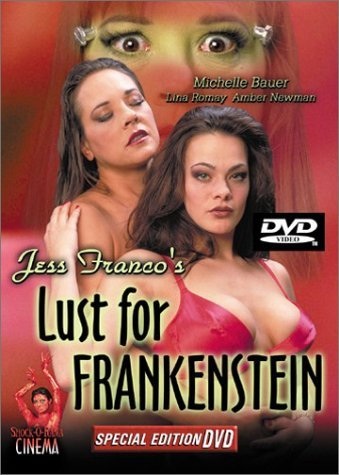
Here's the scene: 1997, a mountainous seaside resort town in Spain. There's a small villa on the hillside facing the sea – a white tangle of stucco cubes, irregularly punctuated with balconies and windows. On one of those balconies sits infamous Spanish schlock-horror director Jess Franco (in flick reviewed today he's billed under his Christian name, no pun intended: Jesus Franco). He sips a cappuccino. It's his second of the morning. A newspaper, perhaps the local rag, sits folded on the small table to the right of his wicker chair. He holds the rich, bitter coffee in his mouth a moment. Then breaths in slightly through pursed lips, noticing how the sea air changes the flavor of the drink. Normally, small details like this would please Mr. Franco. But not this morning.
See, Jess has a problem. He's got something like 170 directing credits to his name (names actually, he's helmed flick under nearly thirty different identities) and he's not proud of a single thing he's done. In fact, he's made it a matter of public record that he hates every single one of his films and, as far as he's concerned, he's never made even a halfway decent flick.
But he wants to. He wants to make a Citizen Kane or a Grapes of Wrath. Something enduring, something profound. A film, at last, to be proud of.
Then suddenly, it dawns on him: "I'll make a Frankenstein movie – except it'll be Frankenstein's daughter and the monster will be a woman with a sort of penis stub for a clit and they'll have lots of sex." And the very next year – taa-daa – the world gets "treated" to Franco's Lust for Frankenstein. This is actually the second film this month that puts a kinky twist on the Frankenstein story. The first was the B-grade Italian production Lady Frankenstein. Weirdly, there's a strange Orson Welles connection between the two. The later starred Joseph Cotton who worked with Welles in Kane. The former was directed by Franco who assisted Welles during his on-again, off-again Don Quixote shoot and who later "finished" the film for Welles. This simply a coincidence and has no really impact on the film in question. I bring it up only because that minor detail is about 1,000 times more interesting than anything that happens in the film.
A plot description will, unfortunately, make this dog of a flick sound more interesting that it is. Frankenstein had a daughter, Moira (played by Lina Romey – hot stuff when she started working in flicks back in 1973). Shortly after her birth, Frankenstein's wife passed away. The doctor then remarried, but his new wife turned out to be an a-class superfreak who not only slept with the good doctor, but the help, passing strangers, human-sized housewares – you get the idea. She also, frequently, turned her attentions on young Moira (though, later, Moira in flashbacks will clearly be played by her older self – perhaps lesbian incest prematurely ages one). Then the doctor passed on. Moira married and moved out of the home. Her marriage was a lousy one and Frankenstein, from beyond the grave, decides to visit his daughter and lead her his last creation. This, we learn, he does because he wants to teach her "lust." That's right. Dad doesn't think his little girl gets her nasty groove on so he's going to hook her up with a monster. We learn all this in voice over narration. When the film starts, an older, somewhat saggy Moira is visited, Hamlet-like, by her father's ghost. He sets her on a mission to find his last monster.
Mercifully, his last monster was stashed in a glass display case in Moira's old room, in the closet. The monster is a beefy woman with sockets in her neck and several lines of baseball-grade stitches running across her body. She tells Moira that if she revives her, she'll initiate frumpy Moira into the ways of ecstasy. Personally, from this woman, I would have taken that as a threat. But Moira must be lonelier than we thought because she promptly uses the life of one of her stepmom's many young bucks to bring the creature to life.
After some creaky-on-chunky action, Moira ends up going out to a stip-club and bringing back a young dancer to fuel her monster butch. Shortly after that, Moira's hubby shows up and gets dispatched. In between, Moira catches her monster top humping a tree and she has several nonsensical flashbacks to what I guess is her childhood (though, since the same actress plays her in these scenes, Moira appears to have been in her early 50s all her life).
This movie was crap. It had visual effects that would have been considered embarrassing in the first year of MTV music videos. I've had plates of linguini with more structure than this film had. Finally, and perhaps most damning, the only time this film was scary was when it was trying to be sexy. Watching this film feels like catching your parents fumble through something they thought was sexy, but is really just embarrassing. The combination of limply clumsy un-erotic pawing and utter humiliation makes the whole misadventure doubly scarring. Dusting off my Noteworthy Canadian News Events of 1998 Film Rating System I'm giving this flick an abysmal Crash of Swissair 111, and it is only getting that because it did consist of moving pictures and, therefore, qualifies on some minimal level as a film.
The scariest thing about Lady Frankenstein, a mildly kinky Italian-produced re-imagining of the Frankenstein story, is what it reveals about the career paths of even major Hollywood stars. I have to figure that a some point during production, perhaps while stuffing a clearly rubber-foam brain into the head of his monster, Joseph Cotton had to wonder how he ended up here. From Orson Welles' Citizen Kane and The Magnificent Ambersons to Mel Welles' Lady Frankenstein (note his misspelled name on the poster). Where did it go wrong? Not that this move was an outlier in an otherwise sterling late-stage career. Sadly for Mr. Cotton, it was just a trashy rest stop on a long trip down from Cukor's Gaslight and Hitchcock's Shadow of a Doubt to spots on Love Boat and Fantasy Island. Would-be actors and actresses, look on Cotton's works and tremble.
In all fairness, as rungs on a downward ladder go, Lady Frankenstein isn't that bad. It is an entertaining mix of B-movie schlock that, in its final half hour, starts developing some delightfully perverse themes. Unfortunately, as they always do, angry villagers come to cut the fun short. The resulting sleazus interruptus means the film ends up being more of a flirtation with the seamy side than an all out embrace of the kinky. Still, the shift in gears gives the somewhat flagging film a needed and appreciated boost in energy.
When the story begins, Baron Frankenstein (the gamely unembarrassed but still completely phoning it in Joe Cotton) and his assistant, Charles, are doing what Frankensteins do best: building a monster. I can't help but wonder if the name Charles wasn't some sort of allusion to Citizen Kane. The assistant's name allows Cotton several opportunities to drawl out the name Charles, much as he did as Leland Smith, long-time friend than enemy of Charles Foster Kane.
The good doctor and Chuck take a short break in their work to welcome back Tania, the hottie daughter of the Baron played by Rosalba Neri (credited under the name Sara Bey). Tania, we learn, has been off at med school and she has now returned a full-fledged surgeon like her pops. We also learn that Chuck has a thing for his boss's daughter. Shortly after Tania's return, she discovers her father's life-work on a slab in the basement. She wants to help her father with his work, but he rejects the offer of assistance. This is how Tania happens to be absent from the lab when daddy's monster awakens, kills the Baron, and wanders off into the world for some indiscriminate violence.
Tania decides to fight fire with fire and create a second monster to kill the first. She offers to give herself to the older and decidedly un-sexy Charles if he will agree to have his brain put in the body of the family's dull-witted but perfectly hunky handyman and use the super-human strength the monsterization process will give him to fight Monster 1.0. Chuck agrees. Tania seduces the handyman. She takes the big lug to bed and, while she rides him, Chuck smothers him.
Meanwhile, villagers are getting killed, the authorities are getting suspicious, and Monster 1.0 is stumbling around the countryside killing side characters and tidying up loose ends in the plot. Whether by random wandering or intentional design, Monster 1.0 ends back up at the Baron's castle, a gaggle of torch wielding villagers hot on his heels. Chuck gets his brain put in the handyman's body in time to revive and fight Monster 1.0. Monsterized-Chuck is successful and the thrill of combat has apparently turned Tania on. They proceed to get down right there in the lab, on the lab table, while the villagers burn the castle down around them. The film ends with a Tania being strangled by Monster Charles as they rut. Why? I don't know.
This was another title from one of the several shovelware collections currently littering my home. As is typical of the format, the print is pretty bad quality but, happily, it seems to be a genuinely uncut, uncensored version of the film. The effects were horrible and the plot, until Tania starts shedding her clothes and moral qualms in the effort to create a second monster, was fairly cheesy. However, before the viewer loses interest, things start to heat up a bit and the bizarre dynamic between Tania, pre-, and post-monster Charles makes for entertaining viewing. Strictly B-grade fare, but a nice diversion for a lazy afternoon or evening. Using the seasonally appropriate Finland's Ministers of Finance from 1918 to 1958 Movie Rating System, I'm giving this flick a lightly likable Sakari Tuomioja.
Hey Screamin' Regulars and Welcome Newcomers
Don't forget to submit an entry to ANTSS's first-ever contest: Horror haiku.
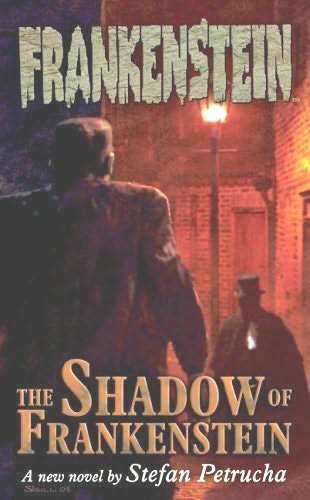
I’ve praised the joys of mix-and-match style stories before. While I might be curious about a story containing Dracula, tell me that it features the Lord of Vampires going toe-to-toe with Al Capone and you’ve got my undivided attention. In The Shadow of Frankenstein, another in Dark Horse Press’s new line of Universal Monster tie-in novels, Stefan Petrucha offers readers just such a promising match-up: Jack the Ripper meets Frankenstein’s monster.
Unlike Di Filippo’s freewheeling and heavily revisionist take on the Creature from the Black Lagoon, Petrucha’s book is more overtly an extension of the Universal film franchise. It is meant to fall in between James Whale’s legendary The Bride of Frankenstein and Rowland V. Lee’s excellent 1939 follow-up, Son of Frankenstein. The novel begins with the Frankensteins, the mad doctor Henry and his long-suffering and increasingly unhinged Elizabeth, fleeing legal scrutiny and the hatred of the villagers in their native land. They are off to England with Minnie, trusty but annoying maid servant in toe. Unfortunately for them, the good doctor’s most famous bit of work tags along for the ride.
The Frankensteins and their eponymous monster get separated once they reach the shores of England. Henry, unable to let was he believes to be his dead monster rest, begins investigating the history of the brain he purchased to install within the creature. Meanwhile, the monster saves the life of a Whitechapel prostitute and is taken under her care. In one nice touch, the whores of Whitechapel, used to seeing the effects of urban squalor on their neighbors, find the monster’s horrific appearance somewhat unremarkable.
Into this mix comes Jack the Ripper. After years of retirement, the killer is once again stalking the streets of Whitechapel. Jack’s life, we discover, has been unnaturally prolonged through black magic. Sadly, for our active-senior/serial killer, the old spells just aren’t working like they used to. After encountering Frankenstein’s monster on one of his bloody patrols through the city, Jack comes to believe that, if installed in such a body, he could live forever. All Jack’s got to do is get the good doctor to see things his way. And, it turns out, Saucy Jack can be quite persuasive.
Petrucha’s novel is a fun, light romp through the universe created by the classic Frankenstein movies (and they are extremely movie-centric - if there was an allusion to the novel that started it all, I missed it). Petrucha sacrifices description and mood for a brisk and action-filled narrative that resembles less Whale’s surreal and atmospheric classics and more the crowd-pleasing, but less accomplished later entries in the series, such as 1944’s House of Frankenstein. His book is almost exclusively focused on getting his main characters into position and then letting all holy heck breaks loose. Along the way, he makes sure to hit all the archetypal scenes any self-respecting Frankenstein movie must have. You can almost imagine Petrucha with a check-list of required, archetypal scenes he needs to hit: “Body harvesting in the graveyard. Check. Frankenstein raging at God. Check. Kites training electrical wires. Check.” The presence of Jack the Ripper and the perceived needs of a presumably more bloodthirsty audience means we get considerably more gore out of Petrucha’s work than any classic Universal flick would give us, but all in all is stays true in spirit to the source material.
Not that Petrucha’s novel is without clever flourishes and nice touches. Lines from the classic films are recontextualized throughout the book to good effect. Nod and wink allusions are sprinkled about for the close reader – including my favorite, a short discussion on transferring the captured monster to Seward’s asylum. Petrucha also finds time, despite the pace of the book, to work in some excellent bits of characterization. Most notably, when we get an entire chapter’s worth of backstory on the man whose famously abnormal (“Abby someone”) brain was placed inside Frankenstein’s monster. That chapter is actually a stand out.
Overall, Shadow of Frankenstein is an entertaining tribute to classic horror icon. It is less innovative than Filippo’s entry to the series, though, if in a more narrow way, it is really no less enjoyable.
I have no pets. I own several ties, but rarely have a reason to wear any of them. I sing in the shower but can never remember the words, so I make them up as I go along, and they always end up being songs about showering. I collect slang dictionaries.
 THe NY Times is reporting on a multiple court cases involving the forgery of horror memorabilia. From the article: