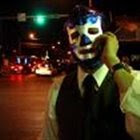
Threadless is having a big ol' $10 t-shirt sale. You can snag this bad boy, Alex Solis's "Battle of the Giants," and a ton of other nifty designs for a Hamilton a shot.
Monday, June 14, 2010
Stuff: Bedeck thyself.
Threadless is having a big ol' $10 t-shirt sale. You can snag this bad boy, Alex Solis's "Battle of the Giants," and a ton of other nifty designs for a Hamilton a shot.
Sunday, June 13, 2010
Music: "The girls are saying that you're wrapped too tight."

In the world of horror rock, the B-list rarely sees love. There's more Drac, Frank, and Wolf Man tunes than you can tip a Marshall stack at, but you don't run across a ton of tunes singing the praises of the Blob, for example. (Though the Latin-jazz influenced bubblegum of The Five Blob's "The Blob" is nice, it doesn't have the presence on Halloween mixes that lesser vampire or werewolf tunes do.)
Today, we get snippet of one of the best songs about the Mummy, another under-represented baddie from the filmland. I Was a Teenage Mummy a 1992 indie that aped the teen-horror schlock of the '50s. One of the highlights of the flick is the wonderful soundtrack filled with fuzzed out modern rockabilly garage groups. Below is the trailer, with the A-bones squonked-out sax-enhanced theme song "Mum's the Word."
The full song's available on iTunes and Amazon for download.
Friday, June 11, 2010
Movies: I suggest social promotion, if only to avoid having to see this one again next year.
 There's a bizarre allegorical mirror at the heart of The Final, Joey Stewart's 2010 torture porn-lite teensploiter. In the film, a group of clever young people steeped in horror flick conventions and lore band together to create an allegorical atrocity for mass consumption. Which, in broad terms, is what the Stewart and his crew are doing as well. Neither atrocity comes off as planned. A Saw for the post-Columbine teen set, The Final is a plodding combination of promising ideas and poor execution. The result is a film that has plenty to talk about, but is stammering and tongue-tied. It's exemplary of a sadly too common failure in horror: a film that is "about something," but simply isn't very good. Such film suffer from Romeroism.
Stewart starts off strong enough. Perhaps the most interesting thing about The Final is that it seems to spring up directly from the headspace of its main characters. Like the children combatants of the superior Battle Royale, the teens in this film find themselves thrust into a situation that taxes the limitations of the cognitive tools they have to make sense of the world. The result is they must rely on the rough and naked products of their own imaginations, such as the painfully earnest goth girl diary entries we hear in voiceover, or the ready-built tools of the media sphere around them, as when the aforementioned diarist adopts the look and mannerism of Asami from Miike's revenge-horror Audition to carry out her own revenge plot. The most emotionally real characters in The Final fluctuate between these extremes of helpless vulnerability and a detached, learned cruelty that's the only enduring thing the adult world bequeathed them.
In contrast to Battle Royale, the world of The Final seems like a projection of this mindscape. BR focused on the collision of youth and adulthood; The Final starts by removing adults almost entirely from the picture. This absence is communicated in the film's first act by making sure the faces of the adults in the film are always obscured. (Think of the Austin Power's bit where the characters' naughty bits are always conveniently covered – it works like that.) Without the stifling effect of adult authority, the characters live in a world made up of operatic emotions and vapid received stereotypes. Every bully is not just a jerk, but the biggest a-hole you can imagine. The school's mean-girls aren't just self-absorbed drama queens, they're sadist driven to seek out a constant stream of fresh hells to inflict on others. Consequently, there's a dramatic logic to absurdly extreme revenge plot the underdogs – a costume party that turns into a subCaptivity-grade torture-fest – cook up. In a world where everybody relentless follows trajectory of escalation based in simplistic logic of their characterization, then any revenge plan must skew towards the most horrific and definitive result. This relentless logic of character feels appropriate because the filmmaker initially handles it with ironic detachment. Unfortunately, that doesn't last.
By the end of the flick, Stewart trades in his winningly ironic and satiric tone for the less attractive tone of a hectoring afterschool special. I can see why Stewart might have felt the need to throttle back. When the world seems to reflect the tumult inside out victims-turned-torturers, the films builds quite a bit of sympathy with them and comes dangerously close to working as a sort of apologia for school shootings. As a remedy, Stewart slips in a character that acts as our moral touchstone: a generic "nice guy" who, despite the easy charisma of actor Jascha Washington, is intrusively out of place. Furthermore, the return of adult figures to the plot, complete with lessons about bravery and honor, feels like a total loss of nerve. This feeling is compounded by the bloodless torture-scenes that follow. When it is time to unleash hell on his characters, Stewart's resolve fails him.
Perhaps this could all be forgiven, but an unevenly paced script and lackluster visuals give you ample time to ponder why The Final isn't coming together. The result: a D, at best.
Tuesday, June 08, 2010
Mad science: "You know that she is in a movie in which sharks eat people; she thinks that she is living a normal life."

Paul Bloom, Yale psych professor, has an extensive and excellent article about the pleasures of the imagination posted on The Chronicle of Higher Education. Bloom discusses the role of imagination and focuses on those liminal experiences that seem to hold over both real and fictional stimulation. The whole article is worth your time, but I pull out a little extract here because it discusses the first kill in Jaws, a horrifying scene I recently wrote up as an unofficial entry in Arbogast's "One I Would Save" blog series.
Here's Bloom on the role of empathy death of Chrissie Watkins:
Often we experience ourselves as the agent, the main character, of an imaginary event. To use a term favored by psychologists who work in this area, we get transported. This is how daydreams and fantasies typically work; you imagine winning the prize, not watching yourself winning the prize. Certain video games work this way as well: They establish the illusion of running around shooting aliens, or doing tricks on a skateboard, through visual stimulation that fools a part of you into thinking—or alieving—that you, yourself, are moving through space.
For stories, though, you have access to information that the character lacks. The philosopher Noël Carroll gives the example of the opening scene in Jaws. You can't be merely taking the teenager's perspective as she swims in the dark, because she is cheerful, and you are terrified. You know things that she doesn't. You hear the famous, ominous music; she doesn't. You know that she is in a movie in which sharks eat people; she thinks that she is living a normal life.
This is how empathy works in real life. You would feel the same way seeing someone happily swim while a shark approaches her. In both fiction and reality, then, you simultaneously make sense of the situation from both the character's perspective and from your own.
Saturday, June 05, 2010
Movies: The two Palmer girls.
 One of the finest pieces of horror criticism comes from Bart Simpson. During the first "Treehouse of Horror" special, Lisa reads Poe's "The Raven" to her brother (who agrees to be subjected to a book only after Lisa assures him that he will not learn anything). When the narrator of Poe's "The Raven" searches for the source of tapping at his chamber door and finds an empty hall, Bart says, "You know what would have been scarier than nothing? Anything."
Bart's objection is, I think, demonstrably false: the world's full of anythings that aren't particularly scary. That said, the more general assertion that "The Raven" just isn't scary is spot on. It is a point even Lisa concedes later when she speculates that earlier audiences of poem simply must have been easier to scare.
Though, honestly, even early audiences of "The Raven" didn't find it particularly scary. Elizabeth Barrett, in a letter to the poet, claimed the poem produced "a fit o' horror" but admitted the mixed emotional response when she claimed that "Some of my friends are taken by the fear of it and some by the music." The poem's style, more often than its supposedly horrific content, was the source of most criticism, favorable and negative. Though, notably, one critic for the Southern Quarterly Review seems to have agreed with Bart and Lisa, claiming that the poem's scares would only work on "a child who had been frightened to the verge of idiocy by terrible ghost stories."
So, even adjusting for shifting cultural context, one comes to the conclusion that "The Raven," one of the cornerstones of the American horror tradition, simply isn't that scary.
In the horror blogosphere, many many posts have been dedicated to parsing out the experience of horror. We draw fine distinctions between various flavors of dread and speculate about their sources and the effects that best produce them. Less attention has been given to the odd phenomenon of horror that isn't scary. We should take care to separate this subgenre from horror that fails to be scary. It's possible to try to scare your audience and not succeed. Instead, what were considering is a genre of horror that purposefully chooses some other emotional register as primary mode. The dread in "The Raven," despite its gothic mood and trappings, is more akin to melancholy than fright. It's a grim meditation on death. A dark mirror of the transcendent function dead lovers served in Renaissance poetry, Poe's poem is about the inescapable and inevitable pain of loss that eschews the trope of redemption (completing a program of literary subversion that began 300 years earlier with Philip Sidney's "Astrophel and Stella" poem cycle). It's about being epically sad.
It might not seem like such a leap from fear to depression, but one can just as easily find comedies that would be welcome on just about any horror blog. Erotica, adventure, romance . . . we could go on, but that belabors a seemingly obvious point: Horror, as a genre, seems almost boundlessly flexible, even to the point of undermining the emotional response that the genre's name would seem to elevate as its highest and clearest goal. Though perhaps the point isn't particularly obvious. One still finds people attempting to work up definitions of horror that will exclude random work X from the genre by appealing to some reductive, "purified" definition of the genre. Looked at from the position of how the genre is experienced by creators and consumers, such efforts seem always already doomed.
I bring this up because Lake Mungo, the 2008 faux-documentary ghost tale from Joel Anderson, is one of the best horror films of the first decade of the 21st century. And it is too good a horror film to worry about being scary.
I'm a couple years late to this particular party, so I'm not going to bother with a long summary of the plot. In short: The Palmers, a New Zealand suburban family, lose their teenage daughter, Alice, on an outing to a local swimming hole. They gain a modicum of fame when local media outlets find out the dead daughter is haunting their house. The haunting turns out to be a hoax. However, after the media loses their interest, weird things keep happening. In an effort to get to the bottom of these strange events, the family uncovers a second life that their daughter led and these secrets overturn what they believed they knew about Alice.
To get the whole review-function out of the way, I liked this film. In fact, it's been a long damn time since I've seen a horror film so involving.
There, that's done. Let's talk about the flick now.
Lake Mungo is, curiously, the anti-Twin Peaks. Both works center around the excavation of the hidden life of a deceased teen girl. Alice and Laura share the same last name - Palmer - so it is fair to point out a certain family resemblance. Both works capitalize on the intrusion of the surreal on to mundane world of middle-class life (curiously, despite the idea that Twin Peaks was a logging town, blue collar concerns - union/management conflicts, the tension between resource limitation and jobs, and so on - surfaced obliquely; Twin Peaks was, locale aside, just another suburban nowhere).
What sets them apart is Lake Mungo's sympathy for Alice.
Laura is part of vast horde of fictional young women who meet their demise because they were spoiled. Laura's secret life follows a familiar dramatic arc: The perfect girl wanders off the path. Her sexual awakening is squalid, it marks not so much her introduction into adulthood, but the death of her virginal innocence. And, ultimately, this taint of sexualized corruption is connected to her literal death. Laura Palmer appears wrapped in plastic, washed up on the edge of a lake (another connection between Alice and Laura) because she ceased to be a clueless innocent. Her journey from clueless youth to active agent in the in the demimonde of Twin Peaks was just the first half of her march to the grave.
To be fair, this isn't an overtly wrong-headed notion. For everything that growing-up is, it is also the progression to the grave. In the sense that Laura is moving forward in her life, she's also moving towards her death. Still, this idea of the fatal corrupting crisis has a distinctly feminine slant to it in our culture, especially once sex enters the picture. Male coming of age stories can have a touch of sadness about the edges: think of a bittersweet narration of "and then we never saw one another again, but they are still my best friends" of countless Stand By Me-ish films. But, mostly, the quest for sexual maturity for boys is presented as an adventure or a comedy. More importantly, whatever the tenor of the tale, the central theme is one of completion rather than downfall. At the end of any given "we have to lose our virginity before we go to college" film, the male protags have gone from boys to men. They've become whole. In contrast, the women emerge from the same adventure irreparably broken.
What's interesting about Lake Mungo is that it uses it's dead-pan tone to wreck that idea. Alice, like Laura, kept secrets. But, unlike Laura, her death was, in the end, an accident. She drowned. It had nothing to do with the life she was living. It was the sort of dumb, senseless, stupid death that can befall anybody at any moment. It does not come as a judgment upon her.
Furthermore, the excavation of Laura's life is, oddly, invasive. Meant to solve the mystery of her death, there's something obscene about it. In death, Laura is defenseless and the investigators keep stripping her rep naked. It's investigation as rape. Here, the exploration into the Alice's life is driven by the presence of the ghostly Alice herself. It isn't an unveiling or a confession, but something more personal and profound. It's not unusual for ghost stories to trot out the "unfinished business" trope, but rarely is the business so poignant: Alice haunts her family because she wants the people to love to know her, entirely and truly know her.
And this, ultimately, is what sets Alice apart from Laura. Laura's a McGuffin. Her life exists to give others meaning and every decision she makes is a puzzle piece to fit into the story of her murder. She's a little girl converted in a tragedy by forces that rob her of life. Alice's life, by contrast, isn't a simple narrative. It's a awkward, opaque series of decisions made by a young woman quietly balancing the demands of two worlds.
Uncanny, sometimes heartbreaking, Lake Mungo's a powerful little film.
Friday, June 04, 2010
Contest: Crush crush sweet Charlotte.

The loser of ANTSS "Killer Kaiju" give away is Charlotte, NC. Why? Because it is the stomping grounds of choice for our winner: Aaron White! To claim your prize, shoot me an email at crwm44[the at symbol]yahoo[the dot]com.
A building-sized thanks to everybody who played along.
Thursday, June 03, 2010
Contest: Leave nothing but smoking rubble in your wake!
 Last day to get in on the action! I'm giving away one brand new copy of Killer Kaiju Monsters, a richly illustrated homage to all things big, Asian, and stompy by Ivan Vartanian. To enter the contest, just click through to the original contest post and leave a comment telling me what city you would stomp if you were a giant monster and why. There's plenty of unstomped real estate left. A winner will be selected at random tomorrow.
Kaiju-Fink art by McNail.
Wednesday, June 02, 2010
Books: The novel as zombie.

Mark McGurl takes a look at the bumper crop of zombie books in n + 1 and comes up with a novel thesis: Zombies novels are so hot right now because the novel itself is now an undead genre.
To say that the novel is a zombie genre is therefore not only to say that it may have outlived its life as a key cultural form, animated now only by its connections to film and television on the one hand, the university on the other. It is also to say something about what has often been taken, most recently by Benjamin Kunkel in an essay in Dissent, as the novel’s chief claim to our attention and respect and even political hope. This is its capacity for the creation of deep, psychologically complex fictional characters, the kind we find at the center of realist novels like Pride and Prejudice. Their “roundness” makes space for our fondest hopes for humanity, that it might stop and reflect and set a course for a better world. To the extent that these characters continue to appear in contemporary fiction, do they succeed in killing the crowd of zombies gnawing at the metaphorical door?
The essay focus's almost entirely on the canon of American zombie film and literature (I think Shaun of the Dead might be the only non-US production mentioned), but McGurl manages to get quite a bit of stuff out of the relatively slim sample. First he zeros in on the idea of the "zombie" as a character in a very specific genre sense:
Zombies are “characters” in the sense recently revived by the critic Aaron Kunin—they are a type whose existence extends beyond any one work or even medium. This is why we can speak of “the zombie” in the first place, and why the specter of the ludicrous hovers even over the realist commitment to character. In his book on laughter Henri Bergson observes, “In one sense it might be said that all character is comic, provided we mean by character the ready-made element in our personality, that mechanical element which resembles a piece of clockwork wound up once for all and capable of working automatically. It is, if you will, that which causes us to imitate ourselves.” When “clockwork” characters show up in popular genre fiction, as they so often do, critics are apt to take them as an aesthetic offense to the human. It might be more accurate to say that our aesthetic displeasure in hackneyed types records our confrontation with a truth about the human we would rather deny, but which the zombie brings to the fore. As a kind of character, then, the zombie is a pure negation of the concept of character at the heart of Austen’s realism.
From there he goes on to discuss how the absence of anything like traditional characterization basically forces us to treat zombies as allegories.
So: Zombies are anti-characters, but they do make for good allegories, their very flatness propelling us into speculation about what they might mean “on another level.” Since one thing they mean on that other level would seem to be “flatness” itself, it will not do to criticize zombies for being stiff and uninteresting, as allegorical characters have been for at least a few hundred years . . . [Allegory's] intellectual virtues are too essential to be dissolved into realism and that its most vivid modern manifestations are to be found in genre fiction. Above all, in a way that realism rarely does, allegory gives us a kind of vivid speculative access to the superhuman designs, whether spiritual or natural, that structure consciousness from without. This is especially true of science fiction and horror. These designs may constitute the ultimate reality, in comparison to which ordinary experience is only a kind of dream, but when they are rotated into the space of representation they can look very “unrealistic” indeed. Their realism is what we might call a speculative realism.
Before he finally comes to the punchline:
Once upon a time the designs of allegory were understood by direct reference to theology, and more than a hint of end-of-days religiosity remains in recent evocations of the otherwise secular zombie “apocalypse.” Cormac McCarthy’s The Road is the best known and certainly the classiest example, trading up from the zombie to realistic-seeming depictions of postnuclear cannibals who want to eat a suspiciously Jesus-like boy. But look closely, notes Fletcher, and you will see that modernity brings about a basic reversal in the direction that allegory now tends to move. What used to take us higher toward celestial structures now takes us downward to the physical truths that determine our organic being and give it a hard deadline. McCarthy’s high seriousness as a writer has always coincided with a certain attraction to genre—in his case the western—but in a way the “badness” of actual genre fiction, the kind that never wins big literary awards, is a more authentic expression of our lowly, pulpy state. Real zombie stories are more honest about our essential stupidity than works like The Road, drowning out the last yelps of human pride in the tide of their own mediocrity.
I love that last line.
Which brings up this only semi-related issue. I found the image that kicks off this post GISing for some suitably zombificated imagery to use as an illustration. How f'ed up is that image? Sometimes I feel like the zombie holocaust just can't come fast enough.
DON'T STOMP THINKING ABOUT TOMORROW! If you haven't entered ANTSS Killer Kaiju contest yet, you freakin' should! It's as easy as stomping on your favorite scale-model city.
Subscribe to:
Posts (Atom)