Thursday, April 15, 2010

Books: Your Twi-hate is strictly amateur hour stuff.


Sure Twi-bashers talk about Twilight, but are they ever going to do something about it? Well, somebody out there is trying: According to the American Library Association, Twilight made 2009's
most challenged books list.

Here's the winners:

1. ttyl, ttfn, l8r, g8r (series), by Lauren Myracle
Reasons: Nudity, Sexually Explicit, Offensive Language, Unsuited to Age Group, Drugs

2. “And Tango Makes Three” by Peter Parnell and Justin Richardson
Reasons: Homosexuality

3. “The Perks of Being A Wallflower,” by Stephen Chbosky
Reasons: Homosexuality, Sexually Explicit, Anti-Family, Offensive Language, Religious Viewpoint, Unsuited to Age Group, Drugs, Suicide

4. “To Kill A Mockingbird,” by Harper Lee
Reasons: Racism, Offensive Language, Unsuited to Age Group

5. Twilight (series) by Stephenie Meyer
Reasons: Sexually Explicit, Religious Viewpoint, Unsuited to Age Group

6. “Catcher in the Rye,” by J.D. Salinger
Reasons: Sexually Explicit, Offensive Language, Unsuited to Age Group

7. “My Sister’s Keeper,” by Jodi Picoult
Reasons: Sexism, Homosexuality, Sexually Explicit, Offensive Language, Religious Viewpoint, Unsuited to Age Group, Drugs, Suicide, Violence

8. “The Earth, My Butt, and Other Big, Round Things,” by Carolyn Mackler
Reasons: Sexually Explicit, Offensive Language, Unsuited to Age Group

9. “The Color Purple,” Alice Walker
Reasons: Sexually Explicit, Offensive Language, Unsuited to Age Group

10. “The Chocolate War,” by Robert Cormier
Reasons: Nudity, Sexually Explicit, Offensive Language, Unsuited to Age Group


Now that's how you hate on something, ladies and gentlemen!

Admittedly, the folks who hate the fact that vampires sparkle and the folks who object because they find the neo-Victorian relationship of Bella and Ed "sexually explicit" probably agree on little else, but the enemy of the enemy is your friend and all that.

On a sidenote: Just listing these titles with the objections made against them, and no other info, makes all of them sound really awesome. I've never had any interest in the work of Jodi Picoult, but "Sexism, Homosexuality, Sexually Explicit, Offensive Language, Religious Viewpoint, Unsuited to Age Group, Drugs, Suicide, Violence" all in one book? Hot damn.

On another sidenote: I wish they'd been more specific with the charge against And Tango Makes Three: "penguin homosexuality".

Wednesday, April 14, 2010

Mad science: How werewolves became imaginary.


Over at the Fortean Times web site, writer Brian Regal tracks the history of the werewolf feared monster of Europe's darkest forests to figment of the imagination. The broad arch of the werewolf's lapse into fantasy is familiar, but Regal points out that the extent to which the werewolf became strictly fictional is uniquely notable:

For most of recorded history, the half-man, half-wolf lycanthrope reigned supreme as the creature travellers most feared encountering in the woods and along dark roads at night. Numerous legends concerned werewolves – the awful deeds they committed, how to protect against them, how to kill them – and belief in their reality can be found in many cultures from ancient times to the present. But while the werewolf still holds a place in fiction and films, few people today actually fear meeting one in reality. Many individuals and groups actively search for cryptids, but there are no werewolf-hunting organisations. So – where have all the werewolves gone?

From the late 19th century on, anomal­ous primates like the Yeti, Sasquatch and Bigfoot nudged aside the wolfmen of old and stepped forward to occupy the niche of this fearsome man-like monster. But what accounts for this curious transformation?


Regal starts his story with a discussion of the dog-headed proto-werewolf of Greek legend: the Cynocephali, the race of dog-headed men that even included (in the lore of the Eastern church) St. Christopher, pictured above. He notes that, curiously, Europe started to dismiss the possibility of werewolves even as its belief in demons and witches proved fatally strong:

Despite the widespread cultural acceptance of werewolves as a reality, by the late 1500s some European writers were questioning the concept. While belief in witches flourished with murderous abandon, views on werewolves had little consistency in learned circles, and though werewolves often found themselves associated with witches, no werewolf ‘craze’ ever developed. In fact, there are only a few werewolf trials on record. As the Enlightenment dawned, a debate ensued over whether demons could transmute a human into a werewolf. Philosophers and theologians wondered whether the human soul was capable of becoming genuinely bestial, and such theological reservations posed the same problems for werewolfery as evolution did two and a half centuries later. It was during this period of scient­ific revolution that psychological, rather than physical, explanations for lycanthropy gained currency.

Ultimately, he argues, the rise of Darwin put paid to the wolf man. Evolutionary theory began to kill off the beasts of myth, replacing them with an equally fantastic, but more "scientific" zoo of missing links, prehistoric survivals, and "nature's mistakes" (though Darwin himself was dismissive of any notion of a missing link). Notably, apes - and their cryptid shadow relatives, Bigfoot, yeti, sasquatch, the stink ape, and so on - became the beast-man link of choice.

Monday, April 12, 2010

Books: Jibber-jabber.

Though I can't seem to embed the video here, this here click-click will take you to a video of Sir Christopher "Blood of the Saxon Men" Lee reading Lewis Carroll's "Jabberwocky."

Saturday, April 10, 2010

Movies: Bitching and moaning.

There's a story, one of those industry stories that may or may not be true, but it's good and telling, and that's a good as true - better than true - in the business of making dreams, so people keep telling it.

Before the sputtering collapse of the Sex Pistols, punk Svengali Malcolm McLaren was trying to assemble a film project that he'd already titled, with uncharacteristic honesty, The Great Rock and Roll Swindle. There was already something of a script and, from the details I've gleaned from the various sources I've run across, it was something of a mess of a film. A phantasmagoric collage of unconnected provocations, it was meant not only to ensure the impresario's status at the UK's most scandalous entrepreneur, but to put his increasingly rebellious help - the Pistols themselves - in their place. For example, the plot would have required John "Rotton" Lydon to play act his way through an incestuous affair with an actress playing his mother, a shot at the fact that Lydon's family bonds were one of the reasons he was never as fully under the sway of McLaren's spell as some of his other bandmates (most notably and regrettably Sid Vicious).

UPDATE: Roger Ebert recently wrote up the full story of the Meyer/McLaren unpartnership, for the details as Ebert remembers them - along with portions of Ebert's unused script for the film - click over to the Chicago Sun Times. If differs from this version is many important respects.

McLaren hoped to rope Russ Meyer, American king of the softcore flick, into shooting this disaster. He flew Meyer and his youthful sidekick and sometime-collaborator Roger Ebert to England. McLaren, in his typically weird simultaneously self-promoting and self-defeating way, sent John Lydon as his representative. Meyer, Ebert, and Lydon met for dinner and Lydon started to trash talk the State's premiere titty flick expert. Meyer, a WWII vet, launched on a classic "if it wasn't for us, you'd be speaking German" diatribe - apparently unaware that a few of the Pistols were infamous for working swastikas into their fashion statements. A physically imposing, near-bullyish sort of man, Meyer actually scared the crap out of Lydon. Lydon backed down and apologized for his behavior.

Later, after the meal, it was revealed that Lydon didn't have enough money for cab fare back home. McLaren had given him just enough to get to the dinner and pay for his meal. Ebert and Meyer questioned Lydon and discovered that McLaren controlled the purse strings, taking essentially everything the Pistols made. And he liked to keep the boys hungry. Lydon hadn't had a good meal in days because McLaren kept him in a state of poverty. Meyer and Ebert got a cab, got Lydon some groceries and some beer, and dropped him off at home.

After that meal, Meyer decided he'd seen enough of the sort of outfit McLaren was running and he went back home.

Meyer was never going to work with McLaren. No doubt McLaren saw Meyer's breast-filled flicks and believed he recognized the work of a fellow soul. McLaren assumed, not without reason, that somebody who makes and exploitation flick is, by definition, an exploiter. McLaren assumed that the Great Rock and Roll Swindle would be a conspiracy of vampires.

But he had drastically misread the nature of Russ Meyer. It's common for film viewers to construct a pathology of filmmakers that's reverse engineered from the final product they've viewed, though this exercise is the equivalent of attempting to diagnose the makers of Rorschach cards on the basis of the images you believe you see within them. What McLaren missed is that Russ Meyer was, essentially, sentimental. At his best, Meyer was a sentimental fool. He believed there was evil and good, that families that didn't love each other were genuinely broken, that betrayal was a sin, and corruption ultimately ate itself from the inside out. His most significant dramatic modes were broad action and comedy, partaking of the lowest common denominator of existence that is also our most essential shared experience, and melodrama, defined by Guy Maddin: "I think that melodrama isn't just life exaggerated, but life uninhibited." It hard to buy this because we often employ a sort of comic book mentality to our assessments of others. We can't believe that there's room enough in one head to believe in good and evil and to be obsessed with giant tits. But, it can happen. Meyer is proof. He earnestly owned his obsessions and his beliefs. In his excesses, he was honest, often embarrassingly and thrillingly so. Perhaps it was a product of Meyer developing his chops as a cameraman in WWII, a residual and unstated bias that what happens on the other side of your lens should matter. If not to everybody, at least to filmmaker.

What Meyer "lacked" that McLaren had was cool detachment. McLaren, despite his importance to punk, did not traffic in excess. He did exactly what he needed to in order to create his desired effect. There's a cold monasticism to McLaren's art that suggests a strategic and outward focus. He's doing everything for the reaction of others. For those with long memories, there's some debate over McLaren's repeated use of the naked photos of the under-aged lead singer of Bow Wow Wow for marketing purposes. (Defenders who cite the artistic allusion to Manet as a dismissal of McLaren's exploitative impulses often ignore that said cover was actually the second nude photo of Lwin that McLaren created to shill his wares, the first being the nude cover of the "I Want Candy" single.) Whatever the ultimate result of the moral calculus on that decision, one can be sure that McLaren wasn't doing it for his own kicks. In McLaren's eyes, Lwin's nubile flesh wasn't an erotic draw. It was a canny investment.

Meyer was one of cinema's last primitives. Uncooth, awkward, vibrant, energetic, forceful, and unironic. For better or worse, he's fully present. In contrast, McLaren approached the medium with the economical and emotional detachment of a junk bond trader.

Rick Jacobson's 2009 Bitch Slap is a fast moving B-flick that shows us what Faster, Pussycat! Kill! Kill! would have looked like if Malcolm McLaren made it.

Friday, April 09, 2010

Stuff: The Men in Black speak.

Even the most sinister of secret black op sites needs a surprising number of independent contractors to keep the place running. Take Area 51, for example. Sure it might be filled to the brim with nameless spooks and technocrats dissecting alien bodies and all that. But there's also a whole cadre of support staff and minor tech support guys who just punch the clock and make a living at the place.

Which poses a problem: You can't have these minor players blabbing about the alien microwave gun the lab boys are using to make crop circles. The conspiracy-minded might suggest eliminating these loose strings. Heck, if we can bump off foreign leaders, we certainly can snuff a cafeteria lady or the random radar operator. Here's the thing though, in the remote locales suitable for secret installations, labor isn't an inexhaustible resource. Not only will you work your way through all the qualified mechanics pretty quickly, but eventually your rep as a place where workers vanish will scare off the rest of the talent pool.

No, as unsexy as it is, better to just swear the little guys to secrecy too.

In Area 51's case, the contractual obligation to secrecy for many minor employees extended 47 years. Which means, for those keeping count, employees who worked the site in the 1950s and '60s are now free to discuss what they witnessed.

Sadly, no aliens.

The Seattle Times interviews are few Area 51 vets, like James Noce, formerly the radar operator at the infamous site. Though Noce has no tales about alien crashes, his recollections about the crash of a A-12 spy plane in 1963 should sound familiar to any UFO fancier.

Noce remembers when "Article 123," as one of the A-12s was called, crashed on May 24, 1963, after the plane stalled near Wendover, Utah. The pilot ejected and survived.

Noce says he was among those who flew to the crash site in a giant cargo plane loaded with several trucks. They loaded everything from the crash into the trucks.

He remembers that a local deputy had either witnessed the crash or had quickly arrived at the scene. There also was a family on a vacation car trip who had taken photos.

"We confiscated the camera, took the film out," says Noce. "We just said we worked for the government."

He says the deputy and the family were told not to talk to anybody about the crash, especially the press.

"We told them there would be dire consequences," Noce says. "You scared them."

As an added incentive, he says, the CIA arrived with a briefcase full of cash.

"I think it was like 25 grand apiece, for the sheriff and the family," says Noce.

Wednesday, April 07, 2010

Stuff: "Sometimes you're too honest about your feelings."

When I was young, I had these cheapo set of magic linking rings I purchased at Foodini's, a short-lived concept theme-restaurant that was given it's test run at a local mall before vanishing off the face of the Earth. I was never very good with them. The problem wasn't a lack of manual dexterity, but rather that I respected the skepticism of any potential audience enough that I only wanted to perform tricks that could be thoroughly scrutinized later. If the audience couldn't, after I'd finished, manipulate the rings themselves, then I would have felt their own sense of being conned too acutely and the trick would have felt shabby, even if it was expertly executed.

There was one ring trick I was really good at though. It involved taking three identical and unbroken rings linked in a linear series, like a chain, and moving the bottom ring up a link, so that the chain now resembled something like a key ring: the top ring now had two unconnected rings hanging off it. The magical transformation was removing the bottom link from the middle chain and linking it to the top. The change took less than a second and the results could always be safely handed to audience members.

My explanation might have already given away the game, but in case it isn't clear, the key to the trick was simply a matter of forcing a certain perspective on the audience. Remember that all the rings are identical. There was no linking or unlinking going on. I showed the rings in a chain, holding on to the Ring 1, with Ring 2 under it and Ring 3 at the bottom. Then I gathered them all into one hand, waved my free hand in front of them, and slightly shifted my grip so that I was holding on to Ring 2 and not Ring 1. When I released the rings, Ring 2 was the top link and Ring 1 and Ring 3 dangled from it. However, because I explained what I was going to do, people simply assumed the top ring was still Ring 1 and I'd somehow moved Ring 3. I could hand the rings to the audience and let them test it because their test was always the same: They wasted all their time looking for breaks or trying to somehow force what they though was Ring 3 to uncouple.

Instead of making me a cynic (that took a magic trick named "dating Stephanie," which I attempted years later and, thankfully, never mastered), I found the fact the whole trick revolved around a bluff and the contagious nature of misinformation far more interesting than the idea of magic itself. That instant conspiracy of suggestion and unjustified confidence in the very senses that deceived us in the first place was, itself, magical in a way.

I bring this up because, over at the online front of Skeptic magazine, they are featuring a spiffy downloadable PDF of ten easy lessons on how to be a psychic. Specifically, the piece focuses on the "cold read," the art of reading somebody you have no prior knowledge of. Now Skeptic offer this too you as a satiric bunking of humbugs, which is fair: humbugs are what psychics are. But offer it to in the spirit of art appreciation. In the museum of humbugs, there is no performance art as rigorously demanding or highly evolved as the cold read. Done with expertise and style, it can be a beautiful thing.

So, if you think you've got the wits for some quick cash or you're tired of cube life and would like to work from home, check it out.

Tuesday, April 06, 2010

Meta: Holy crap! We're totally famous!

So Mr. McHargue, of I Love Horror (see the sidebar for linking action) fame, apparently really digs on the blog. So much, he was even willing to face near universal public humiliation by publicly proclaiming his love over at Horror Squad. Seriously:

One of the first blogs I came across when I decided to start my own, ANTSS has remained, at least for me, the standard of excellence among horror bloggers.

That's a man kiss!

Thanks Brad and to any new friends who may have found the blog through his kind write up. I'll keep chugging along and, hopefully, I can keep it all interesting for y'all.

Friday, April 02, 2010

Stuff: "That was a safe assumption, of course, until . . ."

In Details magazine, Jeff Gordinier profiles Matthew Roberts, a rock musician and strip-joint DJ whose search for his biological parents took a turn for the weird that instantly quailfied him for a post on ANTSS.

The adopted son of a "straight-laced" Illinois couple, Matthews started the search for his biological parents in 1999. From the article:

In 1999 he called an adoption-search organization in the Midwest, coughed up a few hundred dollars, and was given her name. She was living in a cabin in Wisconsin without a phone or a car, he says. "The adoption lady kind of warned me, 'Your mother's a little bit off.' Then I got a letter from my mother, and she was talking about her rhubarb and her cats, and I thought, well, she's just kind of a hippie. But at a certain point it became obvious that there was something wrong with her. Mentally." The woman, a Wisconsin native whom he calls Terry, said that his first and middle names at birth had been Lawrence Alexander. According to Roberts, she sent him food in the mail after warning him, in a weirdly winking way, that her own mother had suffered from Munchausen syndrome by proxy, a mental disorder that can lead parents to poison their children. "One time she sent me a jar of, like, mystery juice," Roberts says. "It had things floating in it. Then she asked me, 'Did you drink the juice?' And I said, 'No.' And she said, 'You're smart!' "

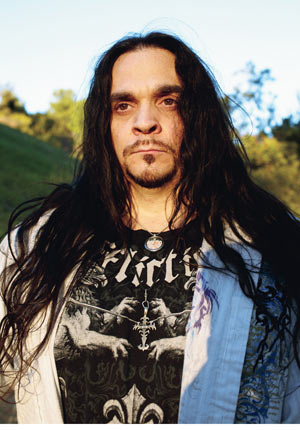
Roberts was beginning to get a sense of where those night terrors might have come from. Only gradually, he says, did his mother let the narrative wrinkles slip out: that he had been conceived during a hippie orgy in San Francisco in 1967, that his mother's participation in the orgy may not have been consensual, that there were four men present, that everyone at the orgy was dropping LSD, that his mother had apparently continued to ingest LSD in the months that followed. It was all eerily similar to Rosemary's Baby: Midway through Roman Polanski's 1968 film about the prenatal care and feeding of Satan's spawn, Ruth Gordon coaxes a pregnant Mia Farrow into gulping down a frothy, fetid glass of herbal goop. In the movie, Roberts says, "they were doing it to create an Antichrist. Well, in this case it just happened." That was a safe assumption, of course, until the day in 1999 that Matthew Roberts finally sent his biological mother a photo of himself, at about 30 years old, with his piercing eyes and his tangled nest of black hair, and she told him she realized which of the four men at the orgy had to be his father . . .


Go ahead. Look at the pic again and take a guess.

Inmate No. B-33920 at the California State Prison in Corcoran, otherwise known as Charles Manson, the most demonic figure in the annals of American murder.

Seriously, Matt. Ask for that couple hundred bucks back.