Friday, June 25, 2010

Mad science: Like the fist of an angry god.

In general, I like my end-of-the-world scenarios to be as wacky as possible. Our presence on this globe is so improbable that it just seems dramatically appropriate that our exit should be just as improbable. But sometimes it rewards a person to consider the classics.

Over at the UK screamsheet tThe Independent, Chris Impey revisits one of the 20th century's most enduring contributions to the intellectual dark ride of our apocalyptic imaginations: death by space object strike:

Every century or so, a 10-meter meteor slams into the Earth with the force of a small nuclear device. Tunguska was the site of the last, in 1908, and it was pure luck that that meteor landed in the uninhabited wilderness of Siberia. Every few thousand years, Earth can pass through unusually thick parts of the debris trail of comets, turning the familiar light show of a meteor shower into a deadly firestorm. Roughly every 100,000 years, a projectile hundreds of meters across unleashes power equal to the world's nuclear arsenals. The result is devastation over an area the size of England, global tidal waves (if the impact is in the ocean), and enough dust flung into the atmosphere to dim the Sun and kill off vegetation. That could ruin your day.

Then there's the "Big One". About every 100 million years, a rock the size of a small asteroid slams into the Earth, causing global earthquakes, kilometre-high tidal waves, and immediately killing all large land animals. Creatures in the sea soon follow, as trillions of tons of vaporised rock cause drastic cooling and the destruction of the food chain based on photosynthesis. There's good evidence that this happened 65 million years ago and our tiny mammal ancestors were the beneficiaries as the giant lizards were extinguished.


Mr. Impey also considers such we're-screwed scenarios as "fried by the high-energy radiation of a distant hypernova," "Sun eats the Earth," and one of my new favorites: "the Big Rip." This is the term for the hypothesis that the expansion of the universe might eventually reach a crisis point and the whole darn thing could just unravel. That's right, the universe could break.

So enjoy the weekend like it may be your last! It's always later than we think!

Thursday, June 24, 2010

Movies: Robert Pattinson's dead.

Now I don't know crap all about Twilight and it's various incarnations and adaptations. But I do know that the next flick is apparently going to feature Peter "Freakin' Bauhaus" Murphy. In his first film role since The Hunger, Murphy is playing a vampire called "The Cold One." (I think – but in the franchise "cold one" is also a werewolf slur for vampires in general – I think. Who can keep up? Googling this stuff is like throwing yourself into maze where all the direction signs are in foreign language.)

Does this lend the franchise anymore cred in the horror blog-twitter pro-am? After all, there's always the possibility that some Twi-hater could ask: "Murphy's cool with it. And, honestly, am I more horror than Peter Murphy?" The answer, of course, would be no. You're just some freakishly untalented subliterate who rode the coattails of more established bloggers to a middling, but still utterly undeserved level of success. Of course you're not more horror than Murphy. Don't be an ass.

Here's a Bauhaus song to make us all feel better. Here's Peter Murphy, Trent Reznor, and TV on the Radio all doing "Bela Lugosi's Dead."

Wednesday, June 23, 2010

Movies: How to build a shark.

I don't have any particular insights to share about the images below. I just thought they were spiffy and should be shared. From the Hollywood Movie Costume and Props blog come these tech drawing of Bruce, the mechanical shark from Jaws.


Saturday, June 19, 2010

Movies: Here's to new friends.

Girly, the American title of Freddie Francis's 1970 flick Mumsy, Nanny, Sonny, and Girly, comes deceptively packaged. First, the flick's latest yank-market dress focuses on the unquestionably marketable lolitaism of Vanessa Howard's girl-woman, "Girly," at the expense of the other characters. Second, the marketing copy suggests some sort of torture pornish plot, spiced up with a bit of gender-politics tinged revenge. Reading the DVD box or scanning the Netflix description, one could be forgiven for thinking that you were getting some precursor to the modern torture porn flick, but squeezed into the '80s template of the classic slasher, where sexual desire is punishable by death.

The bad news is that your not getting anything like the horror movie you signed on for.

The good news is that you getting a small little gem of a flick: an acid-etched portrait of the absurd Victorian ideologies that, even today, hang over any discussion of family life. Surreally straight-faced, gleefully inappropriate, and possessed of that wonderfully British ability to be grotesque and reserved at the same time, Girly is one of the best satires of the nearly-inherent amorality of family life ever made. And who better than the Brits to pull it off? For at least three generations, Brits have creatively and comically wrestled with problem of arbitrary authority. It's a legacy of the last remaining monarchy. From the Goon Show's love of militarized nonsense ("Seagoon: Bloodnok, parade your men!") to Monty Python's Ministry of Silly Walks, there's a brilliant and essential tradition of British comedy that recognizes that order and reason are, sadly, too often strangers. The result is an absurd world of rules, but no purpose; law, but no justice; church, but no faith; government, but no leadership; dictionaries, but no meaning.

And what social structure better epitomizes this horrific state of affairs than the modern family? You've got the authority of the parent figures, whose power is nearly absolute, but also merely an accident of biology. Despite hundred's of years of political evolution, parental authority, with its fascist combination of righteousness through physical superiority and general immunity to the will of the governed, is a monstrous throwback to our cave days. Combine that with the family's tribal clannishness and the idea that, whatever the norms of human behavior are, they stop at the homestead door to be replaced by the wise rule of the parents, you've got the mother - metaphoric play on words intentional - of all grotesquely arbitrary systems of order.

And yet, family often gets a pass. Steeped in Dickensian a mythology of childhood, besotted with "angel of the house" ideology, Brits often laugh off the creepy mini-monarchism of family life, treating these micro-dictatorships as little more than a delightful eccentricity.

Which is why its so delightful when somebody finally says, "Oh, for fuck's sake, let's just say it! This is basically a Ministry of Silly Walks with more doilies."

The plot of Girly will be familiar to horror fans. It's a Boy's Own Paper version of Texas Chain Saw Massacre. (And weirdly evocative of the echo-titled Mum and Dad, which brought the influence full circle by making ostentatiously Brit version of TCM and ending up with a working class splatterpunk version of Girly.) Mumsy, Nanny, Sonny, and Girly live in a massive, rotting castle of an estate, living out some bizarre fantasy of British gentry family life. Sonny and Girly regularly leave the estate to gather "friends" - homeless drunks and the like - whom they bring home for games and treats. Eventually the guests figure out the family is utterly nuts, which leads to a crisis with the fam, which leads to an early demise for the guest.

This pattern begins to unravel when one of the new friends decides that, despite the clear homicidal insanity of the family, he likes the financial and sexual advantages family membership could confer to him. Consequently, he begins to navigate the Wonderland-by-way-of-Most-Dangerous-Game household with an eye to installing himself in the role of the missing patriarch.

(This twist strikes me as a distinctly national flourish: the idea that, despite the horror of the situation, you could make it work for you belongs to a long tradition of anti-hero station-climbers. It appears here and in the much more violent and viscerally unpleasant Mum and Dad. For contrast, the transformation of Stretch from victim to chainsaw wielding madwoman is treated as a descent in the TCM franchise.)

So, what are you not going to get with Girly? Despite the blood splattered packaging, you're not getting gore. There's a body count of, I think, three, in Girly, and though one of these is quite fierce in the violence suggested, there little to no blood on the screen. I don't want to suggest that this is a failing. In fact, I think that's part of the gag. The film's making fun of the way the Cult of Domesticity hides all manner of creepy crap. This overt and clumsy nod to propriety underscores propriety's role in hiding the submerged, sinister Freudian currents of family life.

The semi-feminist empowerment vibe you catch from the ballyhoo is an empty promise as well. The character of Girly is fascinating. There's a reason the rerelease suggests she the anchor of the film. Her strange balance between vapid nymphet seductress and young woman coming into her own power steals every scene she's in. Curiously enough, even the filmmakers seem confused by Girly. Sometimes the camera seems to want to linger on Girly's nubile flesh, as if unaware that Girly's eroticism suggest a fault line in delusion of the family. Other times, the film is overtly suggesting that the family contains the seeds of its own destruction, and Girly embodies that potential. (A situation that is made all the more ironic insomuch as New Friend's lever into the family is Girly's budding sexuality, the very thing that threatens to tear the family apart.) This isn't to say that feminist critics won't find something interesting about the character of Girly. In Jury of Her Peers, a massive history of women's literature in America, Elaine Showalter suggest there are three levels of cultural production that should interest feminists. First, there's anything that is the output of female creators. This holds a historical and archival interest. Second, there are cultural productions meant to overtly promote feminist ideologies. The political importance of this seems obvious, but it's artistic limitations are perhaps less obvious - in horror terms it leads to a feminism that pretends that feminist horror began with Buffy and persists only in her many clones. Third and finally, there are representations of women that reveal the symbolic status of women in their era. Girly is a near perfect exemplar of the third type. At once pitiful and predatory, infantile and aggressive, innocent and overripe, she's the Euro-trashy sister of Lo, wobbly and overburdened with an excess of male anxieties and signifiers.

Visually, Girly is a remarkably conservative flick. Especially if you consider that fact the fact that flick is coming of the tale end of '60s cinema. The film looks good, but the the editing is rigorously traditional and the style calm. It may have been an intentional display of reserve to anchor the surrealism of the story in a "realistic" visual vocabulary. Regardless of the reason, it is notable.

Girly, honestly, is a failure as a horror film. But I think it's marketing as a genre piece is misleading. Check out Girly as wonderful example of black humor. It's near perfect in that weight class.

Friday, June 18, 2010

Music: Henry's downloaded it like 50 times already.

Now you to can sing along with Glenn! Download yourself "On a Wicked Night," a free Danzig tune and howl away.

Thursday, June 17, 2010

Meta: Unmasked.


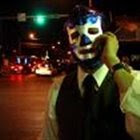
Sorry Screamers and Screamettes. I need to post this somewhere and extract the URL. But, the mystery is over: that's CRwM, sans mask.

Mad science: All the dead are vampires.


Vampires are essentially a Romantic and Victorian phenomenon. Prior to that, a vampire was one of any number of distinct and mostly unrelated local folk beasties. But an explosion of vampiric literature and art in the 19th century began to establish, for what would ultimately become a global audience, the norms for vampires. With the exception of the wonderful Chinese jumping vampire, almost all notions of what a vampire is pretty much a reaction to the Romantic/Victorian template, itself a massive constriction of the diverse and regional sense of the term. (That last bit is worth noting when encountering purists' arguments about what should and should not be considered a real vampire: There's no original vampire; it was always already a mess of different influences, original inspirations, and second-hand ideas.)

At the Chronicle of High Education, science writer turned horror anthology editor Michael Sims attempts to find the
cultural and scientific roots of the Victorian vampire boom. And he comes up with some neat ideas:

The vampire story as we know it was born in the early 19th century, as the wicked love child of rural folklore and urban decadence. But in writing these depraved tales, Byron and Polidori and company were refining the raw ore of peasant superstition. And the peasant brain had simply been doing what the human brain does best: sorting information into explanatory narratives.


I found lots of reports of vampires from Europe—from urban France, rural Russia, the islands of Greece, the mountains of Romania. Along the way, I was reminded of something I already knew but hadn't thought of as relevant in this context: During the Middle Ages and Renaissance, dead bodies were a common sight. Plague and countless other illnesses ravaged every community. Corpses of the executed and tortured were displayed in public as warnings, even left hanging as they decomposed.

Few bodies seemed to rest peacefully even in the ground. Often people in the 18th century had an opportunity not only to see corpses but also to glimpse them again after they were buried. Urban cemeteries were densely overcrowded, sometimes with the dead stacked several graves deep, causing horrific spillage during floods or earthquakes. More corpses than the ground could accommodate resulted in the stench of decay and the constant risk of disease. Grave desecration was also common; a thriving trade in illicit cadavers for medical students joined a vicious rivalry between competing religious groups. After Louis XIV abolished the convent at Port-Royal des Champs as a hotbed of Jansenist heresy, drunken locals dug up nuns' bodies from the cemetery and fed them to their dogs. Corpses of executed heretics were dragged through the streets, then reburied in too-small graves by breaking the body into small pieces.


Sims thinks this familiarity of death lead to the development of erroneous notions about what death should look like: a corpse gently sleeping for eternity. The actual messy process of decay is not so pleasant. And this unpleasantness was interpreted as something out of the norm.

As I continued digging into the literature, I wondered: If ordinary people were encountering the corpses of the recently dead or even long-dead friends and relatives, what were they actually seeing that they misinterpreted and then wove into a vampire mythology? Not surprisingly, no one understood the process of decay within a subterranean chamber. They had no forensic body farm at which to chart a corpse's fade from nauseating stink to cautionary bones.

Any variation from "normal" in the grave provoked fear, yet there isn't really much of a norm in the process of decay under different circumstances. Some coffins protect their residents better than others. Lime helps preserve a body, as do clay soil and low humidity. Graves in different climates and latitudes vary, depending upon air temperature and humidity, soil composition, and insects, not to mention those invisible sanitation workers who turn us all back into the dust from which we came—and of course in the 18th century, no one knew that such creatures existed.


Many natural changes after death were judged to be evidence that the late lamented had turned into a bloodsucker. Like hair, fingernails don't actually continue to grow after death, but as fingers decompose, the skin shrinks, making the nails look abnormally long and clawlike. You begin to look as if you're turning into a predatory animal. Dead skin, after sloughing off its top layer, can look flushed and alive as if with fresh blood. Damp soil's chemicals can produce in the skin a waxy secretion, sometimes brownish or even white, from fat and protein—adipocere, "grave wax." In one eyewitness account from the 18th century, a vampire is even found—further proof of his vile nature—to have a certain region of his anatomy in a posthumous state of excitement. The genitals often inflate during the process of decomposition.

And what about the blood reported around the mouths of resurrected corpses? That too has a natural explanation. Without the heart as a pump to keep it circulating, blood follows the path of least resistance. Many bodies were buried face down, resulting in blood pooling in the face and leaving it looking flushed. Sometimes blood also gets lifted mouthward by gases from decomposition. Vampire stories recognize that death is messy.


It's interesting stuff. Plus, Sims found this brilliant quote:

The scholar Marie-Hélène Huet sums up the subtext of many early vampire accounts: "All the dead are vampires, poisoning the air, the blood, the life of the living, contaminating their body and their soul, robbing them of their sanity."

Tuesday, June 15, 2010

Comics: Once Smurfs go black . . .

The story is familiar: A lone Patient-Zero is exposed to a dangerous new contagion that alters them into a mindless predator. Efforts are made to contain and treat the infected, but Patient-Zero breaks free and spreads the disease. Soon, the infected outnumber the healthy and things look bleak . . .

You've seen it before.

But have you seen it in Smurf Village before?

Comic Book Legends (one of the maybe 3 comic blogs consistently worth reading) has a wonderful story on the Les Schtroumpfs Noirs: "the Black Smurfs."

I'll let columnist Brian Cronin explain:

The Smurfs (or, as they were known in the Franco-Belgium comics where they debuted, Les Schtroumpfs) first appeared in comic writer/artist Peyo's light-hearted sword and sorcery series, Johan et Pirlouit (Johan and Peewit) in 1958. They were quite popular and by 1959 they were starring in their own back-up stories.

Their first album came out in 1963, titled Les Schtroumpfs Noirs - the Black Smurfs.
And the Black Smurfs, their first solo comic title, was basically about zombie smurfs!!!

You see, a Smurf in the comic is stung by a rare fly who effectively turns him into a zombie (his skin turns black). He then bites other Smurfs, who ALSO turn into zombies!

The comic was never reprinted in the United States (I don't know why - likely the "Black" thing, but perhaps the zombie aspect of it, also?), so I'll have to share with you the French pages (Smurf comics aren't exactly hard to follow, luckily)...


He then gives you every page of the short story. Click through and scroll to the bottom of the page. Bonus: There's a bit about Simon Garth, Marvel's Living Zombie in there as well.